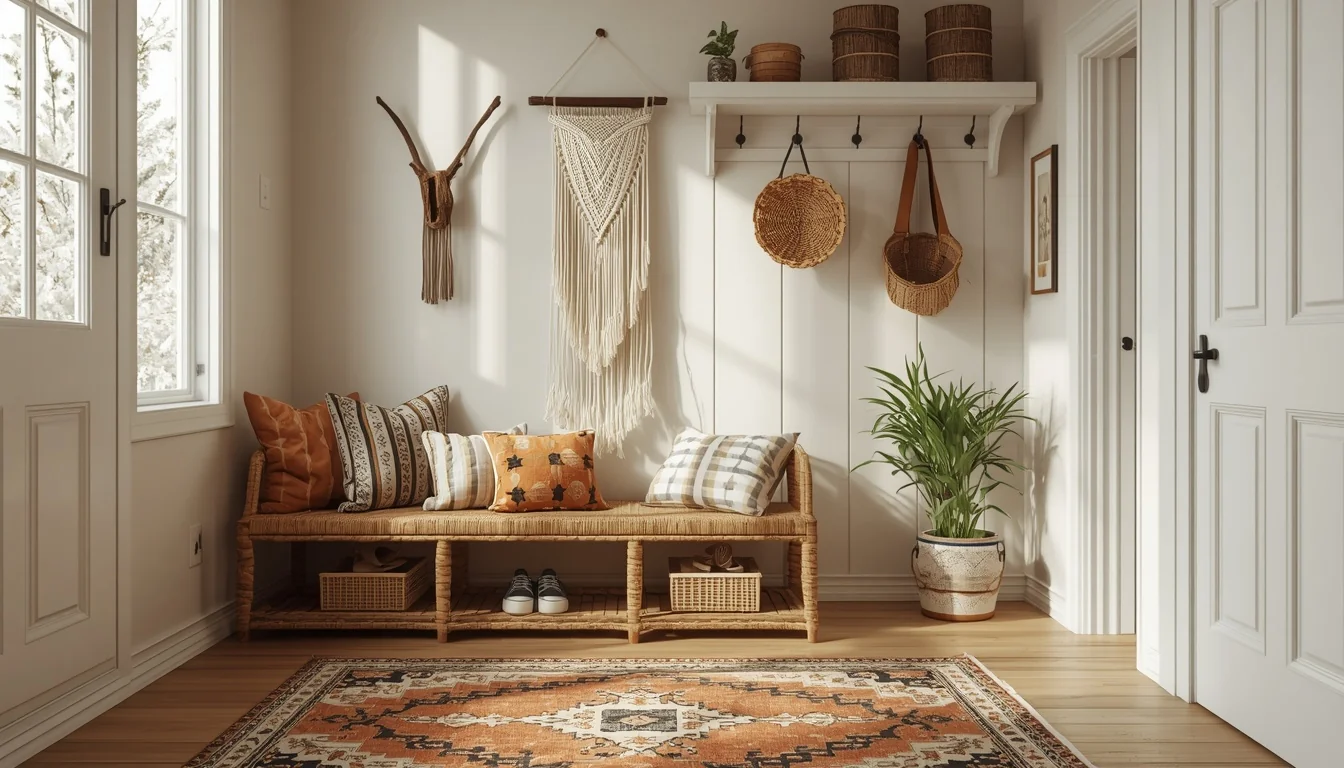
20 Boho Mudroom Ideas That Make Your Entryway Feel Like a Whole Vibe
There’s a feeling you get when you walk into a home that has a great boho entryway.
It’s not polished. It’s not minimal. It doesn’t look like a showroom or a catalog page. It looks like someone actually lives there — and that they have incredible taste and zero interest in following anyone else’s rules.
That’s the whole point of bohemian decor. And it works beautifully in a mudroom.
Because think about it: a mudroom is already the most lived-in space in your whole home. It collects coats and boots and backpacks and mystery items that never quite make it further inside. It holds the chaos of everyday life without complaint.
Why not let it hold some beauty, too?
The boho aesthetic — with its earthy color palettes, layered textures, natural materials, and wonderfully eclectic mix of old and handmade — was practically designed for the mudroom. Woven baskets for storage. Jute rugs that hide dirt while looking gorgeous. Rattan hooks that make coats look like art. Dried pampas grass that doesn’t need watering and pampas-grass-level drama.
These 20 boho mudroom ideas show you exactly how to do this. Some are full room transformations. Some cost under $100. All of them will make your entryway feel like something you’re genuinely proud of.
Table of Contents
- The Terracotta Boho Mudroom — Earthy, Warm, and Completely Alive
- Macramé Statement Wall Above a Cane Bench
- Rustic Boho Farmhouse Mudroom with Shiplap and Rattan
- Moody Boho — Deep Rust Walls with Mixed Metal Hooks
- The Layered Rug Boho Entryway
- Modern Boho Mudroom with Warm Wood Slats and Pampas Grass
- Vintage Mirror Gallery Wall — Boho Entryway Magic
- Moroccan-Inspired Mudroom with Zellige Tile and Brass Hardware
- Desert Boho Mudroom in Sand, Sage, and Terracotta
- Boho Farmhouse Bench Corner — Small Space, Big Personality
- Indigo and Rust Boho Mudroom — The Jewel Tone Version
- The Plant-Filled Boho Entryway — More is More
- Boho Mudroom with Tapestry Walls and Floor Cushions
- Global Boho Mudroom — Collected, Traveled, Perfectly Imperfect
- Dark Boho Mudroom — Midnight Blue and Dried Botanicals
- The Renter-Friendly Boho Mudroom: No Drill, All Style
- Boho Mudroom + Laundry Room Combo in Warm Olive
- Kids’ Boho Mudroom — Playful, Colorful, and Still Beautiful
- Budget Boho Mudroom Makeover — Under $200 Total
- Boho Minimalist Mudroom — Warm Neutrals, Zero Clutter
What Makes a Mudroom “Boho” Anyway?
Before the ideas — a quick grounding point.
Boho (short for bohemian) design pulls from a global, free-spirited aesthetic that celebrates natural materials, handmade textures, eclectic collections, and warm, earthy color. It doesn’t follow strict rules. It doesn’t require matching. It actively encourages layering things you love, even when they don’t “go together” perfectly.
In a mudroom, this translates to:
Materials: Rattan, jute, sisal, seagrass, raw wood, unglazed ceramic, woven cotton, macramé
Colors: Terracotta, warm rust, dusty sage, sand, deep indigo, mustard, warm cream, muted olive
Textures: Layered rugs, woven baskets, aged metals, distressed wood, dried botanicals
Attitude: Collected over time, not bought in a set — things with history and soul
The 60-30-10 rule works beautifully in a boho mudroom: 60% earthy neutrals (walls, bench, floor), 30% warm accent color (rug, cushion, painted surface), 10% a pop of something unexpected (indigo basket, rust-toned macramé, brass mirror).
The Ideas
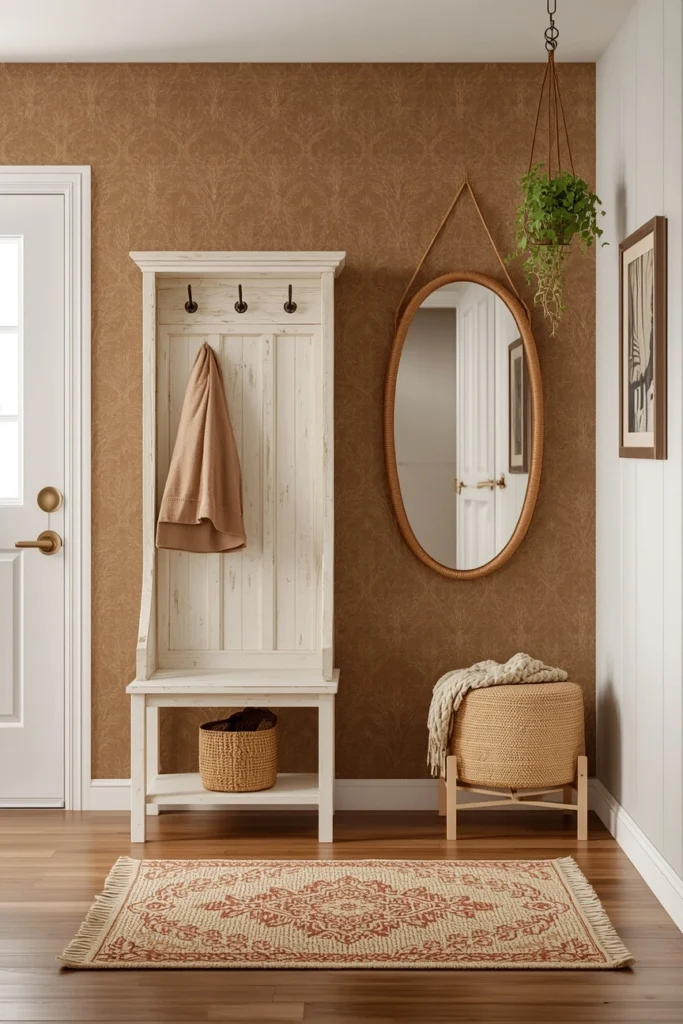
Idea 1: The Terracotta Boho Mudroom — Earthy, Warm, and Completely Alive
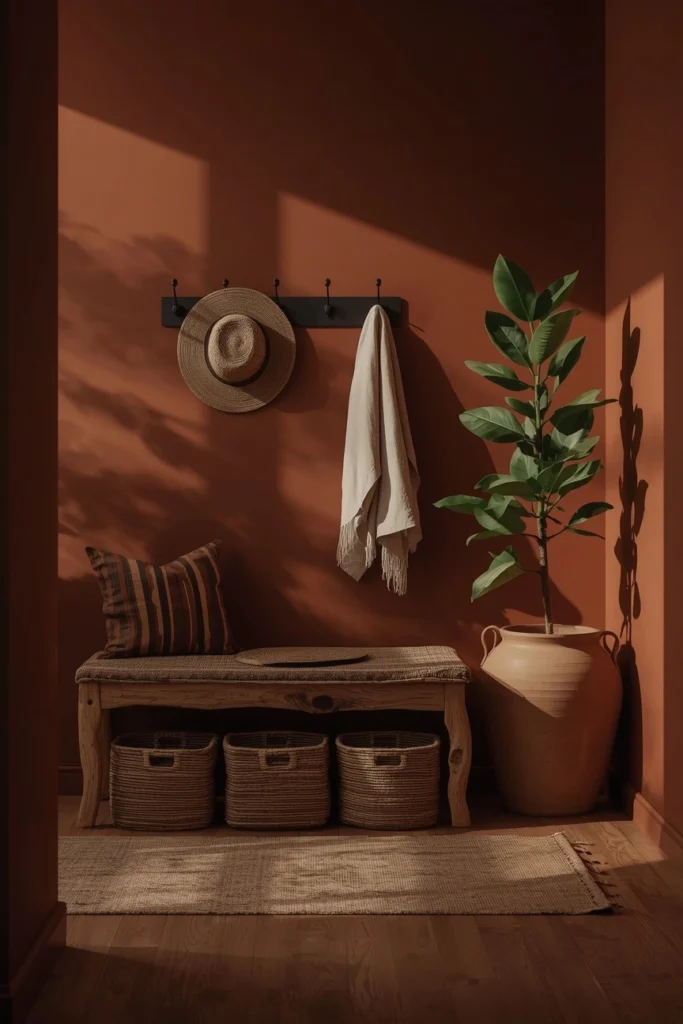
Terracotta is the most boho color on the planet. It’s the color of sun-baked clay pots and Moroccan riads and afternoon light through old linen. And it does something extraordinary in a mudroom — it makes the entire space feel warm the second you open the door.
Paint your mudroom walls in a deep, matte terracotta — not orange, not rust, but that specific clay-brown-red that reads earthy and sophisticated. Think Sherwin-Williams Cavern Clay or Benjamin Moore’s Moroccan Spice.
Against those walls: a weathered wooden bench. Natural jute baskets below. Matte black hooks. A trailing pothos or fiddle leaf fig in a large ceramic pot in the corner.
This is the mudroom that makes people stop and say “oh, I love this room” before they’ve even taken their shoes off.
Color formula: Terracotta walls (60%) + warm cream trim and bench (30%) + deep indigo basket or cushion accent (10%)
Plant that completes it: Fiddle leaf fig in a raw terracotta pot — it almost looks like part of the wall.
Idea 2: Macramé Statement Wall Above a Cane Bench
A great macramé piece can carry an entire room. That’s not an exaggeration.
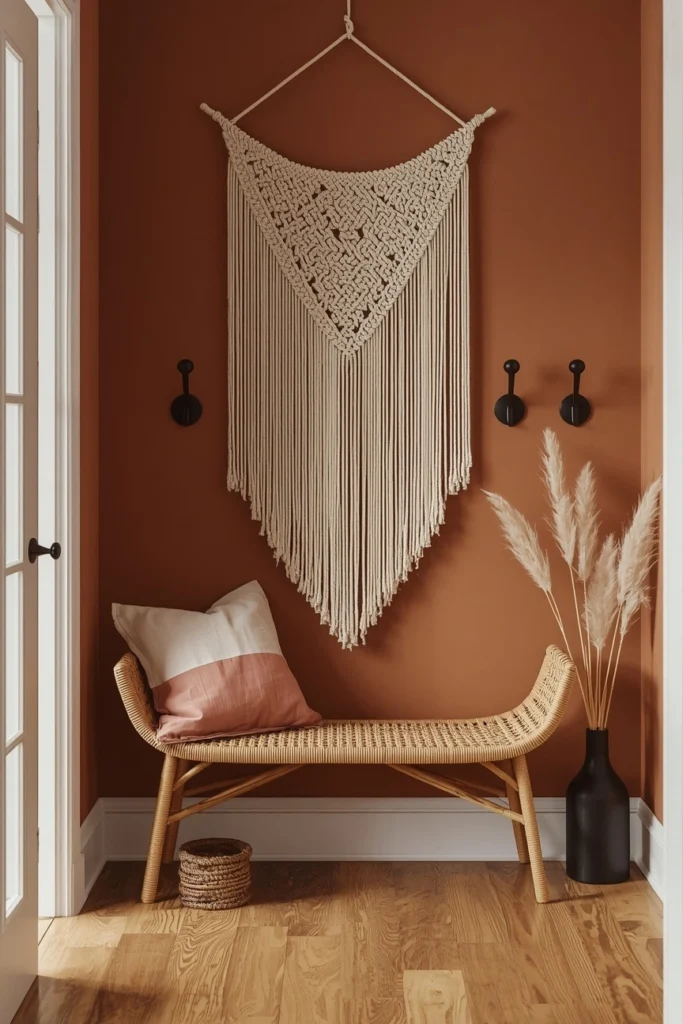
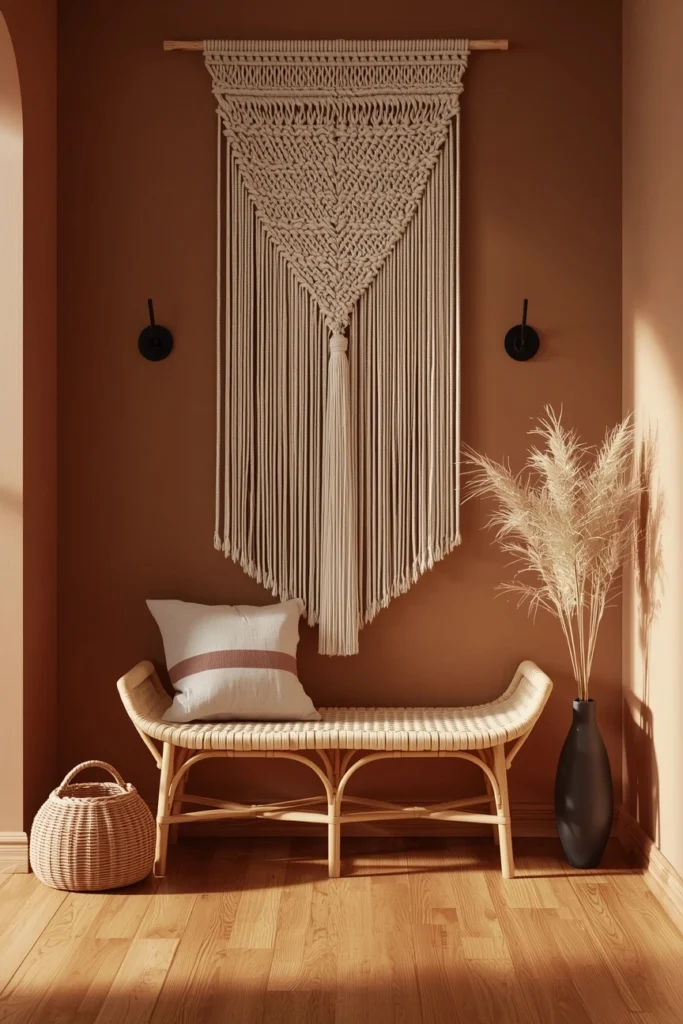
In a boho mudroom, a large macramé wall hanging above the bench acts as the room’s focal point — the thing your eyes go to first, the piece that communicates this space was designed. It adds softness, texture, and genuine artisan quality that no paint color or cabinet hardware can replicate.
The bench underneath should be simple — a cane or rattan bench with a curved silhouette, maybe a loose cushion in a faded cream or dusty rose linen. Keep the hooks minimal and sculptural. Let the macramé do the talking.
Choosing macramé for a mudroom: Go large — at least 24 inches wide. Natural cotton rope in undyed cream reads most authentically boho. Look for ones with fringe ends, braided details, and some variation in knot density. Etsy is genuinely the best place to find handmade pieces that look nothing like mass production.
The height rule: Hang the macramé so its bottom edge sits at about 60 inches from the floor — this keeps it above the coat-hanging zone without disappearing into the ceiling.
Idea 3: Rustic Boho Farmhouse Mudroom with Shiplap and Rattan
This is where two of the most beloved home decor aesthetics meet — and it turns out, they get along beautifully.
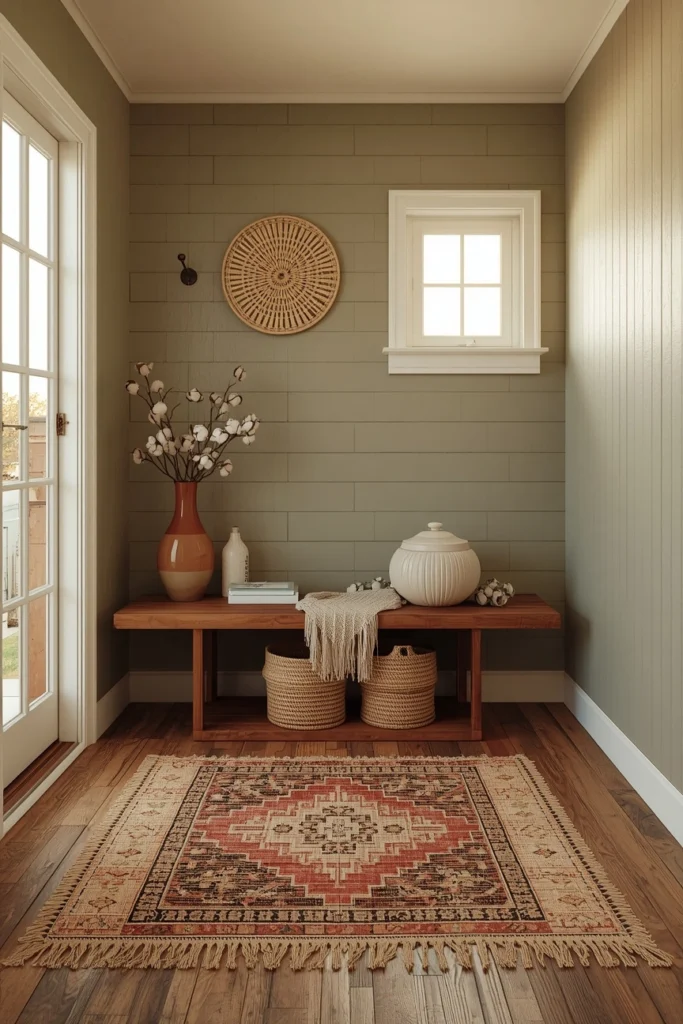
The boho-farmhouse mudroom takes the structural bones of a farmhouse entryway (shiplap paneling, a wood bench, simple hooks) and layers in distinctly bohemian softness: rattan hooks instead of iron ones, a layered Moroccan rug instead of a plain runner, dried wildflowers instead of seasonal wreaths, and woven baskets with fringe edges instead of galvanized metal bins.
The result doesn’t read as one style or the other. It reads as personal.
The shiplap secret: Don’t paint it white. Paint farmhouse shiplap in a warm greige or dusty sage for an instantly more bohemian, less catalog-farmhouse result. The color shifts the whole feel of the room.
Idea 4: Moody Boho — Deep Rust Walls with Mixed Metal Hooks
Most boho mudrooms go earthy and neutral. This one goes bold.
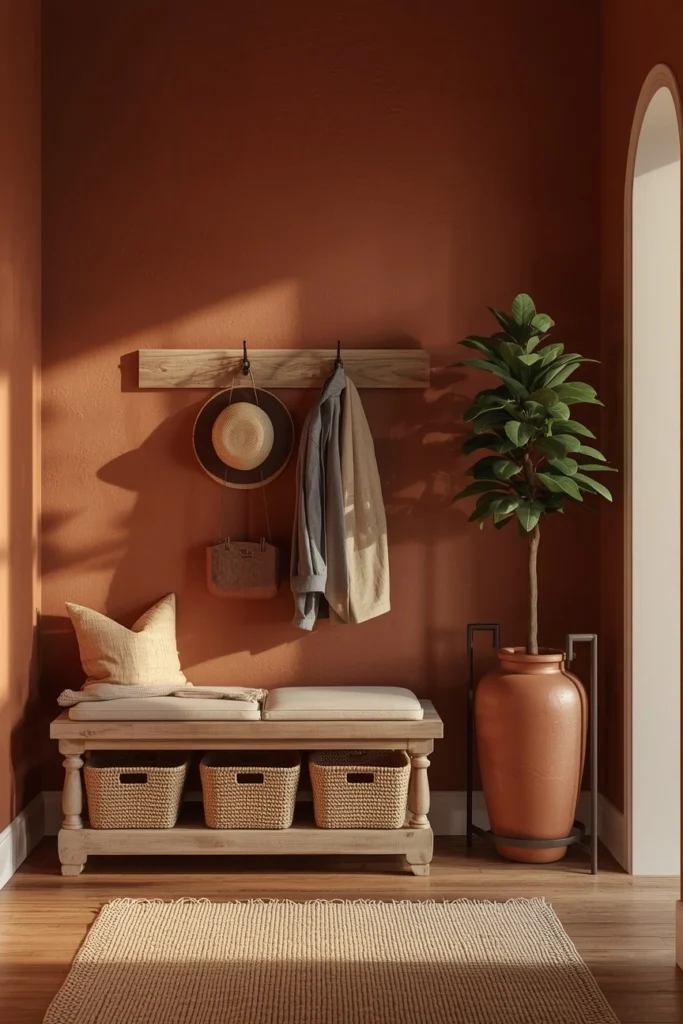
Deep rust — that specific warm red-brown that lives between terracotta and burgundy — creates one of the most dramatic, unexpected boho mudrooms imaginable. It’s not aggressive like red. It’s not predictable like brown. It’s the color of dried leaves and desert canyons and old Indian textiles.
Against rust walls, mixed metal hooks — brass, unlacquered copper, aged iron all together — look intentional instead of mismatched. Layer a dark indigo and cream vintage kilim rug underfoot. Add a deep walnut bench. Hang dried eucalyptus from one hook. A rattan lantern pendant above.
This is a moody boho mudroom — and it feels wildly specific and personal in the best way.
The mixed metal rule: To mix metals without it looking chaotic, limit to three finishes and repeat each one at least twice in the space. Brass hooks + brass pendant + brass mirror frame. Iron hooks + iron lantern. Copper one-off piece.
Idea 5: The Layered Rug Boho Entryway
Layered rugs are one of the signature moves of bohemian interior design — and a mudroom might actually be the best place to do it.
The layered rug look: start with a large natural fiber rug as the base — jute, sisal, or seagrass in a simple natural weave. Layer a smaller, more patterned rug on top — a vintage Persian runner, a Moroccan flatweave with geometric diamonds, or a faded Turkish kilim. The overlap of textures and patterns creates that effortlessly collected quality that takes a mudroom from “nice” to “how did they do that?”
Why it works in a mudroom: The jute base layer is incredibly durable and hides dirt naturally. The smaller patterned rug on top is the style element — and it’s removable for easy washing.
Sizing tip: Your base rug should cover most of the entryway floor. Your layered rug should be roughly half the size of the base, slightly off-center or angled slightly — perfectly straight looks too deliberate.
Idea 6: Modern Boho Mudroom with Warm Wood Slats and Pampas Grass
Modern boho is the 2025 evolution of the style. It’s boho that grew up — still earthy and textured and full of natural materials, but with cleaner lines and a more restrained layering approach.
The signature move in a modern boho mudroom: vertical wood slat paneling in warm honey oak behind the bench. It adds incredible depth and architectural interest without any pattern or color. Then contrast those clean slats with inherently organic, free-form elements: a tall arrangement of dried pampas grass in a linen-wrapped vase, a bench cushion in a nubby boucle fabric, a woven tapestry hung at one end.
The tension between structured (slats) and organic (pampas, weave, linen) is what makes modern boho feel sophisticated rather than just earthy.
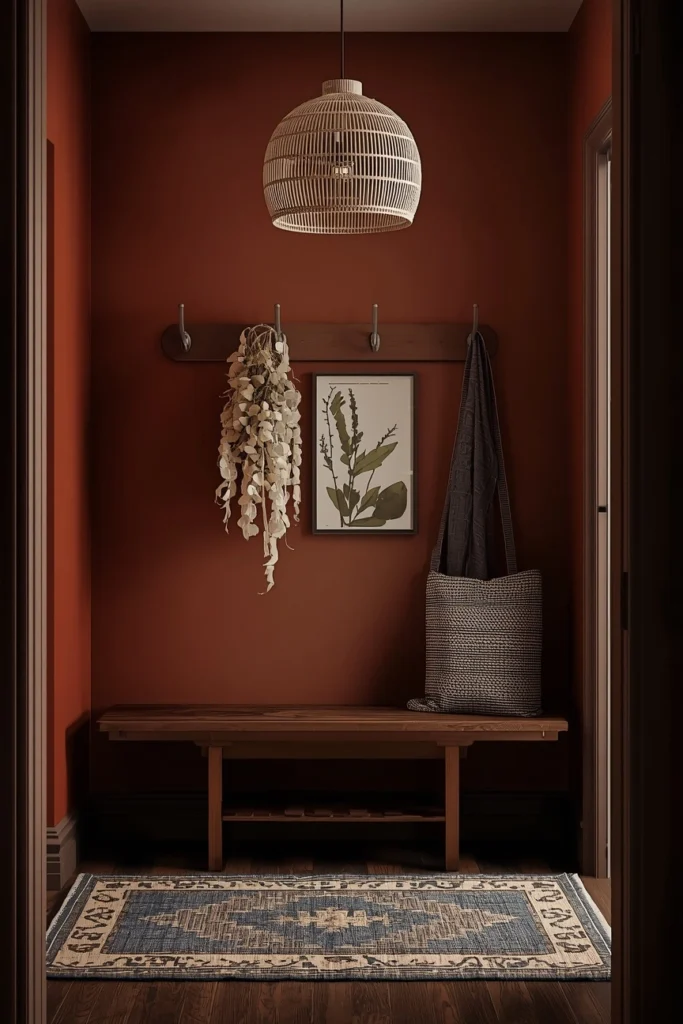
Idea 7: Vintage Mirror Gallery Wall — Boho Entryway Magic
A single great mirror makes a small mudroom look bigger. A gallery of vintage mirrors with different shapes and frame styles makes it look like the most interesting room in the house.
The boho vintage mirror wall is one of the most achievable high-impact entryway upgrades out there. You need three to five mirrors in varying sizes — sunburst, oval, arch, small rectangular, round — with frames in brass, carved wood, aged silver, and rattan. Hang them clustered on one wall above a narrow bench or console table.
The mirrors bounce light around the space, making even a dark, windowless mudroom feel brighter. They also reflect the rest of your decor back at you — which means all those woven baskets and trailing plants and vintage coats get multiplied visually.
Where to find vintage mirrors: Facebook Marketplace, estate sales, and thrift stores consistently have beautiful old mirrors at a fraction of retail price. An ornate gold frame with a slightly foxed surface is better than a new mirror that looks perfect.
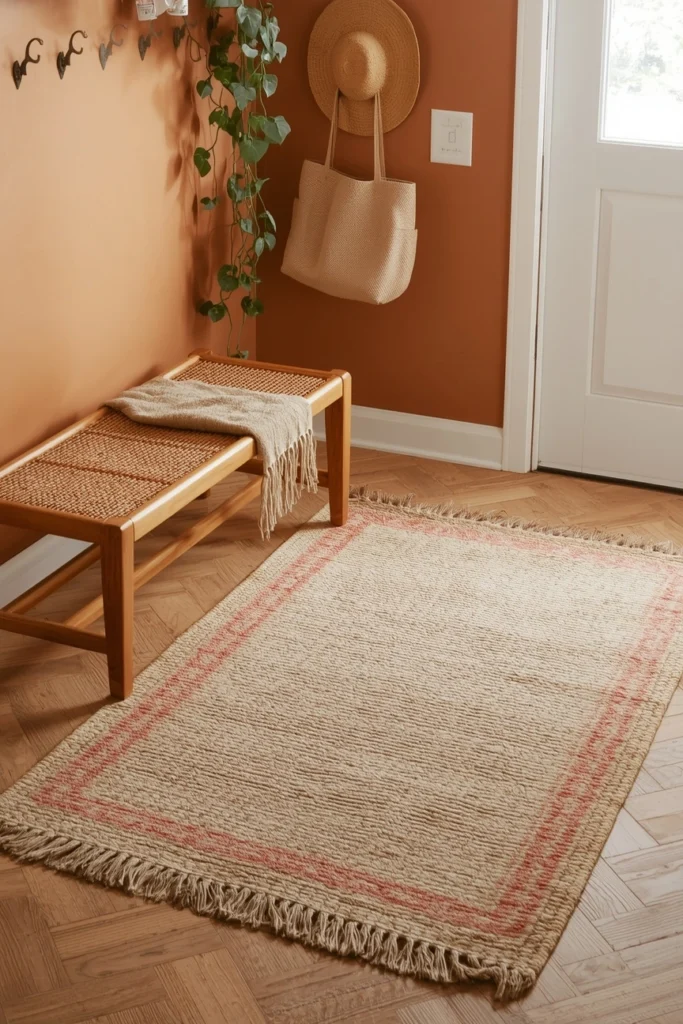
Idea 8: Moroccan-Inspired Mudroom with Zellige Tile and Brass Hardware
Moroccan design is one of the most significant influences on the boho aesthetic — and its most transportive element is tile.
Zellige tile — the handmade, slightly irregular Moroccan ceramic tile with a glassy, jewel-like surface — brings instant global personality to a mudroom floor or backsplash wall. The tiles are never perfectly flat or uniformly colored, which is exactly the point. Each one is slightly different. Together, they create a surface that catches light in a thousand small ways.
Use zellige-style tile on the mudroom floor in a warm terracotta orange, or as a small accent wall behind the bench. Pair with unlacquered brass hooks, a carved wood bench, and an arched Moroccan lantern pendant. Add a faded kilim rug layered on top of the tile for warmth.
A budget note: Authentic imported zellige is beautiful but expensive ($20–$50+ per square foot). Several tile companies make zellige-look porcelain tiles at a fraction of the cost — Cle Tile, Fireclay Tile, and Merola Tile all have excellent options.
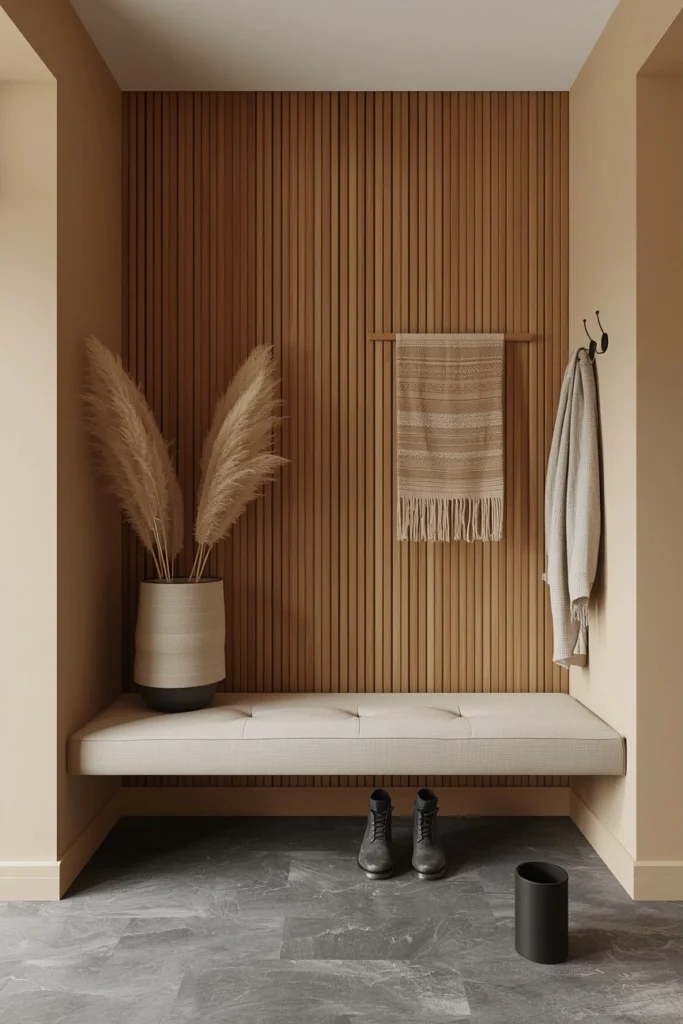
Idea 9: Desert Boho Mudroom in Sand, Sage, and Terracotta
Desert boho is its own distinct flavor of the aesthetic — quieter, drier, more sun-bleached and minimal than the lush layered boho most people think of. It pulls from the colors of the American Southwest and the landscapes of New Mexico: warm sand, faded sage, dusty clay, bleached bone.
In a mudroom, this palette feels incredibly serene. Sand-washed walls. A sage-green bench or cubby unit. Terracotta pot with a tall snake plant. A Navajo-inspired flatweave rug in rust and cream. Matte black hooks. A piece of driftwood on the shelf.
It’s boho stripped back to its most essential, earthy form — and it’s absolutely beautiful.
The single plant rule for desert boho: One tall, structural plant beats several trailing ones. A snake plant, a large cactus, or a sculptural aloe in a raw clay pot works perfectly here. It has presence without messiness.
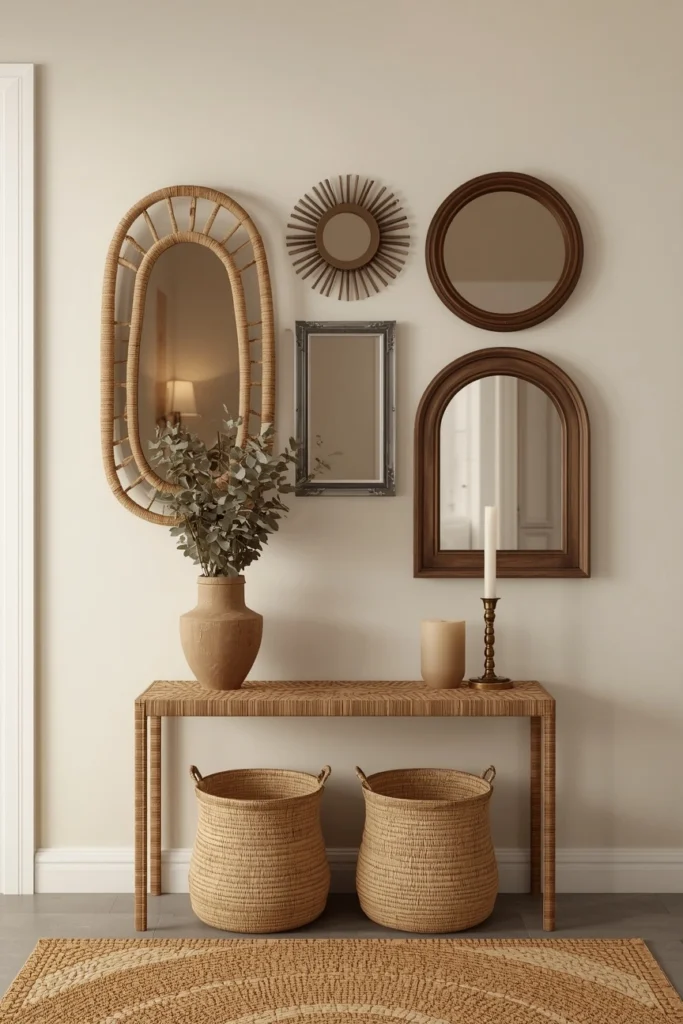
Idea 10: Boho Farmhouse Bench Corner — Small Space, Big Personality
This one is for the hallways and corners and awkward 3-foot entryway nooks that technically have no right to be beautiful — but absolutely can be.
The boho bench corner approach: find a small vintage bench or repainted wooden seat (secondhand is best), add a loose linen or grain-sack cushion. Mount a peg rail on the wall above it — three to five pegs is enough. Layer a small rug below. Add one great plant. Hang one small macramé or woven piece between the pegs.
That’s it. That’s the whole thing. And it looks like something from a design magazine.
The big impact detail: A thin wooden arch shelf above the pegs, loaded with a small ceramic dish, a short candle, and a trailing plant in a small pot. That one shelf takes the corner from “practical” to “designed.”
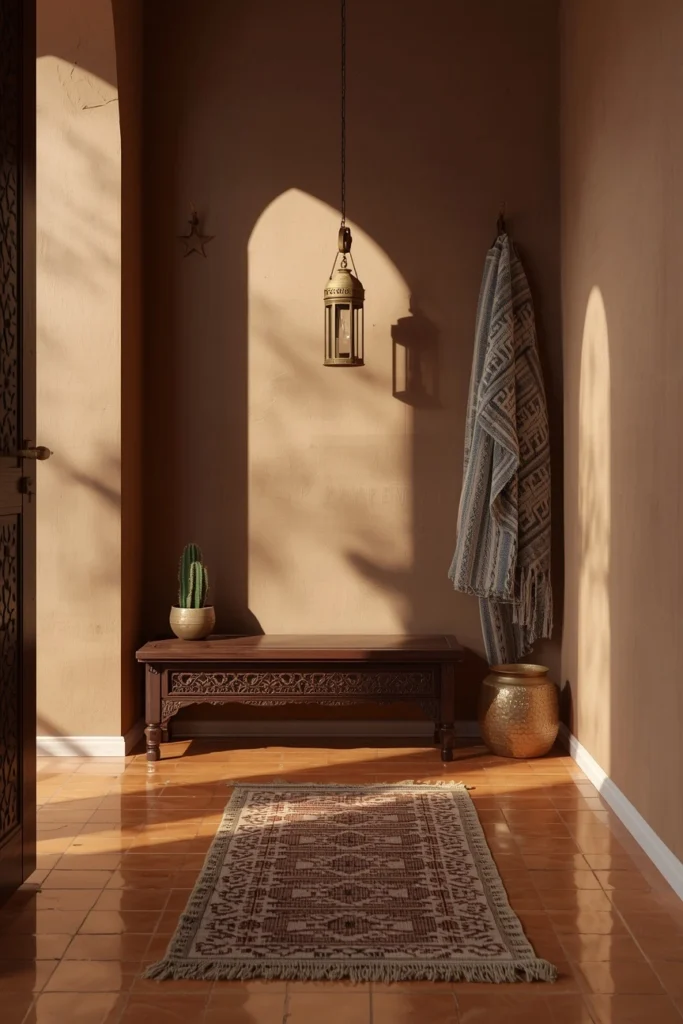
Idea 11: Indigo and Rust Boho Mudroom — The Jewel Tone Version
Most boho mudrooms stay in the warm neutral-earthy zone. This one goes deeper.
Indigo — that rich, slightly purple-toned dark blue — paired with warm rust creates one of the most beautiful boho color stories imaginable. It’s dramatic. It’s unexpected. And it feels distinctly global, like something that belongs in a room full of Moroccan textiles and Indian block print fabrics.
Use indigo as an accent color through a vintage rug or tapestry. Bring rust in through wall paint or a painted bench. Add brass hardware, woven natural baskets, and a dried floral arrangement in warm oranges and creams. The contrast of cool deep indigo against warm rust is what makes the palette feel vibrant and alive.
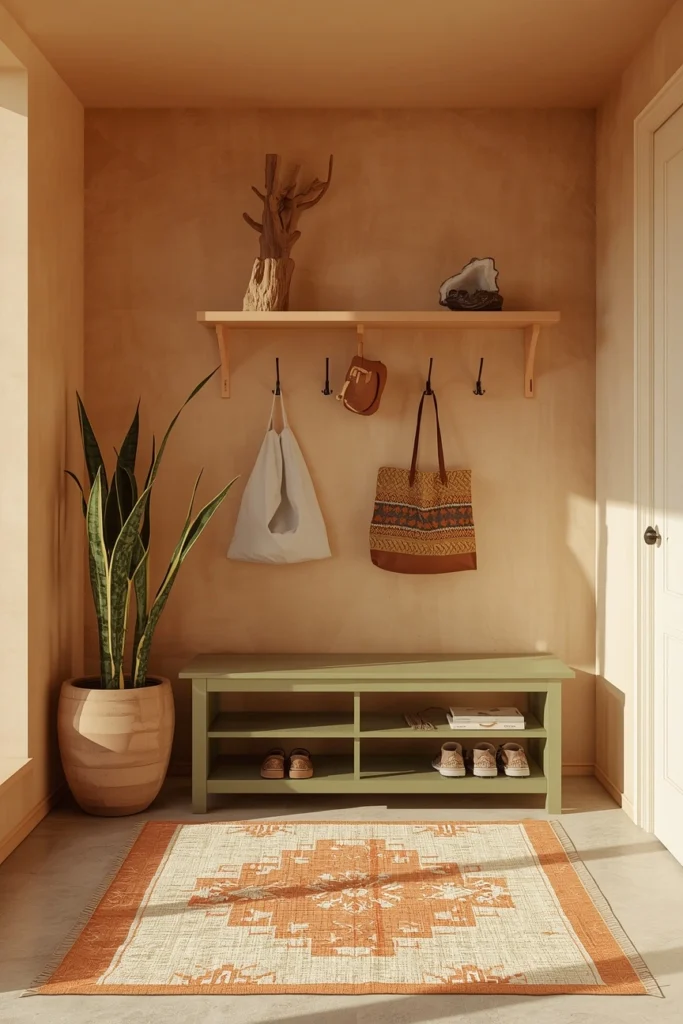
Idea 12: The Plant-Filled Boho Entryway — More Is More
In boho decor, there is no such thing as too many plants. Especially in a mudroom.
A plant-filled boho entryway treats greenery as architecture. Not one small potted succulent on a shelf. An intentional collection — a tall fiddle leaf fig at one end of the bench, a hanging pothos from a macramé plant hanger near the ceiling, a trailing string of pearls in a small pot on the hook shelf, a low basket of preserved eucalyptus sprays on the floor.
Different heights. Different leaf shapes. Some dry, some living. Some hanging, some standing, some trailing.
The result feels lush and alive in a way that no piece of furniture or wall color ever quite achieves.
Best plants for a mudroom (low light tolerant): Pothos (nearly indestructible), snake plant (loves neglect), ZZ plant (thrives in dim light), cast iron plant (handles anything). For dried options: pampas grass, lunaria, dried eucalyptus, dried cotton stems.
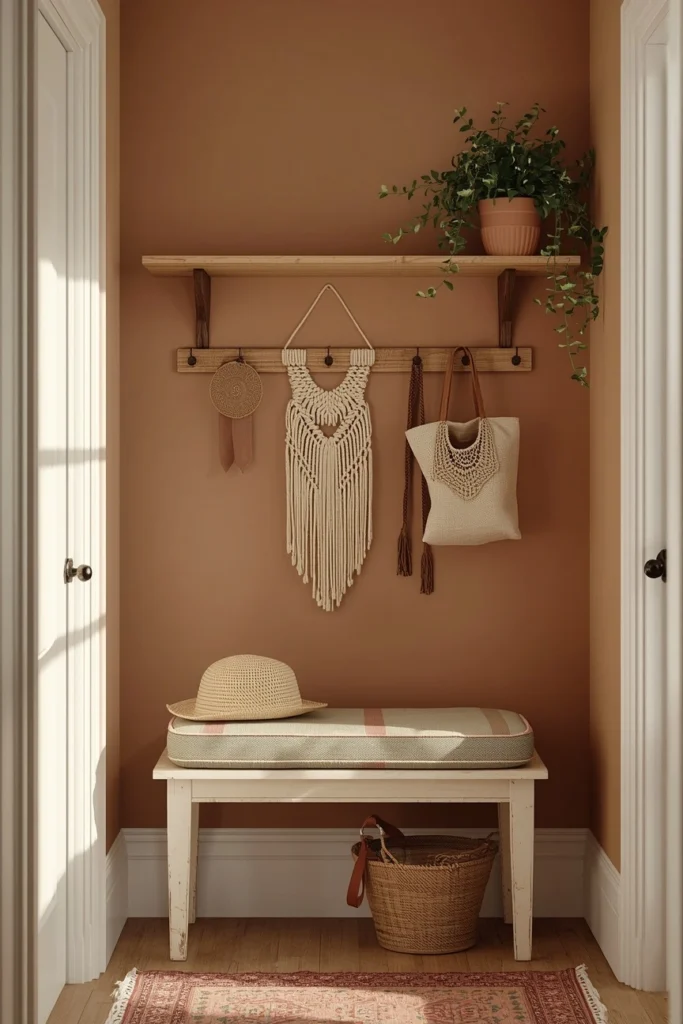
Idea 13: Boho Mudroom with Tapestry Walls and Floor Cushions
One of the most beautiful — and most distinctly boho — things you can do with a mudroom wall is hang a textile instead of a mirror or artwork.
A large woven tapestry — think hand-woven cotton in geometric diamond patterns, or a vintage block-print Indian fabric in deep rust and cream — takes up wall space beautifully and adds an unmatched warmth and visual richness that painted walls or gallery art simply can’t replicate.
Pair the tapestry wall with a low wooden bench or platform and a collection of oversized floor cushions in mixed prints — a Moroccan-striped linen, an embroidered velvet in deep emerald, a plain warm boucle. Yes, a mudroom with floor cushions. Yes, it works. It’s the most boho thing in the world.
Practicality note: Mount the tapestry high enough that it’s not in the direct zone where wet coats drip. A slim wooden dowel rod through the top loops makes hanging clean and adjustable.
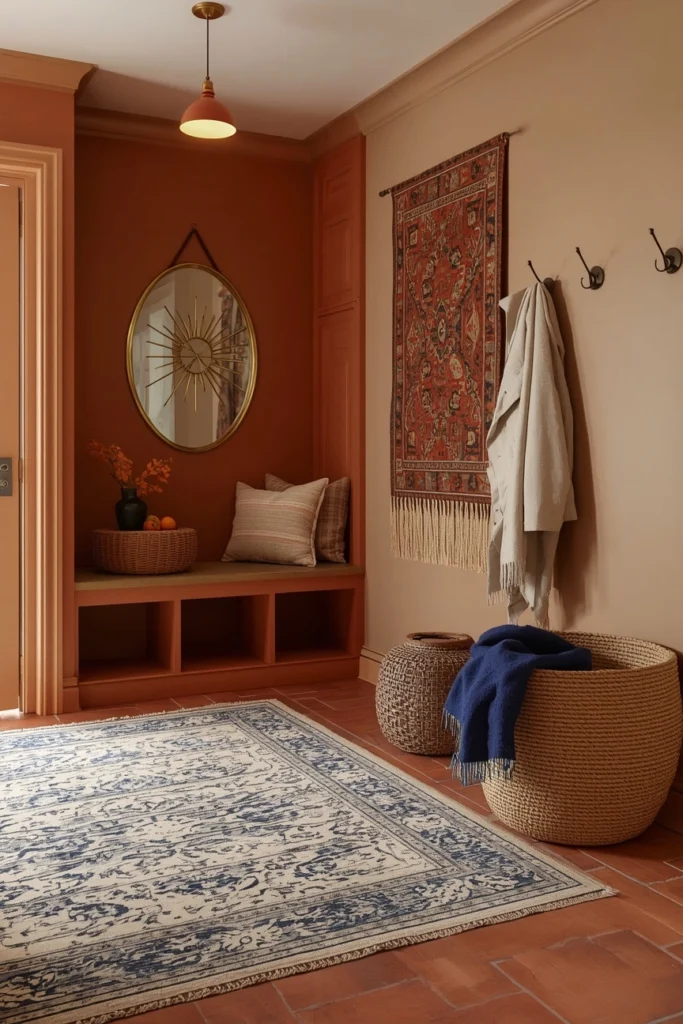
Idea 14: Global Boho Mudroom — Collected, Traveled, Perfectly Imperfect
The truest bohemian mudrooms look like they were built one piece at a time over many years, from many different places.
A vintage Moroccan lantern found at a market. A carved wooden hook from a craft fair. A faded Turkish runner from an estate sale. A hand-thrown ceramic bowl from a local potter for keys. A woven basket from a beach vacation. An old painted wooden sign in a language you learned to love.
None of it matches. All of it belongs together.
This is the global boho approach — and it’s not about spending money at Anthropologie. It’s about resisting the urge to buy things in sets. It’s about individual pieces with history and presence.
How to start building a global boho mudroom: Begin with the rug — it sets the color story for everything else. Then choose hooks that feel interesting rather than uniform. Finish with a plant and one beautiful object that makes you happy every time you see it.
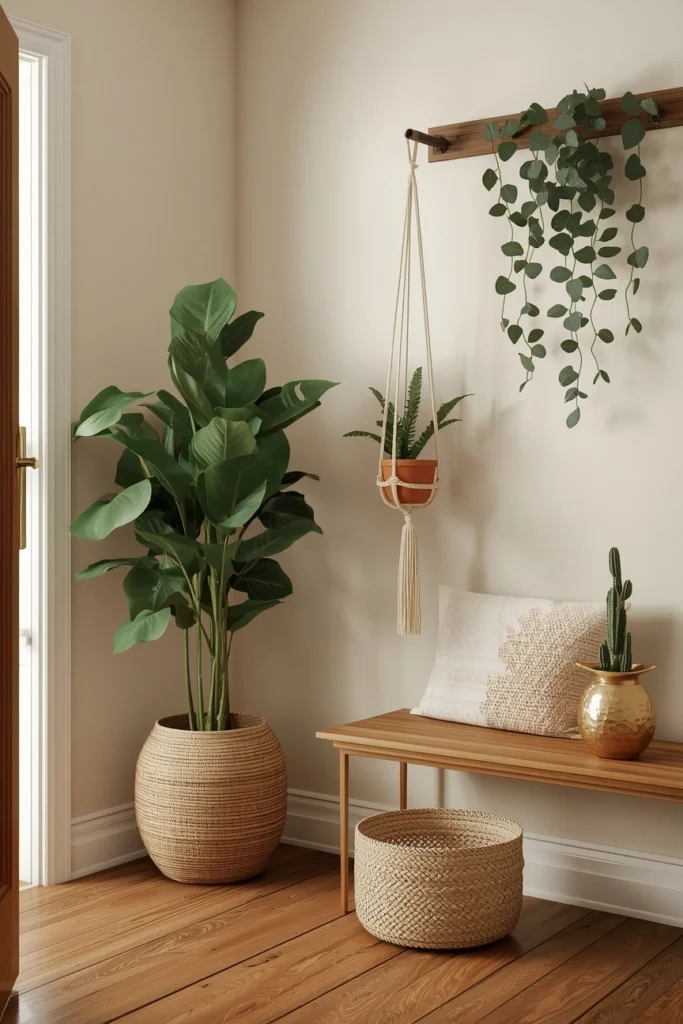
Idea 15: Dark Boho Mudroom — Midnight Blue and Dried Botanicals
Dark boho is having an enormous moment — and the mudroom might be its natural home.
Midnight blue walls — that specific blue that’s almost navy but has a warmth and depth that true navy doesn’t — paired with the dried, papery textures of botanicals creates something genuinely atmospheric. Dried pampas grass. Preserved magnolia leaves in deep olive. Dried lunaria with its papery moon-shaped pods. Eucalyptus sprays that go silver as they dry.
Against midnight blue, these botanicals look ancient and beautiful. Add warm brass hardware, a dark walnut bench, and a woven rug in gold and cream to keep the space from feeling cold.
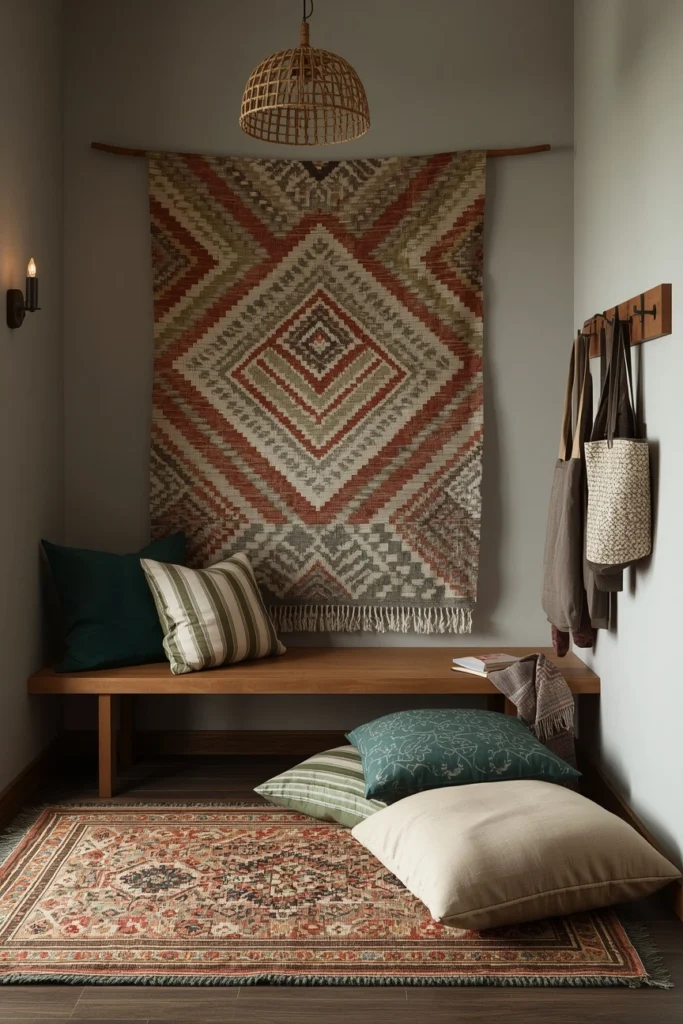
Idea 16: The Renter-Friendly Boho Mudroom: No Drill, All Style
You don’t own the walls. That doesn’t mean you can’t have a boho mudroom.
Renter-friendly boho is genuinely achievable — and in many ways, the constraints make you more creative.
The no-drill boho mudroom toolkit:
- Command strips and adhesive hooks hold surprisingly heavy loads and remove cleanly from most walls
- A freestanding hall tree gives you hooks, a shelf, and usually a bench — no installation required
- A large leaning mirror (vintage frame, rattan-wrapped, or ornate brass) leans against the wall and transforms the space without a single hole
- Rugs do 40% of the work — a great layered rug situation makes even a bare, beige apartment entryway feel designed
- Peel-and-stick wallpaper now comes in beautiful boho patterns — terra cotta botanicals, earthy geometrics, vintage florals — and removes cleanly when you move
- Plants do the rest — a tall snake plant, a hanging macramé planter, and a couple of trailing pothos go further than any piece of furniture
Total cost for a renter-friendly boho mudroom: $80–$200, depending on what you already have.
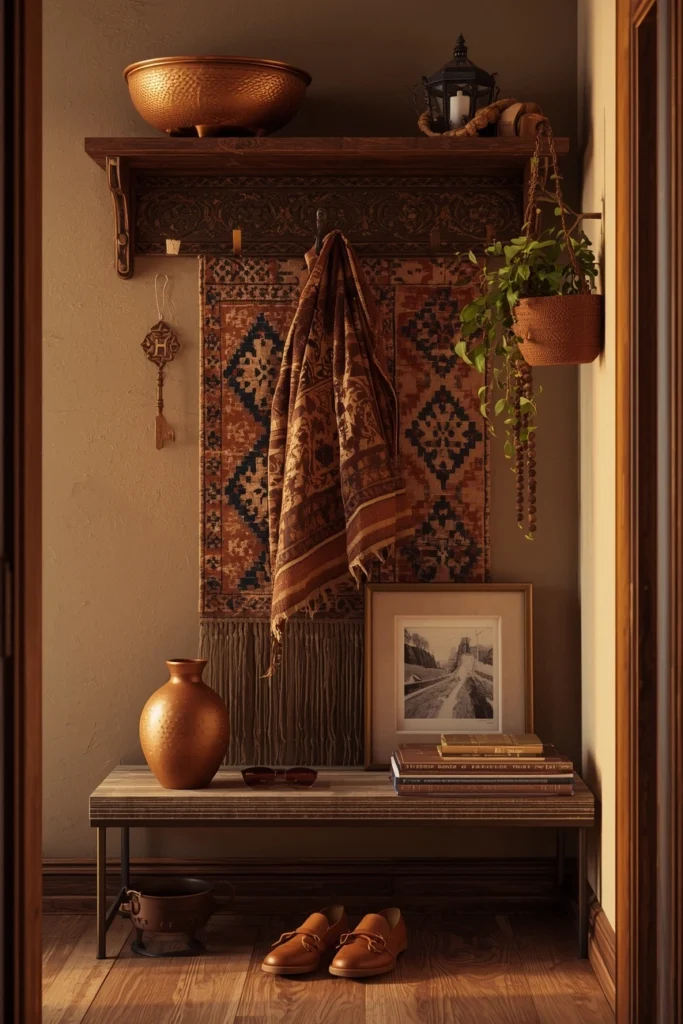
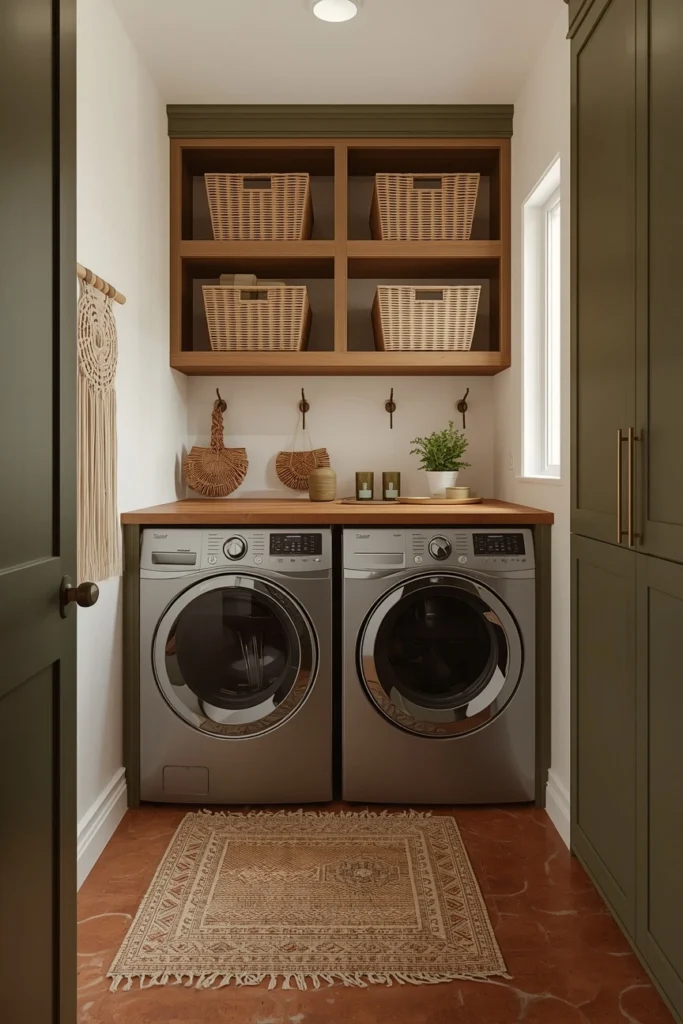
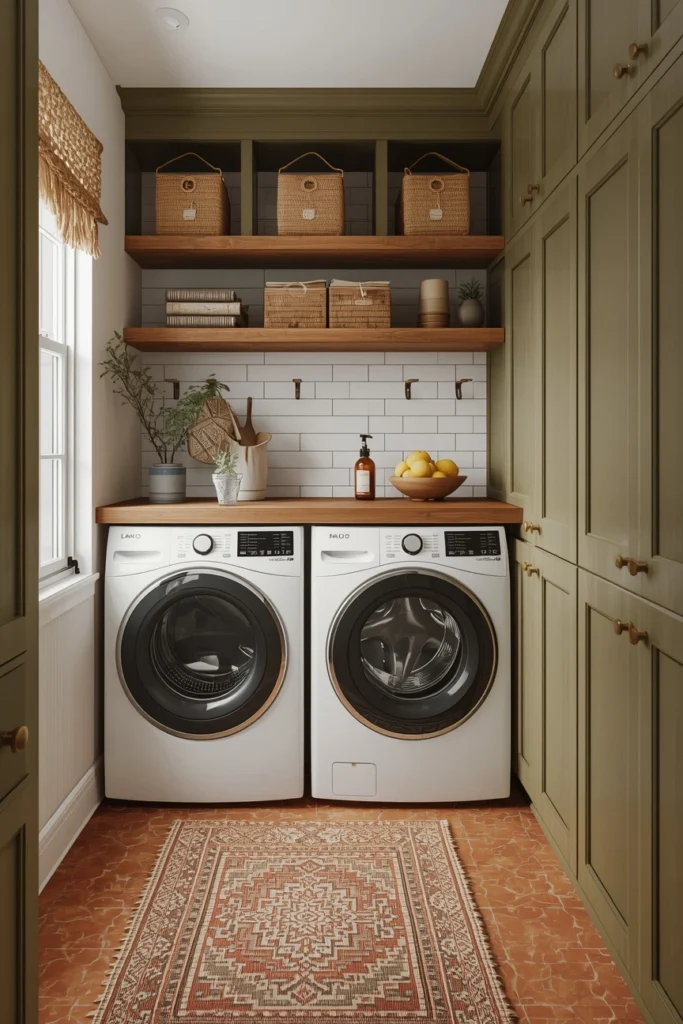
Idea 17: Boho Mudroom + Laundry Room Combo in Warm Olive
The mudroom-laundry combo is one of the most functional floor plan decisions a home can have. It’s also one of the most visually tricky.
The boho solution: commit to a cohesive color story across both zones. Warm olive green cabinets — not a cold sage, but a deeper, earthier olive with brown undertones — gives the whole space an organic, botanical quality that makes even a washer and dryer feel intentional.
Add open wooden shelving above the washer and dryer for woven laundry baskets. Use the same brass hardware throughout both zones. Hang a small macramé piece or dried botanical arrangement above the appliances. A vintage runner rug defines the mudroom entry zone.
The key is treating the two zones as one designed room — not two separate functional spaces stuffed together.
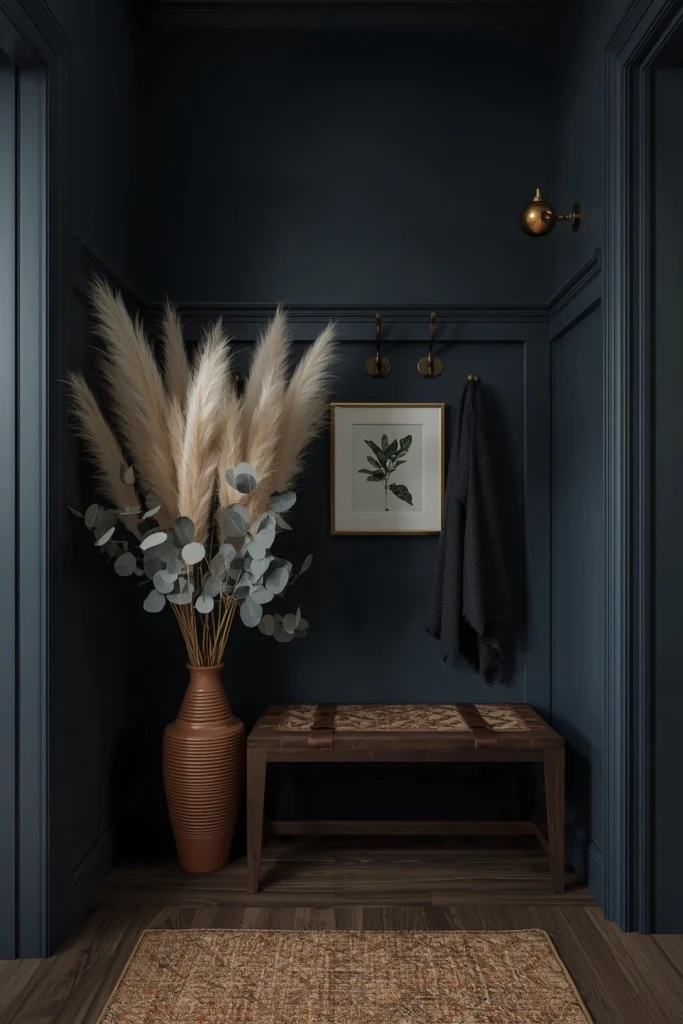
Idea 18: Kids’ Boho Mudroom — Playful, Colorful, and Still Beautiful
The biggest challenge of a family mudroom: it gets used hard every single day by people who have zero interest in keeping it looking good.
The kids’ boho mudroom works around this by making the storage itself beautiful. Lower peg rail in natural wood — one hook per kid, labeled with a small ceramic name tag. Matching baskets in warm natural seagrass below, one per person. A colorful vintage-inspired runner rug that disguises absolutely everything.
Keep the color palette still boho — terracotta, warm sand, sage — but add pops of mustard yellow or coral for a more playful energy. Kids’ artwork in simple wooden frames on the wall. A small cactus up high, out of reach.
The goal is a mudroom that looks beautiful empty and looks almost-beautiful when it’s doing its actual job holding four backpacks and seventeen sports shoes.
Idea 19: Budget Boho Mudroom Makeover — Under $200 Total
This is the honest, practical version of everything above — built for real budgets.
Here’s the exact step-by-step:
Step 1 — The rug ($30–$60): A vintage-style Moroccan or kilim runner from Amazon, TJ Maxx, or IKEA. This single purchase does more for the look than anything else.
Step 2 — The hooks ($15–$30): Replace existing hooks with rattan, wooden, or mixed-metal options. Even three beautiful hooks change the whole feel of a wall.
Step 3 — The baskets ($20–$40): Two or three matching seagrass or jute baskets from HomeGoods or World Market. Label them with small tags for a designed-not-dumped look.
Step 4 — One plant ($10–$20): A pothos or snake plant from a local garden center. Pot it in a terracotta pot you already own or buy one for $3.
Step 5 — The wall moment ($25–$60): A small macramé piece from Etsy, a vintage mirror from a thrift store, or a peel-and-stick removable wallpaper panel on one wall.
Step 6 — Dried botanicals ($0–$15): Pampas grass from a craft store or dried eucalyptus from Trader Joe’s. A plain vase you already own. Done.
Total: $100–$225. Looks like you spent 10x that.
Idea 20: Boho Minimalist Mudroom — Warm Neutrals, Zero Clutter
Not everyone’s boho is maximalist. And that’s completely valid.
The boho minimalist mudroom takes the materials and color philosophy of bohemian design — natural fibers, earthy tones, handmade textures — and applies them with restraint. One beautiful rug. One great bench. Three hooks, not ten. A single plant. One carefully chosen object.
The colors are warm but quiet: creamy white walls, a light oak bench, a single flatweave rug in warm sand and pale indigo, one matte black hook. The macramé here is small and delicate, not sprawling. The basket is one, perfectly placed.
This is boho for people who believe in quality over quantity and find visual calm in a pared-down palette. It photographs beautifully and stays beautiful in real life.
The 6 Non-Negotiable Elements of Every Great Boho Mudroom
These are the things that make the difference between a boho mudroom that works and one that just looks like an inspiration photo you couldn’t quite pull off.
1. A rug with soul. Not a plain gray mat. Not a basic stripe. A vintage-style kilim, a Moroccan flatweave, a hand-knotted jute piece with character. The rug anchors everything.
2. At least one handmade element. A macramé wall piece. A hand-thrown ceramic pot. A woven tapestry. Something that clearly had human hands involved. This is the element that makes the space feel genuinely boho rather than boho-themed.
3. Botanicals — living or dried. Plants bring a mudroom to life in a way nothing else can. If you can’t keep living plants alive, dried pampas grass, preserved eucalyptus, and dried cotton stems look beautiful for months with zero maintenance.
4. Mixed textures. Rattan + jute + linen + raw ceramic + aged wood. No single material dominates. Texture is the thing that makes a boho space feel layered and rich even when the color palette is neutral.
5. Warm lighting. A bare overhead bulb is the fastest way to kill a boho mudroom’s atmosphere. A rattan pendant, a brass sconce, or even a plug-in wall lamp makes the space feel intentional after dark.
6. Something personal. One piece that’s actually yours — a vintage find from a trip, a piece of art from someone you know, a plant from your grandmother’s collection. The best boho spaces always have at least one thing that can’t be bought from a store.
Boho Mudroom Storage Ideas That Are as Beautiful as They Are Functional
The hardest thing about a boho mudroom is keeping it from looking chaotic. Storage is the answer — but in a boho context, the storage itself needs to be beautiful.
- Woven baskets: The cornerstone of boho mudroom storage. Round, rectangular, tall, short — use the same style in different sizes for a cohesive look. Seagrass, rattan, and water hyacinth are the most beautiful natural options.
- Wooden crate shelves: Stack vintage wooden crates as makeshift cubbies. Paint them in terracotta or sage green. Line each one with a fabric liner in a complementary print.
- Rattan bins: Deeper than baskets, rattan bins hold bulkier items (sports gear, winter boots, dog supplies) while keeping the aesthetic cohesive.
- Hanging storage: Don’t just think horizontally. A macramé hanging organizer, small rattan wall baskets, or leather strap shelves use vertical wall space for small items like keys, sunglasses, and dog leashes.
- Under-bench storage: Slide flat woven trays or low baskets under the bench for shoe storage. A woven tray with individual shoe spaces is tidier than a pile and removes easily for cleaning.
Common Boho Mudroom Mistakes to Avoid
Going too matchy-matchy. Boho is specifically not a matchy style. Three identical rattan hooks, three identical baskets, and a matching rug look like a styled set — not a personal collection. Vary the sizes, slightly vary the textures.
Overdoing the pampas grass. One tall arrangement is a statement. Four arrangements is a trend reference that will date quickly. Pick your botanical moment and commit to one strong one.
Ignoring function. The most beautifully boho mudroom still has to work. Make sure there are enough hooks, enough basket space, and a surface to drop keys and bags before worrying about whether the macramé is exactly the right size.
Choosing cold-toned neutrals. Gray-beige, cool taupe, and blue-gray walls don’t read as boho — they read as Scandinavian minimalist. Boho neutrals are warm: sand, cream, greige with golden undertones, warm off-white.
Buying everything new. New boho pieces often look like they’re trying too hard. The best boho mudrooms mix new pieces with genuinely old ones. The vintage runner. The thrift store mirror. The macramé from a small Etsy maker. These are the things that make a space feel real.
Small-Space Boho Mudroom Solutions
The floating shelf trick: A single deep floating shelf in natural wood, mounted at shoulder height, holds a basket, a plant, a key dish, and a small mirror. Below it, two hooks. Below that, a small bench or cube. Entire footprint: 18 inches wide.
The back-of-door approach: The inside of your front door is untapped boho territory. An over-door organizer in rattan or fabric holds shoes and bags. A macramé piece hung from the door handle. A small mirror mounted at eye level. All of it moves when you do.
The corner hall tree: A freestanding hall tree takes up one corner — roughly 24″ x 24″ of floor space — and provides hooks, a shelf, and often a small bench or seat. Look for ones with rattan accents or carved wooden details rather than plain metal.
The peg rail alone: Sometimes all you need is a simple Shaker peg rail — painted or natural wood, 3–5 pegs — on one wall of a narrow hallway. Add a rug below and a single plant above and it reads as a complete, designed mudroom despite having almost nothing in it.
FAQs
Conclusion
A boho mudroom isn’t designed in a weekend. It’s built over time — with a rug you found at a market, baskets from three different places, hooks from a small maker on Etsy, and a plant you’ve been keeping alive for two years.
That’s the whole point.
Boho style celebrates the collected and the personal. It rejects the pressure to buy everything at once from one place and have it all match. And in a mudroom — the room that holds your real life, messy and practical and endlessly used — that philosophy feels exactly right.
Start with one piece that you love. A great rug. A macramé piece you can’t stop looking at. A plant you’ve already named. Build from there.
Your boho mudroom doesn’t have to be finished. It just has to feel like home.