22 Front Porch Ideas That Give Your Home Instant Curb Appeal & Charm
Your front porch makes a first impression before anyone steps inside your home — and most porches are working far harder against that impression than they need to. A few mismatched planters, a worn mat, a porch light left over from the last owner: none of it is dramatic, but together it quietly tells visitors the house isn’t quite finished.
The good news is that porch charm rarely requires a renovation. It requires the right handful of decisions, made with intention: the door color, the furniture scale, the lighting layers, the symmetry. Get those right and even a small, plain porch can look like it belongs in a magazine.
This guide walks through 22 front porch ideas for 2026, organized from the foundational changes that affect every porch to the small-space tricks and seasonal touches that make a good porch feel genuinely yours.
Table of Contents
- Why Your Porch Matters More Than You Think
- The Foundation: Color, Symmetry & Light (Ideas 1–6)
- Furniture & Layout That Earns Its Space (Ideas 7–11)
- Small Porch Solutions (Ideas 12–16)
- Greenery, Texture & Seasonal Charm (Ideas 17–22)
- Designer Tips and Common Mistakes
- Frequently Asked Questions
Why Your Porch Matters More Than You Think?
A front porch does more work than almost any other exterior space in your home, because it’s the one area every single visitor experiences up close, on foot, before forming an opinion about everything else.
This focus on foundational aesthetics creates a sense of harmony and hospitality, making anyone approaching your home feel immediately at ease — it’s about setting a tone of warmth and care even before someone steps inside. That tone gets set in seconds, which is why small, consistent details (cleanliness, lighting, color, scale) outperform any single statement piece.
For 2026 specifically, porch design is trending toward layered, intentional spaces rather than a single wreath or a matching furniture set. Homeowners are mixing textures, flowers, lighting, vintage pieces, and softer seating layouts to create entrances that feel professionally designed rather than randomly decorated. That’s genuinely good news if your porch feels unfinished — the bar isn’t “buy an expensive furniture set,” it’s “layer a few intentional details correctly.”
Keep that principle in mind through all 22 ideas below: a porch becomes charming through a series of small, deliberate choices, not one large purchase.
The Foundation: Color, Symmetry & Light (Ideas 1–6)
Before furniture, before plants, before seasonal decor — these six ideas are the structural foundation every other porch decision sits on top of. Get these right first.
1. Paint Your Front Door a Color That Contrasts (Gently) With Your Home
Answer: A front door in a color that gently contrasts with your home’s exterior is the single highest-impact, lowest-cost change available for porch curb appeal.
Explanation: A bright or eye-catching door color that’s different from the rest of your home’s exterior draws the eye, signals personality, and reflects light beautifully into what might otherwise be a shadowy entry — as long as the shade complements rather than clashes with the body color.
Practical Example: Sage green, soft coral, buttery yellow, and dusty blue are among the most popular 2026 front door colors, each instantly elevating an otherwise neutral exterior without requiring any other change.
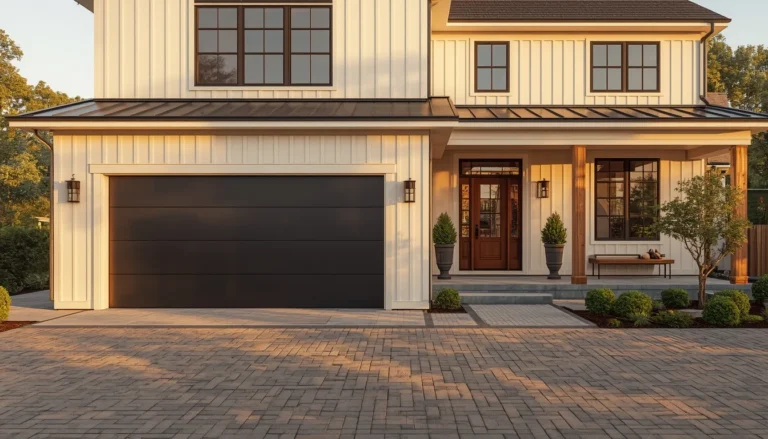
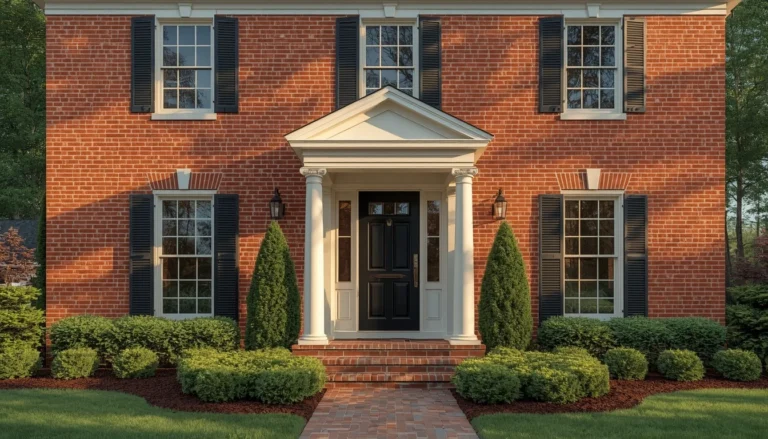
Designer Secret: A black front door framed by white siding is a reliably strong, timeless combination, especially paired with lush greenery and a soft wreath.
Common Mistake: Choosing a door color that fights your home’s undertone (a cool blue door against warm beige siding) rather than one from the same family or a deliberate complementary contrast.
2. Use Symmetry to Instantly Organize the Space
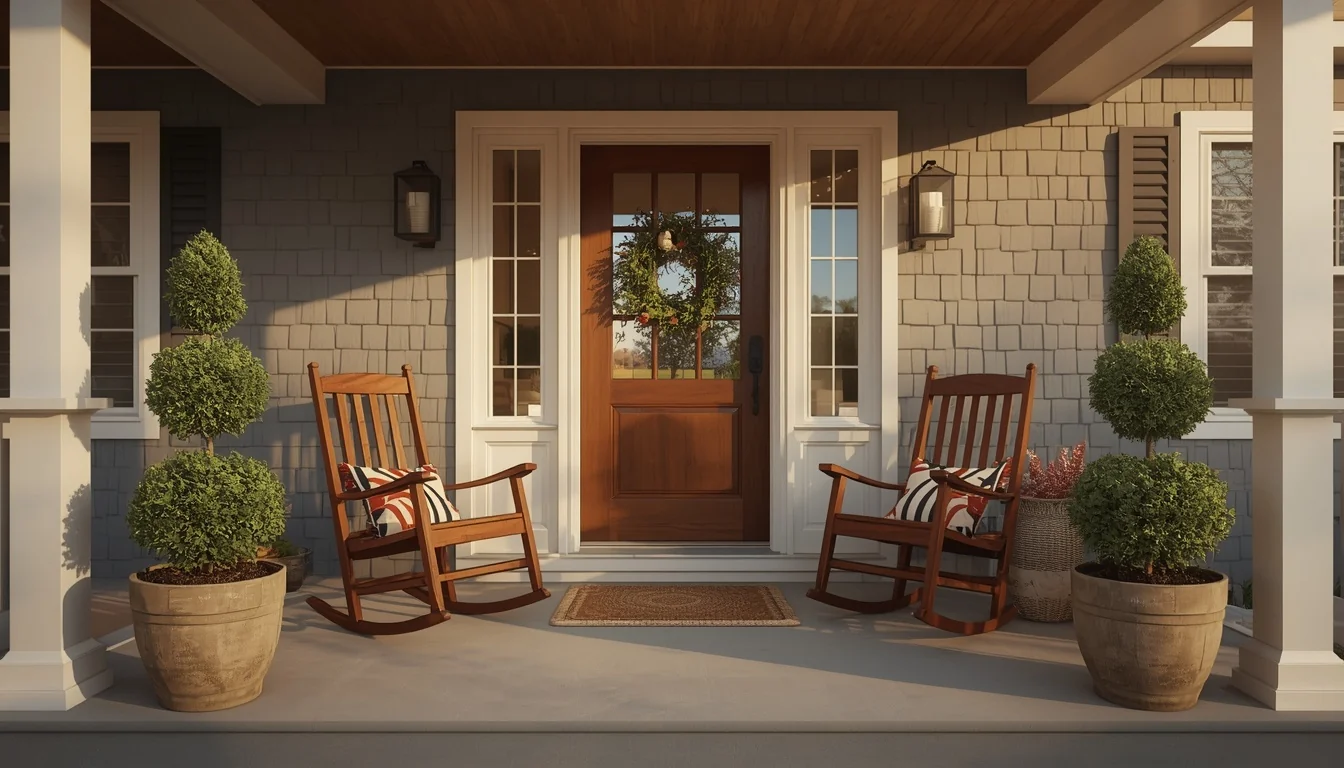
Answer: Mirroring elements on either side of your front door — chairs, planters, lanterns — is one of the fastest ways to make any porch, large or small, look intentional and professionally styled.
Explanation: Symmetry isn’t just aesthetically pleasing; it makes a space appear more organized, even when the porch itself is modest in size, because the eye reads balance as “designed” rather than “accumulated.”
Practical Example: Matching chairs, balanced greenery, and centered lighting create effortless harmony — when in doubt, mirroring your layout is the fastest route to instant structure.
Quick Tip: Symmetry doesn’t require identical items, only balanced ones. Two planters of the same size and shape, even with different plants in them, still read as symmetrical.
3. Layer Three Types of Porch Lighting
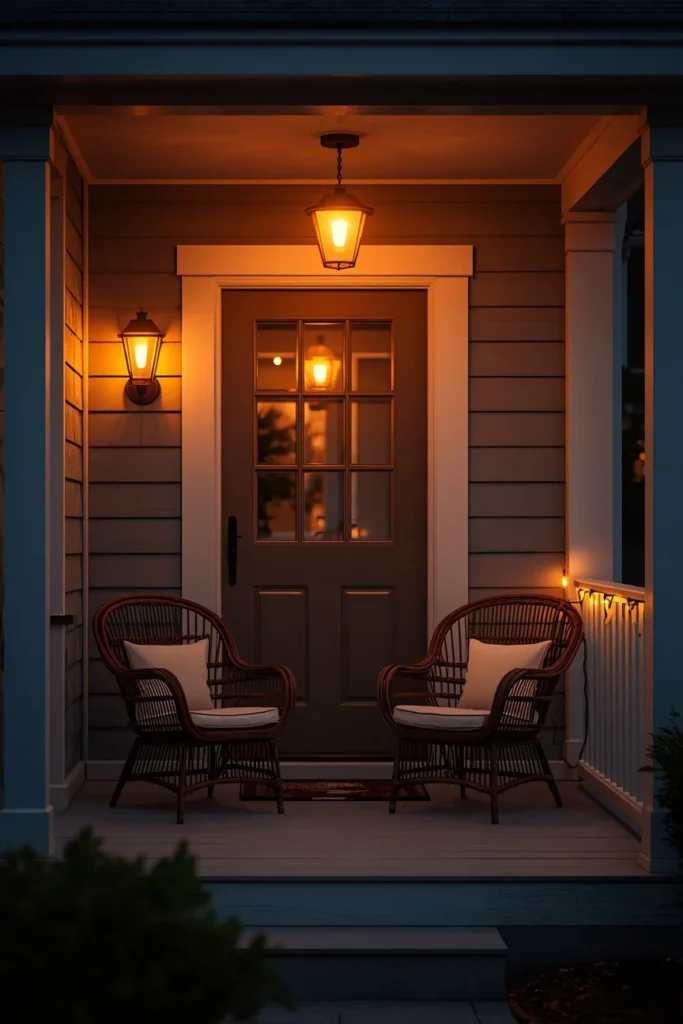
Answer: A genuinely welcoming porch needs more than one light source — sconces for safety and definition, a fixture or pendant for ambiance, and a smaller accent like a lantern or string lights for warmth.
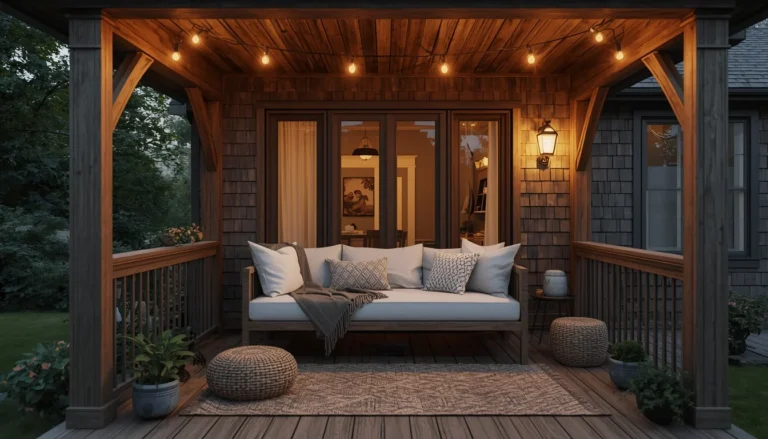
Explanation: Effective lighting enhances a porch’s ambiance and extends its usability into the evening; wall sconces on one or both sides of the front door light a clear path for visitors, while pendants, lanterns, or string lights add a more layered, inviting glow.
Practical Example: A pair of tall, black-framed lanterns flanking the door, paired with a fresh coat of white trim paint, can instantly elevate an entire home’s curb appeal with minimal effort.
Who Benefits: This matters most for porches that feel dark or “foreboding” after sunset — often the result of an enclosed layout, a dark exterior color, or heavy tree cover blocking natural light during the day.
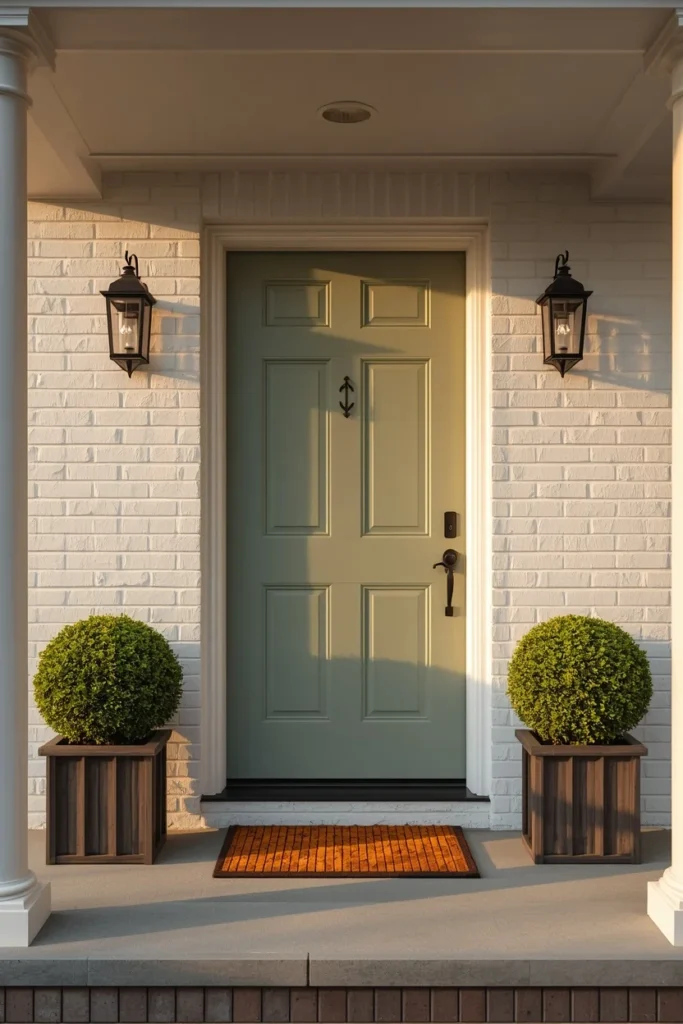
4. Choose a Warm, Layered Color Palette Over a Single Bold Statement
Answer: Rather than relying on one bold seasonal color, the 2026 porch trend favors layered, tonal palettes built from texture and material rather than saturation.
Explanation: Instead of bold colors, this trend creates visual interest through tactile contrast — woven planters, nubby textiles, and weathered finishes — resulting in a porch that feels grounded, calming, and connected to its surroundings rather than loud.
Practical Example: A porch with soft beige and white textiles, plaid throws, and distressed white furniture feels calmer and more cohesive than one built entirely around a single trend color.
Comparison — Color Approach by Desired Mood:
| Approach | Mood Created | Best For |
| Bold door + neutral everything else | Cheerful, confident, classic | Most homes, lowest commitment |
| Tonal/layered neutrals | Calm, sophisticated, grounded | Modern, minimalist, coastal homes |
| Full seasonal color palette | Festive, maximalist, personal | Holiday/seasonal refreshes |
5. Keep It Clean Before You Decorate Anything
Answer: No porch, however well decorated, reads as charming if it’s visibly dirty — cleaning is the single most overlooked, zero-cost step in any porch refresh.
Explanation: Dust and clean light fixtures, sweep away cobwebs and debris, clean any glass on the door or windows, and polish tarnished hardware before adding a single new item. A frequent design pitfall is neglecting upkeep — cracked pathways, peeling paint, or neglected plants can quietly undercut even the best porch design.
Practical Example: Replacing a worn welcome mat alone — without adding anything else — visibly refreshes an entryway that otherwise looks tired.
Quick Tip: Walk up to your own front door as if you were a first-time visitor. Cobwebs, smudged glass, and dead leaves are easy to stop noticing once you live somewhere, but they’re the first thing guests see.
6. Scale Furniture and Decor to the Actual Size of the Porch
Answer: Oversized furniture is one of the most common porch styling mistakes, and it actively shrinks the perceived size of a small or medium porch rather than filling it generously.
Explanation: Whether it’s a rocking chair, accent table, or bench, choosing pieces scaled appropriately for the space maintains an open, uncluttered area — a porch that looks “full” rarely looks charming; it looks crowded.
Practical Example: A small bistro set, rather than a full patio dining set, is often the right scale for a modest porch, while still adding personality through the chairs themselves.
Mini Checklist — The Foundation Recap:
- Door color chosen with intention (contrast or complement, not clash)
- At least one symmetrical element (planters, chairs, or lighting)
- Three lighting layers: path, ambiance, accent
- A cohesive, layered color palette rather than one loud statement
- A clean, decluttered starting point
- Furniture scaled to the actual footprint
Furniture & Layout That Earns Its Space (Ideas 7–11)
Once the foundation is set, furniture and layout decide whether your porch is purely decorative or a space people actually want to sit in. For 2026, function and beauty are expected to coexist.
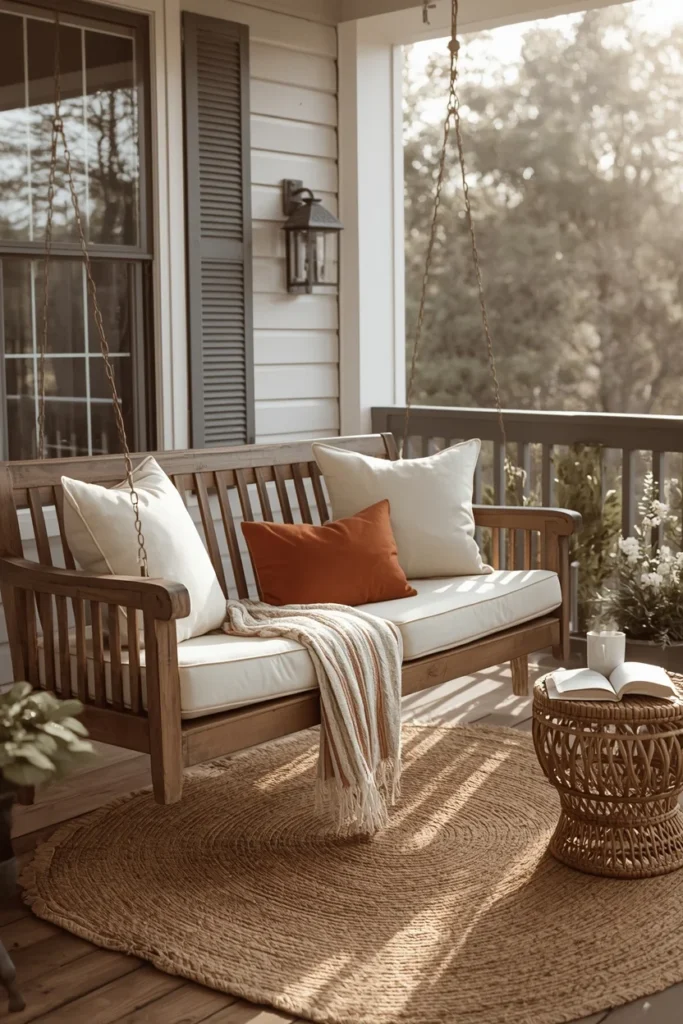
7. Invest in a Porch Swing as a Statement Piece
Answer: A porch swing — hanging or freestanding — is one of the most reliable focal points available, instantly signaling that a porch is meant to be used, not just looked at.
Explanation: Minimal decor, soft textures, and open space let a swing become the natural focal point of a porch; sometimes one standout piece genuinely is all a space needs to feel complete.
Practical Example: Even compact porches can often accommodate a smaller swing, creating a cozy, welcoming focal point without requiring a full furniture set around it.
Designer Secret: If a full swing won’t fit or isn’t structurally feasible, a single oversized rocking chair can deliver a similar sense of “this is a place to pause” with a fraction of the footprint.
8. Layer Weather-Resistant Textiles for a Lived-In Feel
Answer: Outdoor rugs, cushions, and throws transform a porch from “furnished” to “cozy,” and 2026’s emphasis on layering makes this more achievable than ever with widely available weather-resistant fabrics.
Explanation: Layering weather-resistant textiles invites people to linger — think outdoor rugs anchoring a seating area, paired with plush cushions in complementary patterns and a throw blanket draped casually over a chair.
Practical Example: This approach works particularly well on small porches, where every element must earn its place; even a single rug and two cushions can transform a tiny space into a comfortable retreat.
Budget Alternative: Indoor-outdoor rugs and washable cushion covers from mainstream retailers deliver most of the cozy, layered effect of designer textiles at a fraction of the price, and can be swapped seasonally without major cost.
9. Mix Natural Materials for Texture-Driven Interest
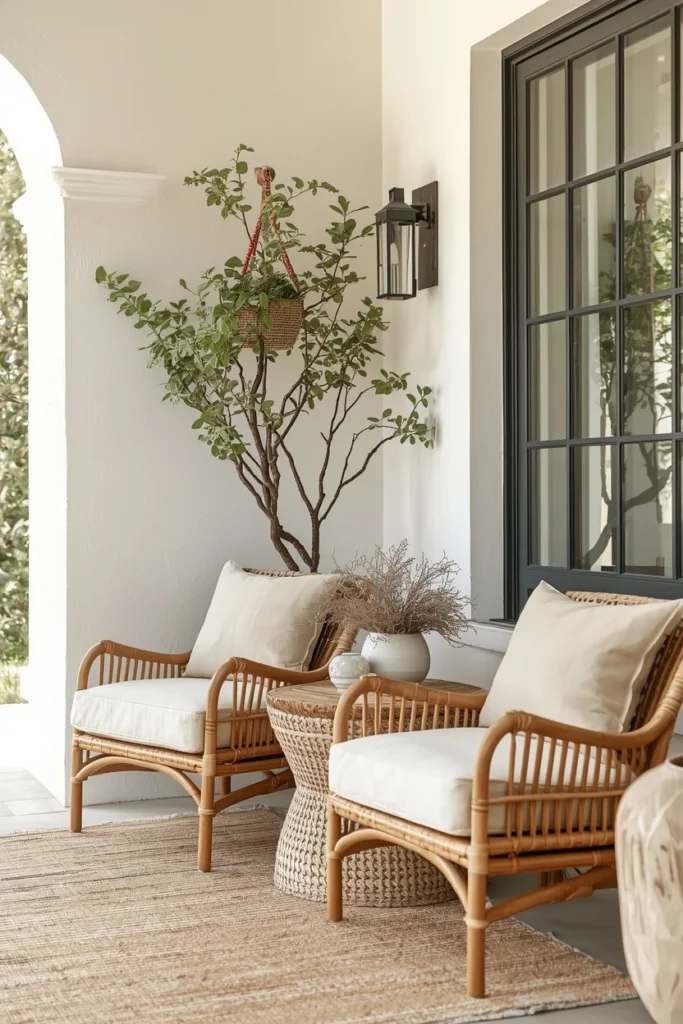
Answer: Combining wood, rattan, linen, and stone creates visual richness without relying on bold color, which is the defining furniture-and-material trend heading into 2026.
Explanation: This nature-inspired approach brings warmth and depth through layered organic materials, creating interest through tactile contrast rather than saturation — grounded, calming, and connected to the outdoors.
Practical Example: A seating set combining handwoven rattan with warm wood, paired with a woven jute planter and a linen cushion, builds a textured, cohesive look without a single bold color in the mix.
Who Benefits: This direction suits homeowners who want their porch to feel sophisticated and current without committing to a specific bold trend color that might feel dated in a few years.
10. Add a Small Table for Function, Not Just Decoration
Answer: Even a porch too small for a full seating set benefits from one small surface — a side table, plant stand, or narrow console — which makes the space genuinely usable rather than purely decorative.
Explanation: A porch that looks beautiful but offers nowhere to set down a coffee cup or a book ultimately functions as a photo backdrop rather than a real extension of your living space.
Practical Example: A slatted side table paired with a single comfortable chair creates a complete, usable “morning coffee” moment, even on porches too narrow for a full conversation set.
Quick Tip: A round table tucked beside a chair generally reads as softer and takes up less perceived visual space than a square or rectangular one, which matters most on tighter footprints.
11. Bring in One Vintage or Personal Piece
Answer: A single vintage, repurposed, or sentimental object does more to make a porch feel “lived in” rather than showroom-staged than any number of matching new pieces.
Explanation: Vintage touches — a repurposed item used as a planter, for instance — add warmth and personality precisely because they don’t match anything else, which is part of what makes a styled space feel collected rather than purchased all at once.
Practical Example: A porch with weathered furniture, layered decor, and soft florals tucked into corners feels like it holds stories, and leaning into that imperfection — mixing old and new pieces without worrying about everything matching — is where real charm comes from.
Common Mistake: Buying an entire matching furniture and decor set in one purchase. A porch styled this way often reads as a showroom display rather than a genuine extension of the home.
Small Porch Solutions (Ideas 12–16)
A small or furniture-free porch is not a design dead end — it’s simply a different set of tools. These five ideas are built specifically for tight footprints, narrow stoops, and porches with little to no floor space.
12. Think Vertically When Floor Space Is Limited
Answer: When a porch is too small for furniture, vertical decor — tall planters, hanging greenery, a wall-mounted sign — delivers impact without ever touching the floor.
Explanation: Faux potted trees are an easy way to add height, texture, and a sense of balance to a small porch; placing a pair on either side of the door creates a timeless, intentional look that feels welcoming without requiring any seating area at all.
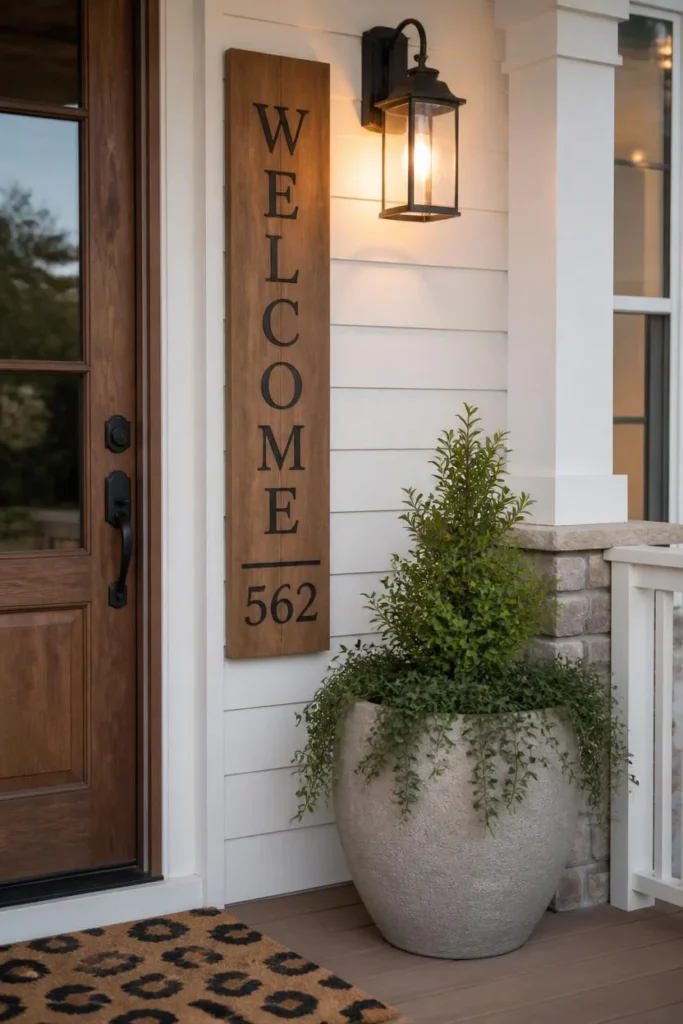
Practical Example: Two artificial cedar or olive trees flanking a front door, paired with a vertical wood welcome sign, fill the vertical space a tiny porch can’t fill horizontally.
Budget Alternative: Artificial trees require no watering or ongoing maintenance, making them a practical, long-lasting choice for porches that get limited direct light or attention during busy weeks.
13. Use a Layered Doormat for Instant Texture
Answer: Placing a smaller, textured coir mat on top of a larger, patterned outdoor rug is one of the most effective small-footprint upgrades available, adding color and texture in a space measured in inches, not feet.
Explanation: The bottom rug acts as a frame, adding pattern and depth to the entryway, while the coir mat on top handles daily foot traffic — together they create a layered look that a single flat mat can’t achieve.
Practical Example: If you have double doors, size up — a standard 18-by-30-inch mat fits a single door perfectly, but double doors need a 24-by-36-inch mat or wider, or the look reads as undersized rather than intentional.
Quick Tip: Double-sided carpet tape between the bottom rug and the porch floor, combined with the natural grip of a textured coir mat on top, keeps the layered look secure without any drilling or permanent fixing.
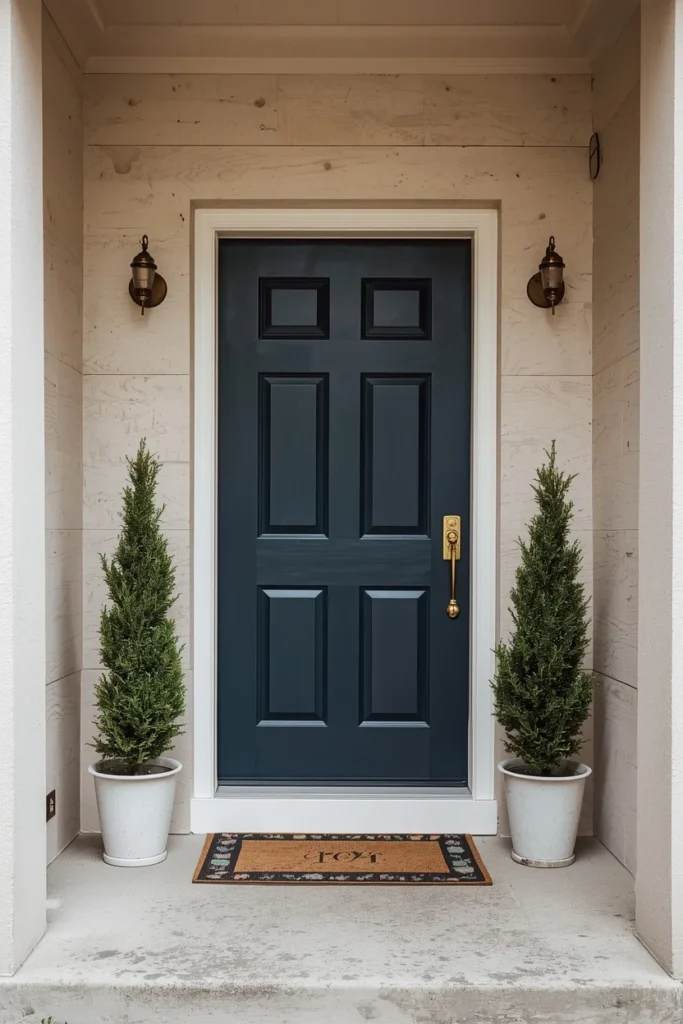
14. Choose One Statement Piece Instead of Many Small Ones
Answer: On a genuinely tiny porch, one well-chosen, slightly larger item — a single oversized planter, one striking wreath, a single bold-colored chair — outperforms several smaller decorative pieces competing for the same limited space.
Explanation: A simple wreath and a few potted plants prove a porch doesn’t need much to make an impact; the space feels airier and more intentionally styled when one statement plant or object is allowed to breathe rather than every corner being filled.
Practical Example: One oversized statement planter, rather than a matching pair of smaller pots, is increasingly the recommended move for 2026 — mixing sizes with earthy materials like stone or concrete reads as more current than matchy-matchy sets.
Common Mistake: Filling every available inch of a small porch with decor. For tight spaces specifically, choosing a few thoughtful pieces and letting them shine outperforms overfilling the space every time.
15. Use a Trellis or Climbing Vine to Add Height Without Footprint
Answer: A trellis fitted with a climbing vine fills blank vertical wall space on a small porch without consuming any floor area at all, softening hard architectural lines in the process.
Explanation: Even the smallest porches can handle a bit of greenery, and a trellis topped with climbing vines fills a blank stretch of wall in a way that planters on the ground physically cannot.
Practical Example: A simple wooden or metal trellis against a side wall, paired with a fast-growing vine, adds a layer of organic softness that grows more impressive each season without requiring more porch space.
Who Benefits: This idea is especially useful for narrow, single-wall porches or stoops with no room for furniture or floor planters at all.
16. Treat the Porch Ceiling as Decor, Not Just Structure
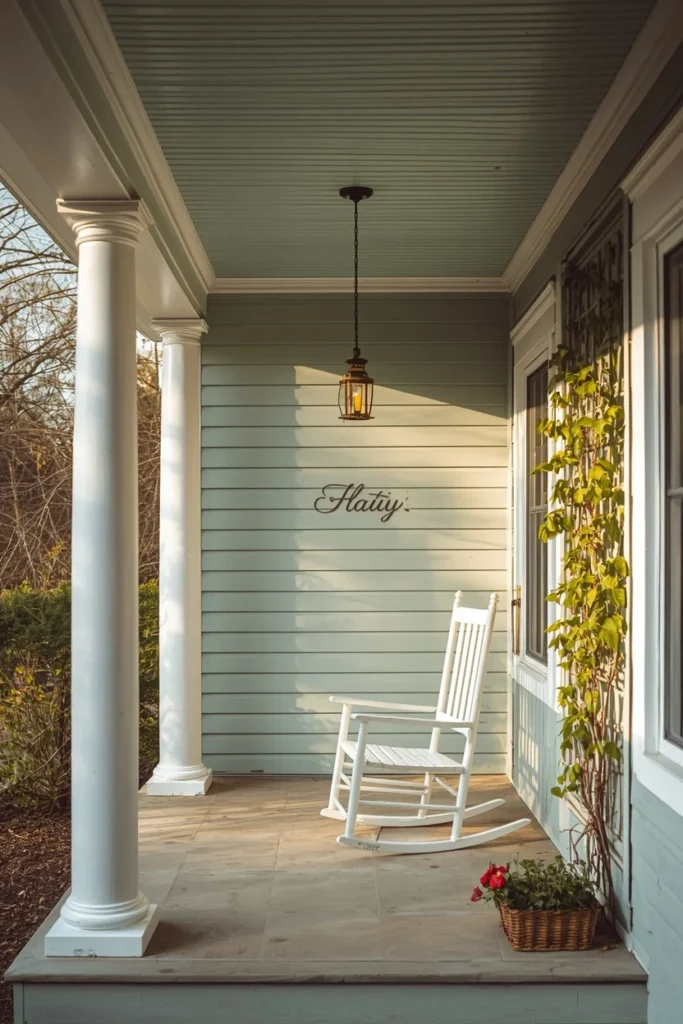
Answer: Painting a porch ceiling a soft, intentional color — most famously “haint blue” — adds charm and depth to a small porch without consuming a single inch of usable floor space.
Explanation: This Southern tradition has gained renewed popularity in 2026 porch styling because it adds a layer of color and personality entirely above the functional zone of the porch, leaving the floor space completely free for furniture or circulation.
Practical Example: A pale haint blue ceiling paired with white columns and classic lantern pendants creates a grounded, polished look that works even on a porch too narrow for more than a single chair.
Quick Tip: This is one of the few porch upgrades that costs roughly one gallon of paint and a weekend, making it one of the highest charm-per-dollar ideas in this entire guide.
Mini Checklist — Small Porch Priority Order:
- Clean and declutter completely
- One vertical element (trellis, tall planter, or trees)
- A layered doormat
- One statement piece, not several small ones
- Consider a ceiling color upgrade if floor space is truly nonexistent
Greenery, Texture & Seasonal Charm (Ideas 17–22)
The final six ideas are what take a well-built porch from “nicely designed” to genuinely charming — the layer of greenery, personality, and seasonal rhythm that makes a porch feel like it belongs to the people who live there.
17. Flank the Door With Matching Planters
Answer: A pair of matching planters on either side of the front door is one of the most universally effective porch upgrades, working on nearly every architectural style and porch size.
Explanation: Even the smallest porches can handle a bit of greenery, and flanking the door with matching planters reliably adds life and color while reinforcing the symmetry principle from earlier.
Practical Example: Galvanized planters lined up neatly on either side of a dark front door feel crisp and intentional against light siding, with the metal finish adding a clean, modern edge that softer ceramic pots don’t.
Designer Secret: Choose containers that match your home’s architectural style rather than buying on sale without considering fit — a sleek modern planter on a traditional Colonial porch (or vice versa) creates visual friction even when the plants inside are beautiful.
18. Use Window Boxes to Extend Greenery Beyond the Door
Answer: Window boxes filled with seasonal flowers and foliage extend a porch’s greenery beyond just the entry, framing the whole facade rather than a single focal point.
Explanation: Lining windows with low boxes filled with foliage does double duty, infusing color and life into the broader exterior while drawing the eye across the whole front of the house rather than just toward the door.
Practical Example: Sweet pansies, boxwoods, ferns, ivy, and geraniums all work beautifully in window boxes, and a warm color palette can easily carry from spring into summer and fall with simple swaps.
Budget Alternative: A single window box on the most visible window, rather than boxes on every window, still delivers meaningful curb-appeal impact at a fraction of the cost and maintenance.
19. Hang Greenery Overhead If You Have a Covered Porch
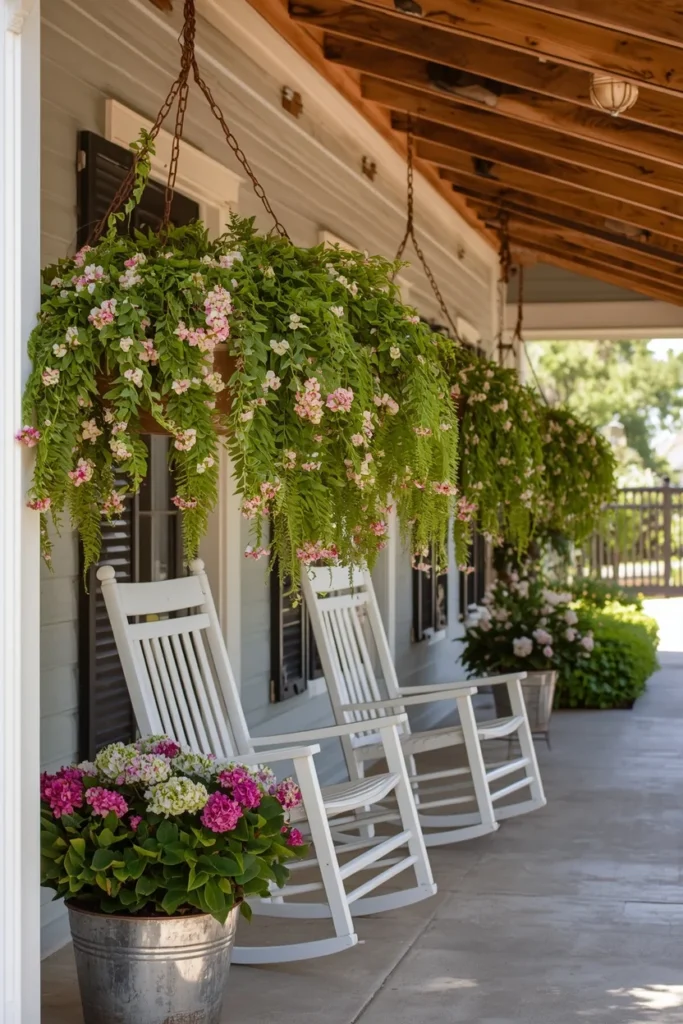
Answer: A covered porch with structural beams is an underused opportunity — hanging lush greenery or flowing flowers overhead adds a dimension of charm that ground-level planters alone can’t achieve.
Explanation: If you have a covered porch, put those beams to good use; hanging plants draw the eye upward and fill the vertical space between the floor and the roofline, which otherwise often goes completely undecorated.
Practical Example: Hanging baskets filled with trailing hydrangeas or ferns, spaced evenly along a porch beam, create a lush, layered canopy effect that frames the entire seating area below.
Common Mistake: Decorating only at floor and door level while leaving the entire overhead space empty. On covered porches specifically, this is one of the most common missed opportunities in the entire guide.
20. Hang or Swap a Seasonal Wreath
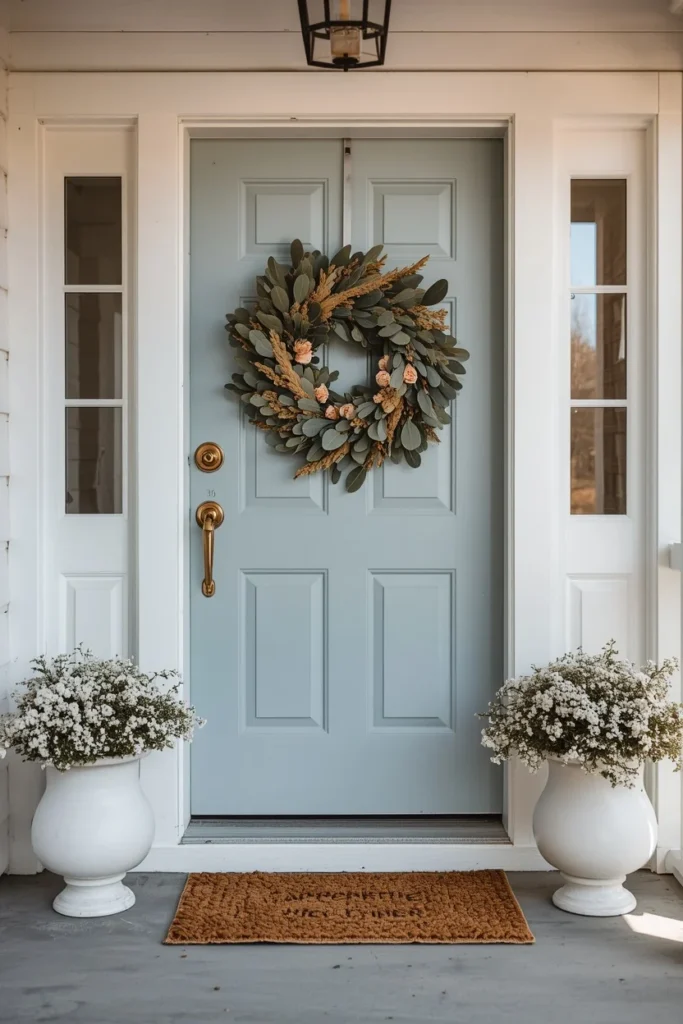
Answer: A wreath remains one of the fastest, lowest-cost ways to mark the season and add immediate texture to a front door, and 2026’s trend favors natural, less “themed” arrangements over heavily styled ones.
Explanation: A fresh wreath changed seasonally is a classic, reliable approach to keeping a porch current; in 2026, the preference is shifting toward natural elements like eucalyptus, pinecones, and dried florals over overtly themed seasonal decor.
Practical Example: A full floral wreath paired with a soft blue door and simple planters creates a look that feels clean but full of personality — even a single well-chosen wreath, without additional seasonal decor, can carry an entire entryway.
Quick Tip: Faux wreaths offer the same visual impact as fresh ones without the upkeep, making them a practical choice for porches that don’t get checked on daily.
21. Build a Seasonal “Capsule” That Rotates Easily
Answer: Rather than fully redecorating each season, building a small rotating capsule of swappable pieces (a mat, a sign, a wreath) keeps a porch feeling current with minimal ongoing effort or cost.
Explanation: Just as a wardrobe gets a seasonal refresh, a porch benefits from a capsule of decor that rotates easily — swap a heavier mat for a floral one in spring, add nautical touches in summer, layer pumpkin themes in autumn, and switch to a cozy winter sign and snowflake mat when the season turns.
Practical Example: A vertical wood sign customized with a house number or “Established” date pairs with seasonally swapped mats and wreaths to create a cohesive, ever-changing entryway built from just three or four core pieces.
Who Benefits: This approach particularly suits homeowners who enjoy seasonal styling but don’t want to fully re-decorate the porch from scratch four times a year.
22. Add Personality Through Humor or a Custom Detail
Answer: A doormat with a touch of humor, or a customized welcome sign with your house number or family name, adds a layer of warmth and individuality that purely aesthetic decor can’t replicate.
Explanation: 2026 porch trends are leaning less formal, with homeowners using doormats specifically to showcase personality before a guest even reaches the door — these small, personal touches are often what guests remember and comment on.
Practical Example: A simple, playful doormat phrase, or a vertical sign customized with your street name or move-in year, makes an entryway distinctly yours in a way that’s impossible to replicate by simply buying the same furniture as everyone else.
Mini Checklist — Charm and Personality Recap:
- Symmetrical planters flanking the door
- At least one greenery element beyond the door (window box, hanging plant, or trellis)
- A current seasonal wreath or mat
- One element that’s genuinely personal — humor, a custom sign, or a meaningful object
Designer Tips: The 5-Minute Porch Audit
Before buying anything new, stand at the end of your front walkway and check these five things — most porch problems trace back to one of them:
- Is your front door color intentional, or just whatever it came with? This is the highest-impact, lowest-cost change available — start here if you start anywhere.
- Is anything mismatched in scale? Oversized furniture in a small space (or undersized decor in a large one) is one of the most common, fixable issues.
- Is your lighting layered, or is there just one fixture? A single overhead light can’t create the warmth that sconces, lanterns, or string lights add together.
- Is the space symmetrical, or does it feel lopsided? Even mismatched items can be arranged to feel balanced — check before buying anything new.
- Is everything clean? No amount of styling compensates for cobwebs, dusty fixtures, or a worn mat.
Common Mistakes to Avoid
Mistake: Buying a matching furniture set and stopping there. A porch styled entirely from one boxed set tends to read as showroom-staged rather than personal. Mix in at least one vintage, repurposed, or unmatched piece.
Mistake: Choosing furniture too large for the space. Oversized pieces shrink the perceived size of a porch and block natural circulation, which works against the welcoming effect you’re going for.
Mistake: Relying on a single light source. A solitary porch light, however nice, can’t create the layered warmth that sconces, pendants, and accent lighting achieve together — and a poorly lit porch reads as uninviting after dark regardless of how it looks during the day.
Mistake: Ignoring the ceiling and overhead space. On covered porches especially, leaving everything above eye level undecorated is one of the most common missed opportunities for adding charm without using any floor space.
Mistake: Letting maintenance lapse. Cracked pathways, peeling paint, and neglected plants undercut even a beautifully designed porch. Coziness and curb appeal both depend on basic upkeep as much as on styling choices.
FAQs
Conclusion
A genuinely charming front porch isn’t built from one expensive purchase — it’s built from a series of intentional, layered decisions: a door color chosen with care, lighting that works in three layers instead of one, furniture scaled to the actual space, and a few personal touches that make it unmistakably yours.
You don’t need to tackle all 22 ideas at once. Start with whichever foundational piece feels most overdue — repainting the door, fixing the lighting, or simply giving the space a thorough clean — and build outward from there. A porch that feels considered, even in small ways, changes how every visitor experiences your home before they ever reach the door.