21 Country Kitchen Backsplash Ideas That Make Your Whole Kitchen Pop
Walk into a country kitchen that has the right backsplash and you feel it before you even see it fully.
There is something about the way the late afternoon light catches handmade tile, the way a wall of creamy beadboard makes even a brand-new kitchen feel like it has been loved for generations, the way a single strip of terracotta behind the stove anchors an entire room in warmth and earth and character.
The backsplash is the smallest wall in your kitchen and the one with the most personality per square inch.
In a country kitchen specifically — whether that means farmhouse, cottage, French country, rustic, or that cozy in-between that does not have a name but you know it when you see it — the backsplash carries enormous visual weight. It sits at eye level. It frames the stove, the sink, and the shelves. It is the first thing guests notice and the thing you look at every single morning while making coffee.
Getting it right changes everything.
These 21 country kitchen backsplash ideas explore every material, every style, every budget, and every color combination that actually works — with specific recommendations, grout pairings, cabinet color suggestions, and installation tips for each. No vague inspiration. Just real, usable ideas for real kitchens.
Your kitchen is about to look completely different. In the best way.
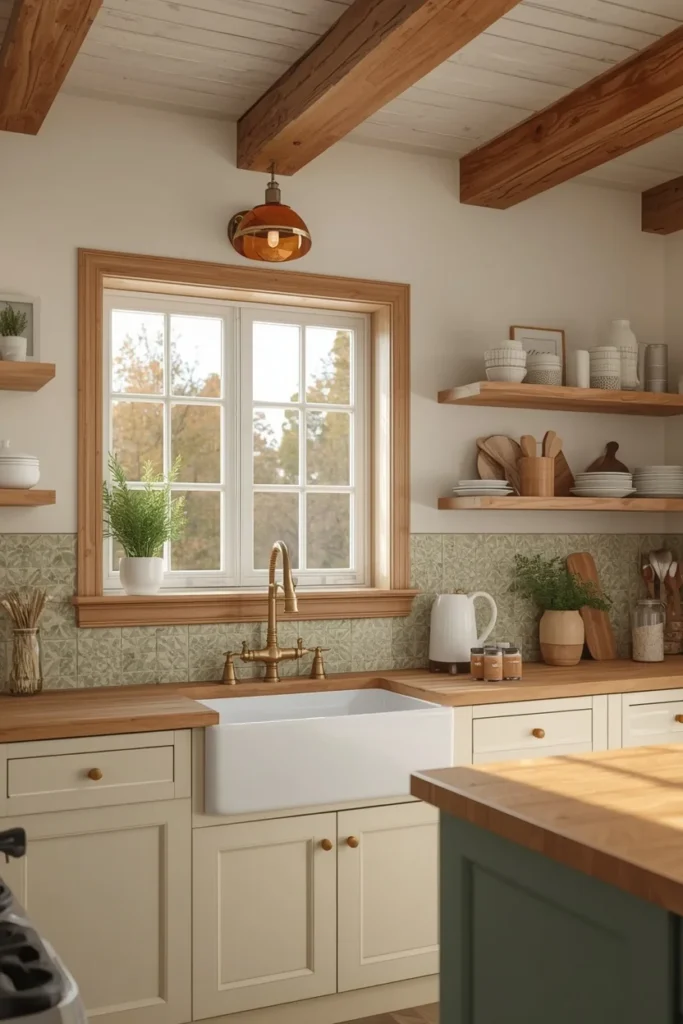
Table of Contents
- What Makes a Great Country Kitchen Backsplash
- Country Kitchen Backsplash Colors That Always Work
- Grout Color Guide for Country Kitchen Backsplashes
- The 21 Country Kitchen Backsplash Ideas
- How to Choose the Right Backsplash for Your Country Kitchen
- Styling Tips to Make Your Backsplash Pop
- Common Mistakes to Avoid
- Budget-Friendly Alternatives
- Small Kitchen Backsplash Solutions
- Pro Designer Recommendations
- Frequently Asked Questions
- Final Thoughts
What Makes a Great Country Kitchen Backsplash?
A country kitchen backsplash is not just a practical splash guard. In this style of kitchen, it is a design anchor.
The best ones share a few characteristics regardless of their material or color.
- They have texture. Smooth, flat, uniform surfaces read as modern. Country kitchens need tactile interest — the slight irregularity of handmade tile, the grain of wood, the pores of natural stone, the tiny ridges of beadboard. Texture catches light, creates depth, and makes a surface look genuinely beautiful rather than just clean.
- They tell the truth about what they are. Genuine terracotta. Real brick. Actual hand-painted ceramic. Natural stone with real veining. Materials in country kitchens are honest — they do not try to look like something else. This authenticity is what gives country kitchens their warmth and their staying power.
- They complement without competing. A country kitchen backsplash sits behind your cabinets, your shelves, your stove, your sink, and your countertops. It needs to be interesting enough to be beautiful and restrained enough to let everything else breathe.
- They age gracefully. Unlike a trendy pattern that will look dated in five years, the best country kitchen backsplashes — white subway tile, natural stone, shiplap, terracotta — look better with time. A slight patina, a tiny chip on a handmade tile, a grout line that has taken on a century of cooking — these things add character, not age.
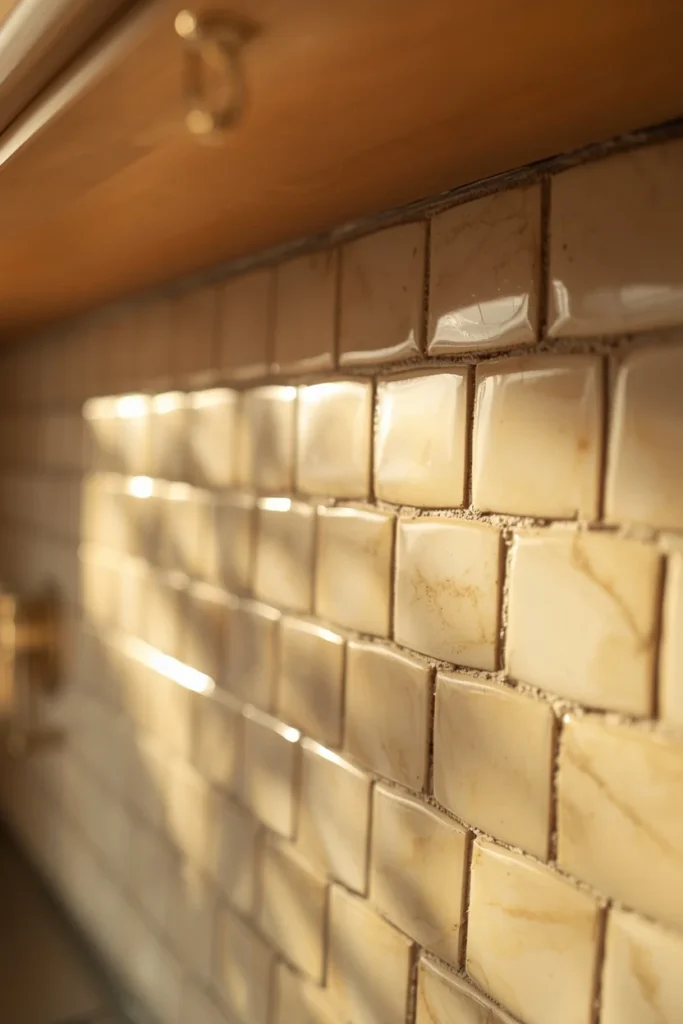
Country Kitchen Backsplash Colors That Always Work
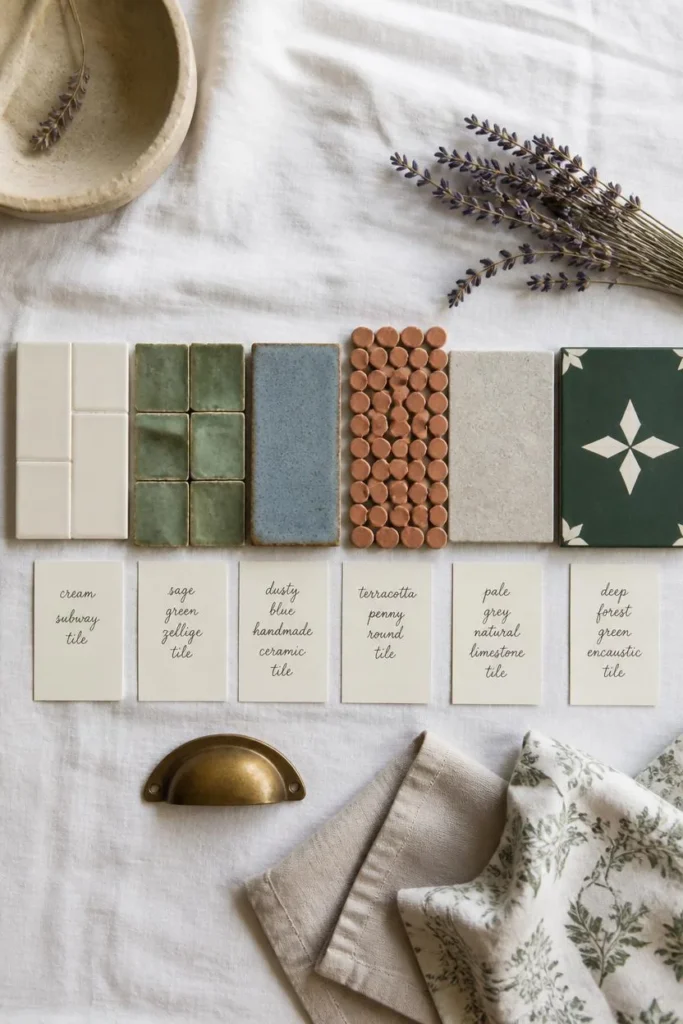
Color choices in a country kitchen backsplash follow different rules than modern or contemporary spaces. Here are the palettes that reliably work:
Warm white and cream — the classic foundation. Works with every cabinet color. Reflects light without feeling stark. Cream grout keeps it warm; charcoal grout makes it pop.
Sage green — the color of 2025 country kitchens. Especially beautiful against cream cabinets, natural wood, or warm white. In zellige or handmade ceramic, sage green has a depth and variation that flat painted surfaces cannot replicate.
Soft dusty blue — instantly evokes English cottage and French country style. Pairs beautifully with warm white cabinets, brass hardware, and natural wood countertops. In subway tile format with white grout it is classic. In handmade ceramic with a slight crackle glaze it is extraordinary.
Terracotta and warm clay — earthy, grounding, and deeply warm. Works best with cream, warm white, or natural wood cabinetry. Matte finish ages beautifully. Glossy finish reflects warm amber kitchen light.
Natural stone grey and taupe — the most versatile neutral in country kitchen backsplashes. Goes with everything, reads as neither warm nor cool, and ages beautifully. German smear, limestone, and pale stacked stone all fall in this palette.
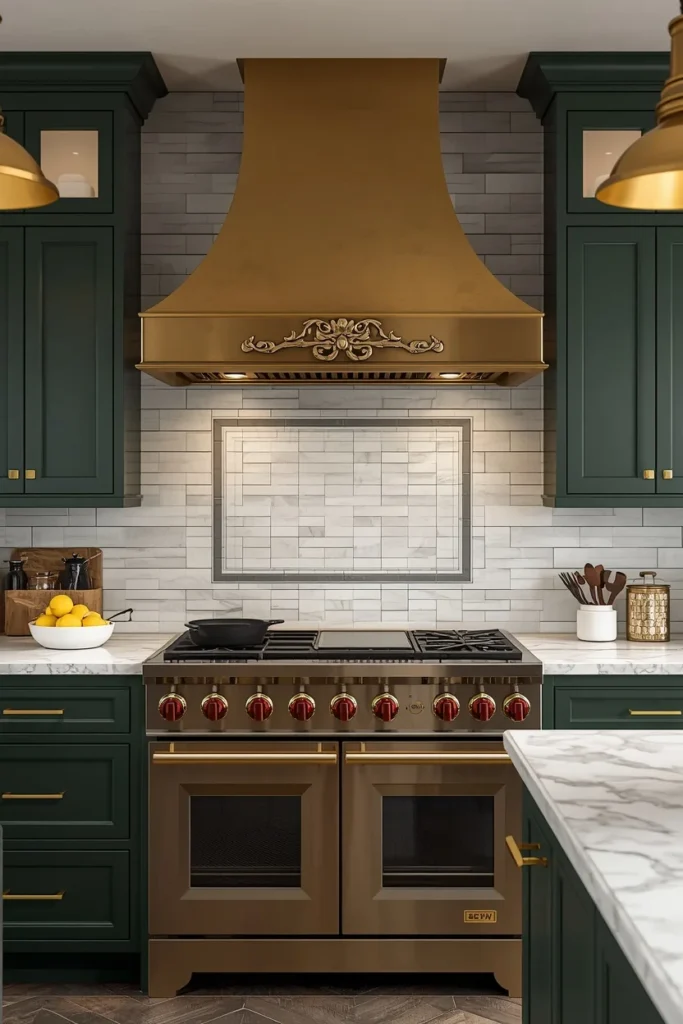
Deep forest green and navy — for the country kitchen that leans dramatic. Beautiful behind light cream or natural wood open shelving. Creates a moody, jewel-box quality that photographs extraordinarily well.
Grout Color Guide for Country Kitchen Backsplashes
Grout is the design decision most homeowners make last and regret most. In a country kitchen backsplash, grout color does four things: it either highlights individual tiles or unifies them, it sets the overall mood from clean to rustic, it affects how easy the backsplash is to maintain, and it determines whether the whole installation reads as modern or genuinely country.
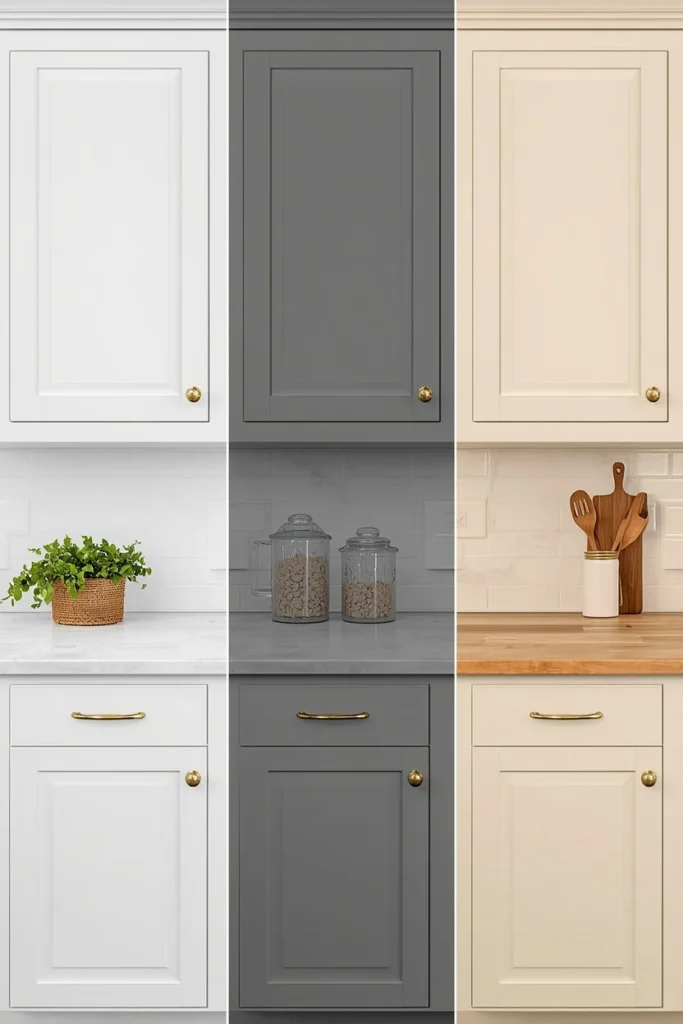
For white subway tile: Dark charcoal or slate grey grout creates dramatic definition and a very photogenic result. Warm off-white or linen grout creates a seamless, old-plaster feel that reads as more authentically aged. Avoid bright white grout on white tile in a country kitchen — it reads as too clean and clinical.
For terracotta tile: Warm sand or buff-coloured grout lets the terracotta read as one continuous warm surface, like the floor of an old Mediterranean farmhouse. Cream grout creates more definition between tiles. Avoid grey or white grout on terracotta — it fights the warmth of the tile instead of supporting it.
For zellige tile: Matching grout in the same family as the tile color creates the most luxurious result — the variation within the zellige itself provides all the visual interest needed. White grout on colored zellige can look too graphic and modern for a country kitchen aesthetic.
For natural stone: Warm grey or taupe grout in a close-to-matching tone keeps the stone looking natural and continuous. Wide grout lines on rough-cut stone with a warm grey grout create the most authentically rustic result.
For hand-painted ceramic: White grout keeps the focus entirely on the hand-painted design — which is exactly where it should be. The grout disappears and the artwork takes over.
For beadboard and shiplap: No grout needed — but paint color matters just as much. Warm white like Benjamin Moore White Dove or Sherwin-Williams Alabaster is the most flattering. Cream adds warmth. Sage green paint on beadboard is one of the most charming country kitchen looks possible.
The maintenance reality check: Lighter grout shows staining faster and requires sealing regularly. Darker grout hides daily cooking splatter better and needs less maintenance. In a working country kitchen — one that actually cooks — medium grey or warm buff grout is the most practical colour choice.
The 21 Country Kitchen Backsplash Ideas
Idea 1 — Classic White Subway Tile With Dark Charcoal Grout
White subway tile is the little black dress of country kitchen backsplashes. It has been installed in farmhouses, cottages, and country homes for over a century — and it looks just as right today as it ever has.
But the version that actually makes a kitchen pop is not the basic white tile with matching white grout most people default to. It is white subway tile with dark charcoal or slate grey grout.
The contrast draws the eye to each individual tile and creates a graphic, almost grid-like pattern that adds visual structure without adding color or visual noise. The result is a backsplash that photographs beautifully, pairs with nearly every cabinet color, and reads as both classic and confident.
The tile size that works best in a country kitchen: The original 3-inch by 6-inch subway tile proportion is the most authentic for country style. Larger subway formats — 4 by 8 or 4 by 12 — can work but lean more contemporary. Smaller brick-shaped tiles in a stacked or running bond pattern lean more vintage and artisan.
Cabinet pairings: Cream, warm white, forest green, navy, sage green, charcoal. Honestly — white subway tile works with everything. That is why it has lasted a century.
Grout recommendation: Mapei Charcoal Grey or Laticrete Pewter. Seal every six to twelve months for kitchen applications.
Cost range: $3 to $8 per square foot for tile, plus installation.
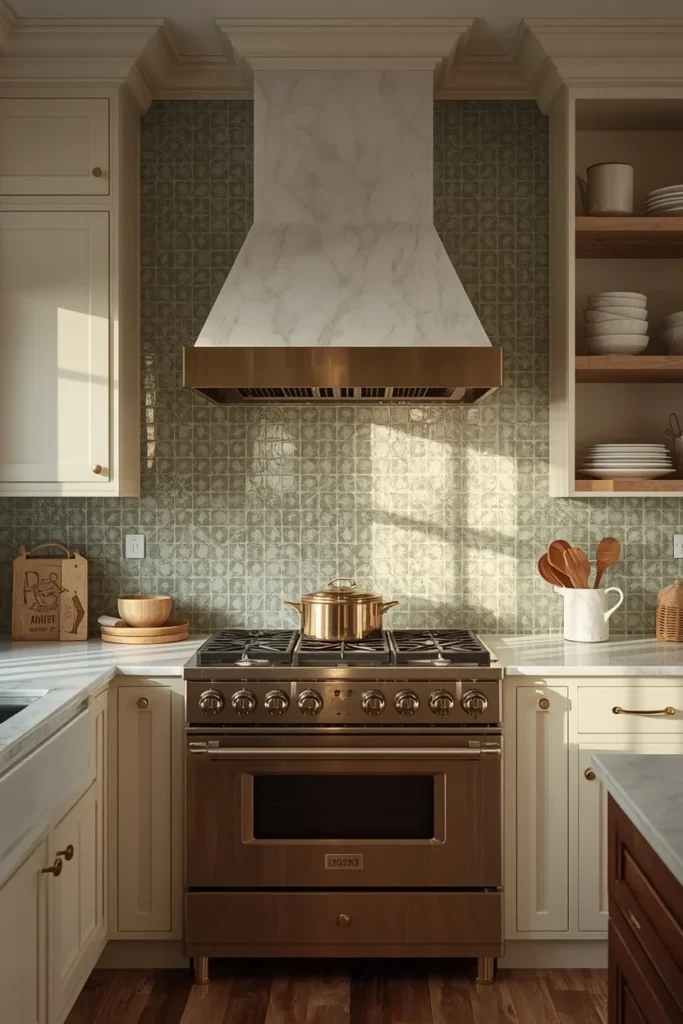
Idea 2 — Handmade Zellige Tile in Sage Green
Zellige is handmade Moroccan tile — fired at lower temperatures than standard ceramic, which creates the slight surface irregularity, tonal variation, and luminous quality that makes it unlike anything else on a kitchen wall.
In sage green, zellige becomes one of the most beautiful country kitchen backsplash options available in 2025. The slight variation in the green — some tiles catching the light and reading almost celadon, others sitting deeper and more olive — creates a living, breathing wall surface that changes quality throughout the day.
Interior designers including Regan Billingsley have noted that zellige “feels timeless — something you will still love ten years down the line.” In a country kitchen, that longevity matters.
How to use it: Floor to ceiling behind the stove as a dramatic accent. Or full backsplash across the whole kitchen at standard height. Both approaches work beautifully. Full-coverage creates the most impact.
Cabinet pairings: Cream, warm white, natural wood open shelving, or light oak cabinetry. The green in zellige is complex enough that it does not need color competition from the cabinets.
Grout recommendation: Matching sage or warm grey grout in an unsanded formulation. Zellige tiles sit close together — wide grout lines fight the handmade quality.
Important note: Zellige is not the easiest tile to install. The slight variation in tile thickness means the wall surface must be exceptionally flat before installation. Hire an experienced tile setter for the best result.
Cost range: $15 to $35 per square foot depending on brand and source. American Clay Zellige, Cle Tile, and Savoy House are among the most recommended suppliers.
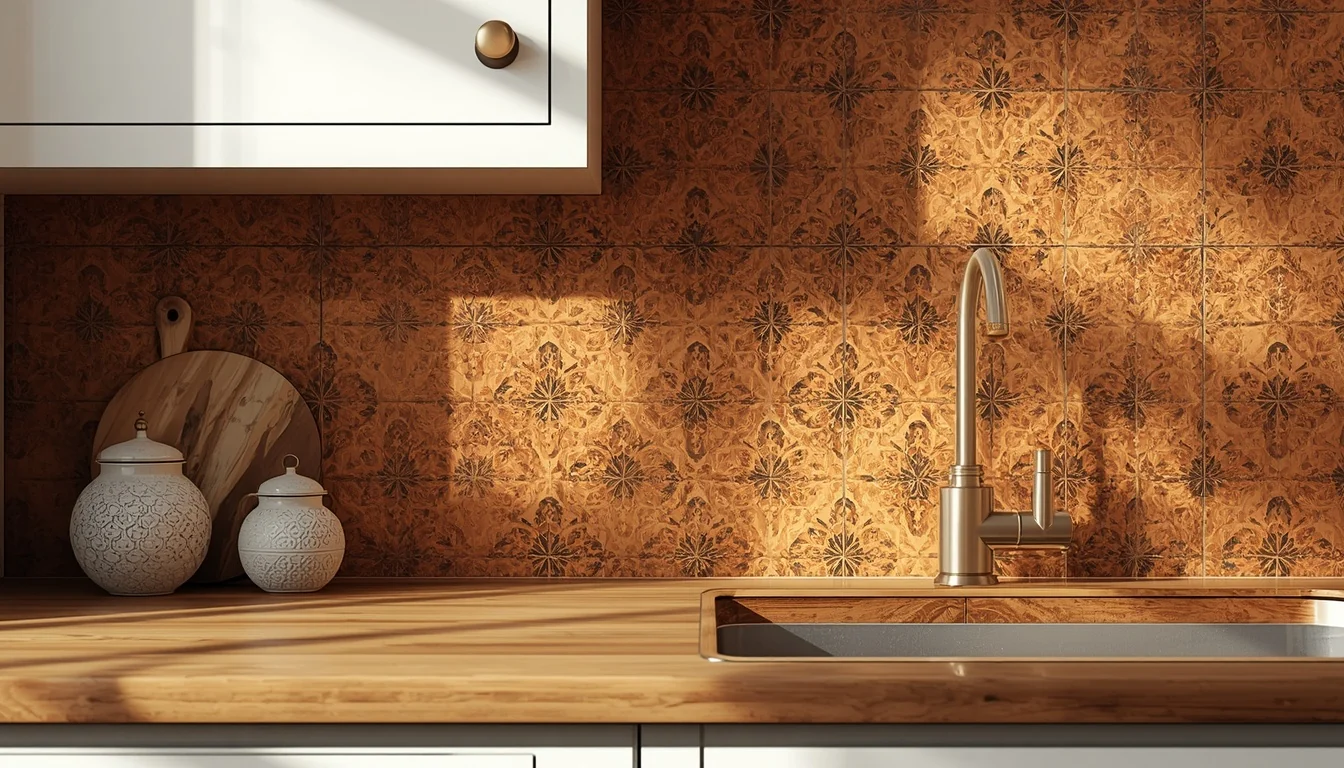
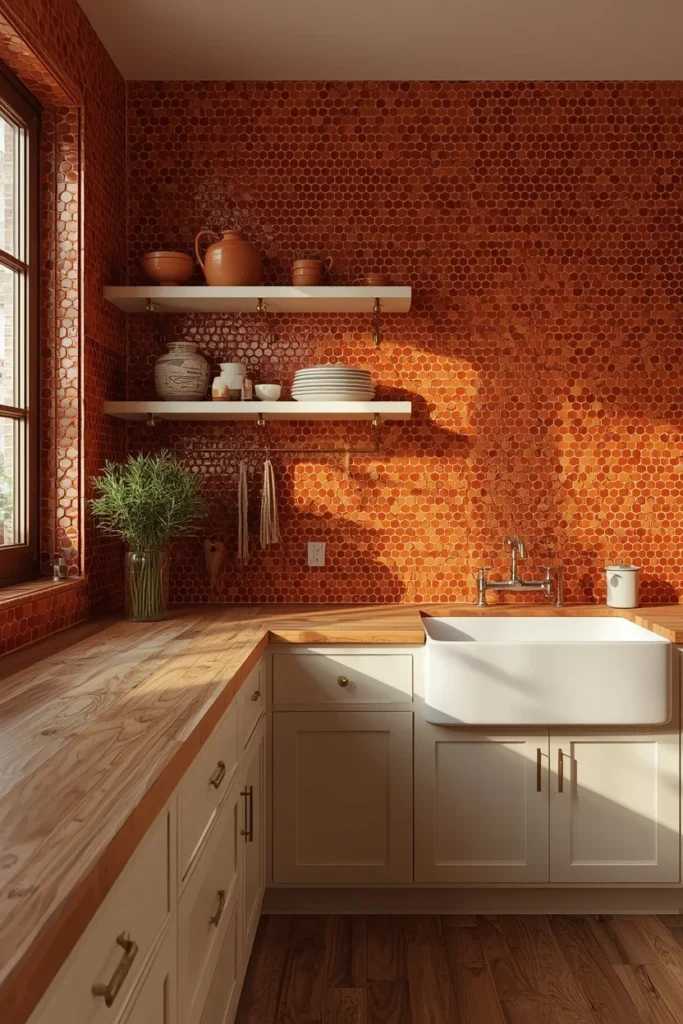
Idea 3 — Terracotta Penny Rounds
Terracotta has been used in kitchens for thousands of years across Mediterranean and Spanish colonial traditions — and its return to contemporary country kitchens feels both inevitable and completely right.
In penny round format — small circular tiles grouped in mesh-backed sheets — terracotta creates one of the most visually rich country kitchen backsplash surfaces possible. The round shapes interrupt the grid pattern most backsplashes follow and create something that feels more artisan, more collected, more genuinely old than any rectangular tile can.
The color itself does much of the work. Terracotta’s warm rust-orange reads differently at every hour — almost golden in morning light, deeply earthy in evening lamplight, rich and complex in between. It ages beautifully, developing a slight patina over years of kitchen use that only makes it more beautiful.
Color pairings that sing: Cream cabinets let the terracotta be the star. Warm white walls stop the room from feeling too dark. Natural wood countertops extend the earthy warmth. Unlacquered brass hardware is the finishing touch that ties everything together.
Grout recommendation: Warm buff or sandy-beige grout in a matching tone. This makes the whole backsplash read as one warm surface rather than individual tiles. Avoid white or grey grout — it fights the warmth.
Practical note: Terracotta is porous. Seal it properly before grouting and reseal annually in a kitchen environment. Unsealed terracotta will stain from cooking oil and water.
Cost range: $8 to $18 per square foot. Mexican and Spanish terracotta tiles are among the most affordable. Italian and artisan-fired versions are more expensive but more beautiful.
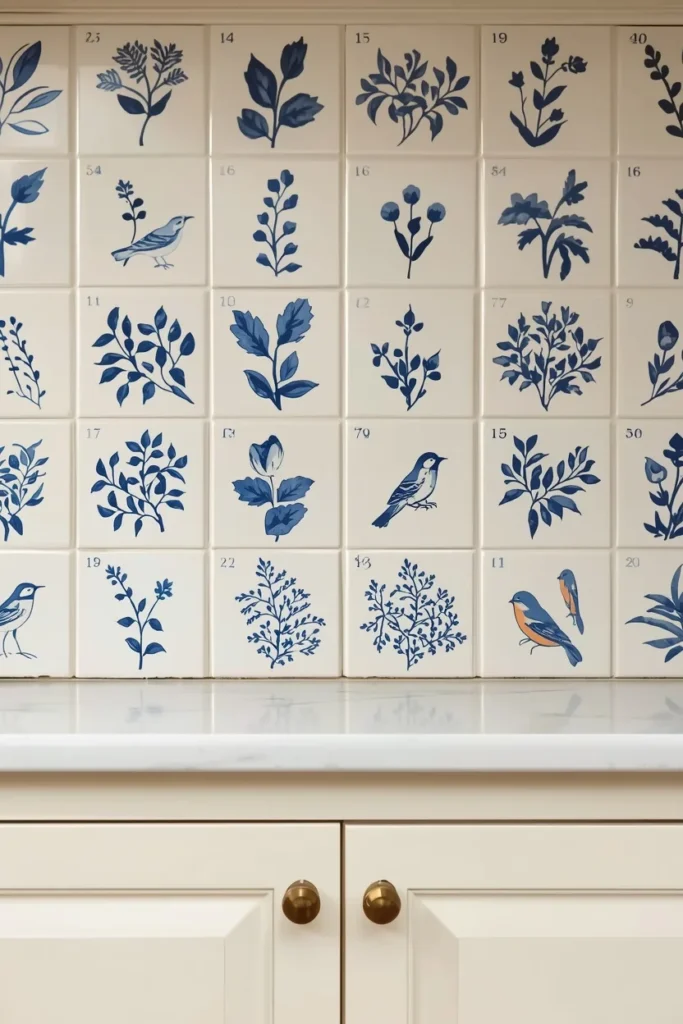
Idea 4 — Hand-Painted Blue and White Ceramic Tiles
This is the backsplash for country kitchens that want to feel genuinely artisan — like every tile was brought home from a pottery studio or a market in Portugal.
Hand-painted blue and white ceramic tiles have roots in Dutch Delft, Portuguese azulejo, and Spanish talavera traditions — all of which have influenced country kitchen design for centuries. Each tile carries a small painted scene or pattern: a flower, a bird, a simple geometric motif, a leaf. Together they create a wall surface that is less like a backsplash and more like a collection of small artworks.
The styling rule: When the backsplash is this visually active, everything else needs to be quiet. Cream or warm white cabinets. Plain countertops in white or light grey. Simple hardware. No competing pattern anywhere else in the kitchen. Let the tiles do every bit of the talking.
Where to source them: Malibu Ceramic Works, Amagansett Tile, Moroccan Mosaic & Tile House, and Etsy sellers offering handmade Portuguese tiles are among the best sources for authentic hand-painted options.
Budget note: Hand-painted tiles are significantly more expensive than standard ceramic — often $15 to $50 per tile. Consider using them as an accent only — behind the stove or as a border along the top of a standard subway tile backsplash — to achieve the look at a fraction of the full-coverage cost.
Grout recommendation: White grout, always. It makes the tiles themselves the entire focus.
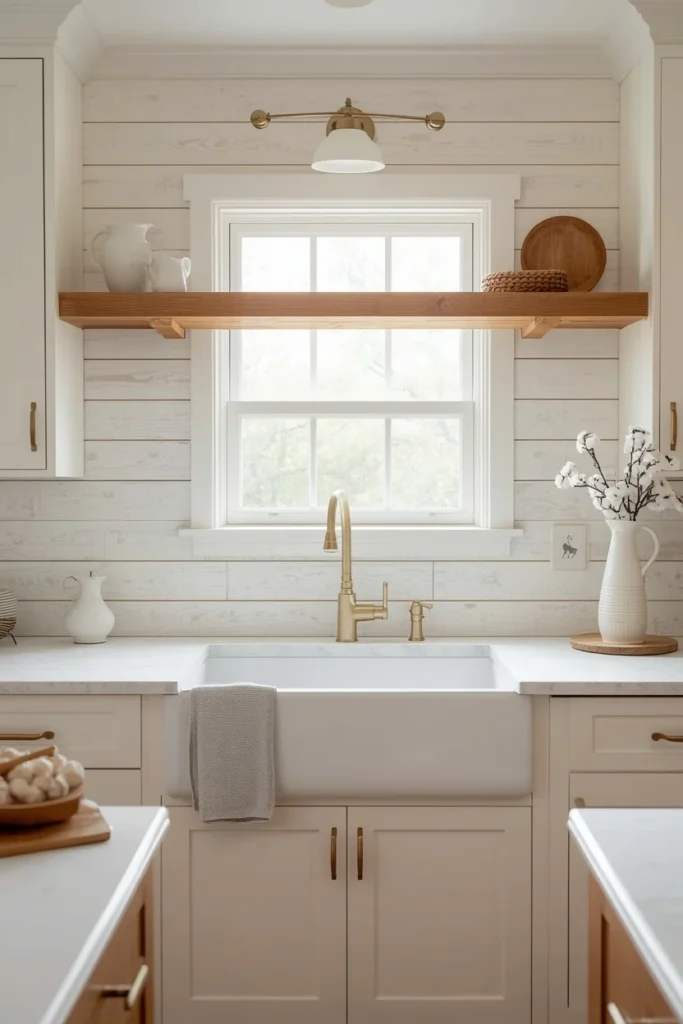
Idea 5 — Shiplap Backsplash in Warm Cream
Shiplap as a backsplash is a more contemporary country kitchen idea — and one that divides opinion among designers. But when it is done well, it is one of the most charming options possible.
The horizontal wood planks create a subtle linear texture that adds visual warmth without adding colour. Painted in Benjamin Moore White Dove or Sherwin-Williams Alabaster, shiplap reads as cream-warm white — richer and more intentional than a plain painted wall, quieter and more rustic than tile.
It works especially well in kitchens that already have a lot of visual interest — open shelving with displayed ceramics, a patterned tile floor, coloured cabinetry — where a tile backsplash would add one visual layer too many.
The practical caveat everyone skips: Shiplap is wood. It is not inherently waterproof or grease-resistant. In the zone directly behind the stove, use a sealed and properly finished version — or replace that section with a simple tile and use shiplap only in the lower-splash and side sections where direct cooking splatter is minimal. Regular sealing with a kitchen-safe matte polyurethane extends its life significantly.
Best finish: Eggshell or semi-gloss paint. Semi-gloss wipes down more easily after cooking splatter. Matte reads more authentically farmhouse but requires more maintenance.
Cabinet pairings: Works with every cabinet color. Especially beautiful with sage green, navy, forest green, or warm cream cabinets.
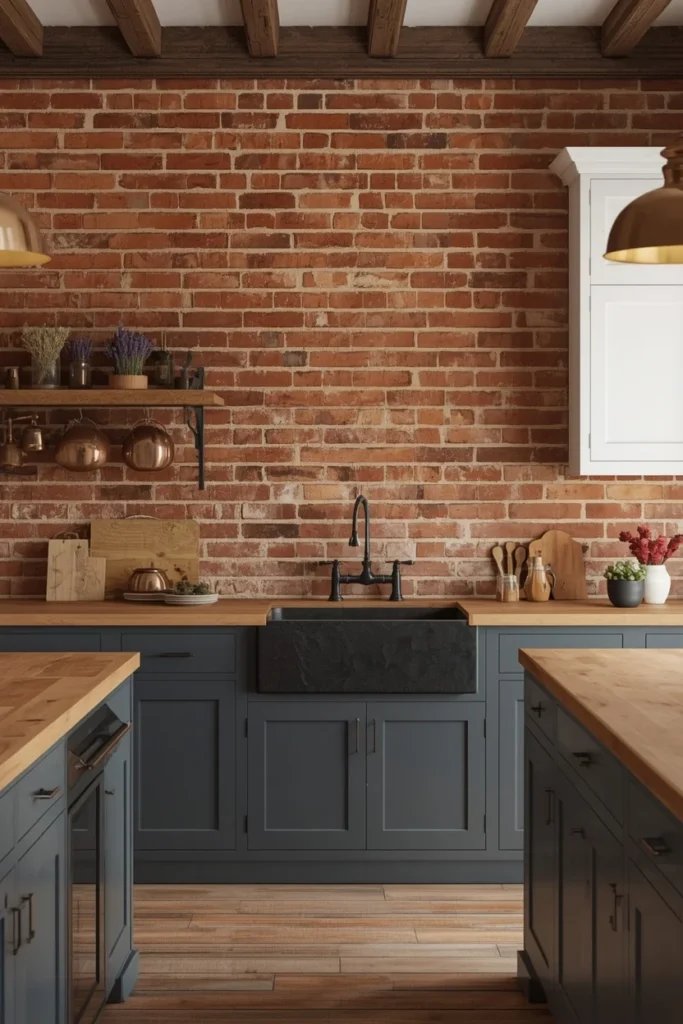
Idea 6 — Exposed Brick in Warm Red-Orange
Raw exposed brick is one of the most instinctively country backsplash materials that exists. It carries history in every uneven surface, every colour variation, every tiny chip in the mortar. No tile or panel can fully replicate what real aged brick does to a kitchen.
In warm red-orange tones — the colour of a clay kiln, a harvest sunset, an old stone farmhouse wall — exposed brick backsplash anchors a country kitchen in a way nothing else quite matches. It reads as completely authentic, completely natural, and completely beautiful.
If you do not have original brick: Thin brick veneer tiles are the most convincing alternative. They are real brick — just sliced thinner so they can be adhered directly to a standard kitchen wall. Brands like Old Mill Brick and Reclaimed Designworks offer authentic-looking options with real colour and texture variation.
Whitewash or limewash option: For a softer, more French country or cottagecore feel, a thin limewash treatment over red brick mutes the colour to a soft creamy pink-taupe that is extraordinary in kitchen light.
Grout recommendation: Warm buff or light cream mortar-style grout in wide joints. This is one case where wide grout lines add to the authenticity rather than detracting from it.
Maintenance note: Seal brick backsplash with a food-safe penetrating sealer before use in a cooking environment. Unsealed brick absorbs cooking oil and is nearly impossible to clean thoroughly.
Idea 7 — Natural Limestone Tile in Pale Grey-Beige
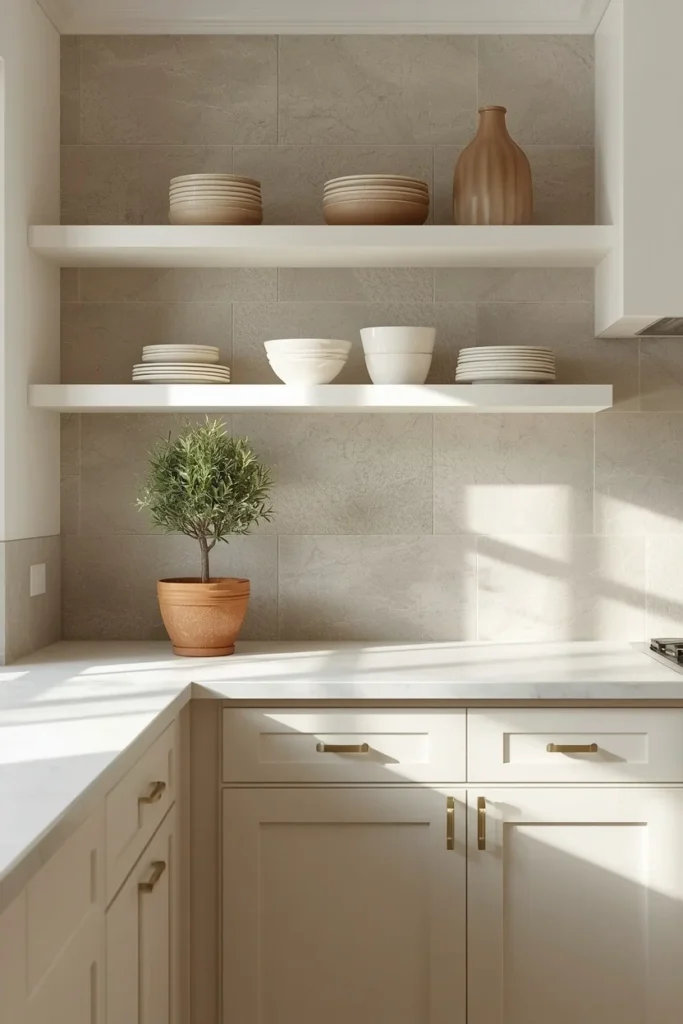
Limestone is what happens when natural stone meets a country kitchen and decides to stay forever.
Unlike marble — which can read as formal or precious — limestone has a humble, earthy quality that is completely at home in a working country kitchen. Its surface is slightly porous, slightly textured, and slightly imperfect in all the ways that make natural stone beautiful. The pale grey-beige tones of most limestone complement both warm and cool colour palettes without demanding attention.
Used as a backsplash in 4-inch by 4-inch or larger format tiles, limestone creates a quiet, grounded wall surface that makes everything in front of it — the stove, the sink, the displayed ceramics — look more beautiful by contrast.
The German Smear variation: A German smear treatment over limestone or concrete block creates a rough, plaster-like surface with extreme depth and texture. If you have seen a country kitchen with a backsplash that looked like an ancient whitewashed stone wall, this is likely what you were looking at.
Sealing is non-negotiable: Limestone is porous. It must be sealed before grouting and resealed annually in a kitchen environment. Unsanctioned limestone backsplash will absorb cooking oil within weeks.
Grout recommendation: Warm grey or taupe in matching tones. Wide joints on rough-cut limestone look most authentic. Tight joints on honed limestone look more refined and easier to clean.
Idea 8 — Beadboard Painted in Sage Green
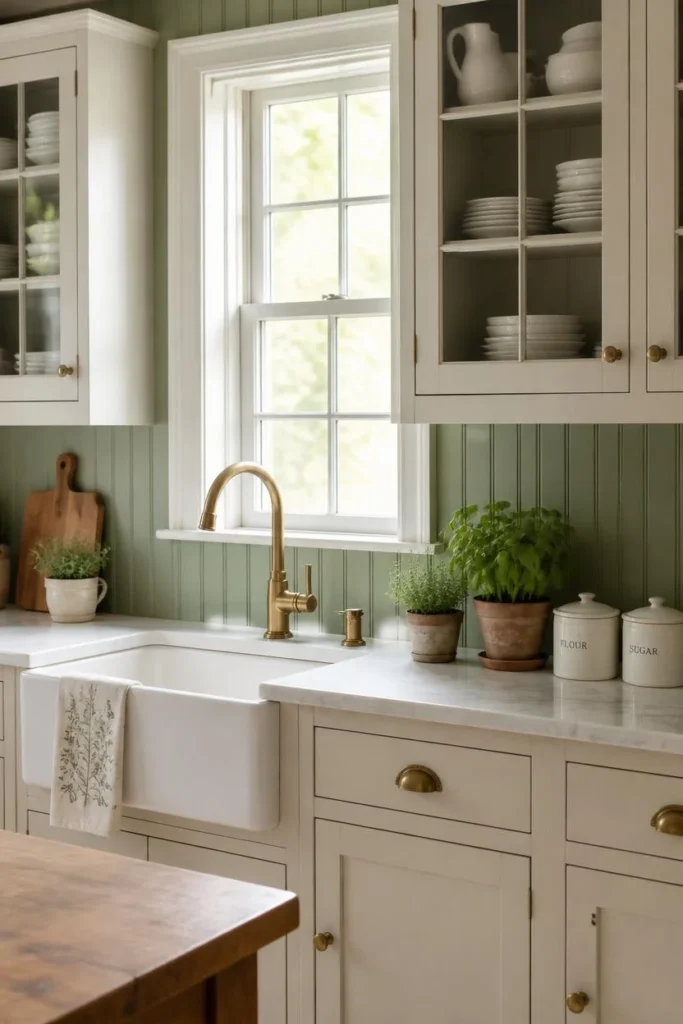
Beadboard is classic country kitchen material — the narrow vertical paneling with its tiny ridge-and-groove profile has been in American farmhouse and cottage kitchens for well over a hundred years.
Painted sage green — specifically in Benjamin Moore Saybrook Sage or Farrow & Ball Mizzle — beadboard becomes one of the most charming country kitchen backsplash options available at any price point.
The vertical groove profile adds subtle texture and dimension without visual complexity. The sage green adds colour without aggression. The painted wood surface wipes down easily. And the whole thing costs a fraction of any tile backsplash.
The color psychology of sage green in a kitchen: Sage reads as both natural and sophisticated — it references plants, herbs, gardens, and the outdoors without being as assertive as forest green or as trendy as millennial pink. In a kitchen it creates a sense of calm that makes cooking feel more enjoyable.
Installation note: Beadboard panels come in 4-by-8-foot sheets that can be cut to fit and adhered directly to a primed wall. An experienced DIYer can install a full kitchen backsplash in a single day. Paint with a semi-gloss finish for easy wiping.
Cabinet pairings: Cream, warm white, natural wood, or a tone-on-tone approach where the cabinets are painted in a slightly deeper sage green than the beadboard.
Idea 9 — Encaustic Pattern Tile in Blue and Cream
Encaustic tiles are not painted — their pattern is created from layers of different colored cement poured into a mold, which means the design goes all the way through the tile rather than sitting on top like a glaze. The result ages differently than ceramic: it softens and develops a patina over time that only makes it more beautiful.
In blue and cream — the most classic encaustic combination — these tiles bring a distinctly French country, Mediterranean, or Spanish colonial character to a country kitchen that no other material quite replicates. Each tile is slightly different from the next. The pattern, when installed across a full backsplash, creates something that looks more like artisan craftsmanship than standard tiling.
Pattern scales that work: Small geometric patterns — stars, diamonds, quatrefoil — work best in country kitchens. Large-scale patterns can overwhelm a small backsplash area. The key is to see the pattern repeat at least two to three times across the width of the installation before it reads as intentional.
Where to source: Cement Tile Shop, Granada Tile, and Clé Tile offer a wide range of encaustic options. Many are available in custom colorways.
Sealing requirement: Encaustic tiles must be sealed before grouting and after installation. Unsealed cement tile absorbs grout haze and becomes permanently stained. This is not optional.
Cabinet pairings: Simple cream or warm white cabinets only. Encaustic pattern tile provides enough visual interest for the entire kitchen — competing cabinetry detail will create chaos.
Idea 10 — Reclaimed Wood Planks Sealed for Kitchen Use
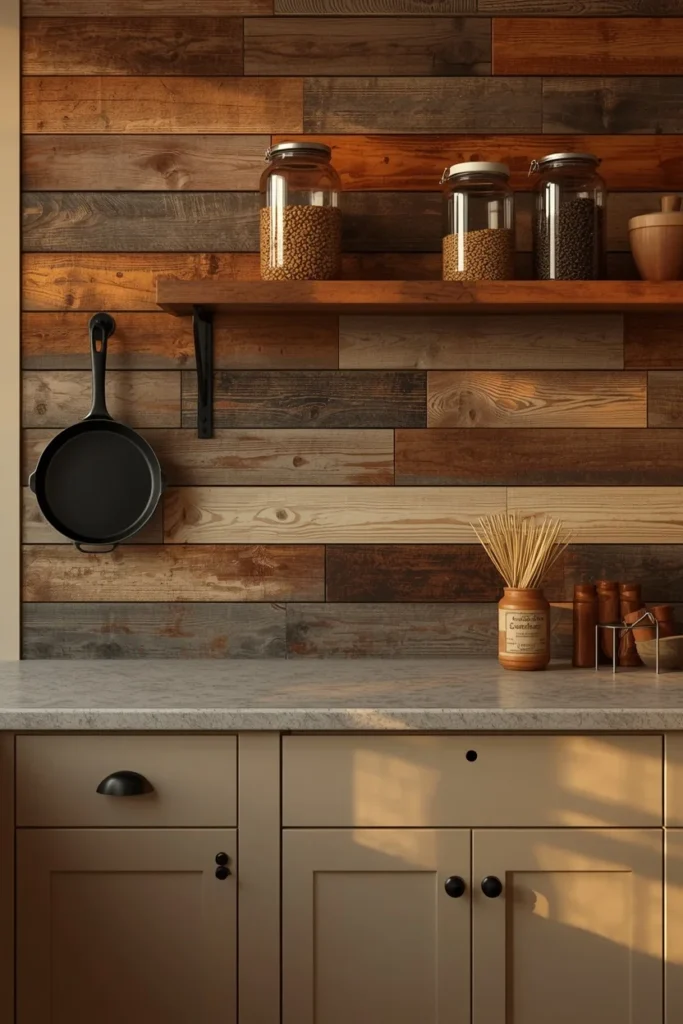
Reclaimed wood as a kitchen backsplash is not for the faint of heart — it requires proper sealing, careful sourcing, and a commitment to a slightly more rustic and lived-in aesthetic. But when it is done correctly, there is genuinely nothing more character-rich in a country kitchen.
The beauty of reclaimed wood lies entirely in its imperfection. Old paint traces in a color you cannot name. Nail holes filled with age-darkened wood filler. Grain patterns from trees that grew decades ago. No two planks are the same. No installation looks like any other.
The critical practical requirement: Wood in a kitchen backsplash must be sealed with a food-safe waterproof finish — either a penetrating wood sealer or several coats of kitchen-safe polyurethane. The zone directly behind the stove should either be replaced with tile or given extra sealer protection and accepted as a higher-maintenance area.
Sourcing authentic reclaimed wood: Salvage yards, architectural salvage dealers, Etsy sellers, and local barns or demolition projects are the most authentic sources. Avoid “reclaimed look” manufactured boards — they do not have the same colour depth or grain character as genuinely old wood.
Best finish for country kitchens: A matte or satin finish. Glossy finish on reclaimed wood looks wrong — it fights the material’s natural character.
Idea 11 — French Country Glazed Ceramic in Dusty Blue
French country kitchen style is its own specific world — more formal than farmhouse, more romantic than cottage, more colour-confident than transitional. The backsplash in a French country kitchen reflects all of this.
Glazed ceramic tiles in dusty blue — specifically the kind of blue that looks like it has been washed by sunlight for years, like Provence lavender fields at dusk, like aged French shutters on a stone farmhouse — create a backsplash that immediately communicates the French country aesthetic to anyone who walks into the room.
The glaze catches light differently than matte tile — a soft sheen rather than a full shine — and the slight variation in glaze thickness that characterises handmade French ceramic adds the artisan quality that makes this style feel genuine rather than manufactured.
Specific shades that work: Think Farrow & Ball Lulworth Blue, Benjamin Moore Wedgewood Grey, or Sherwin-Williams Uncertain Grey at its coolest edge. All of these translate beautifully into glazed ceramic tile color when sourced from ceramic artisans.
Cabinet pairings: Warm white, cream, or stone-grey cabinets. Natural limestone countertops if budget allows — they complete the French country story better than any other surface.
Hardware note: Antique brass or aged bronze hardware only. Chrome and brushed nickel read as too modern against French country tile.
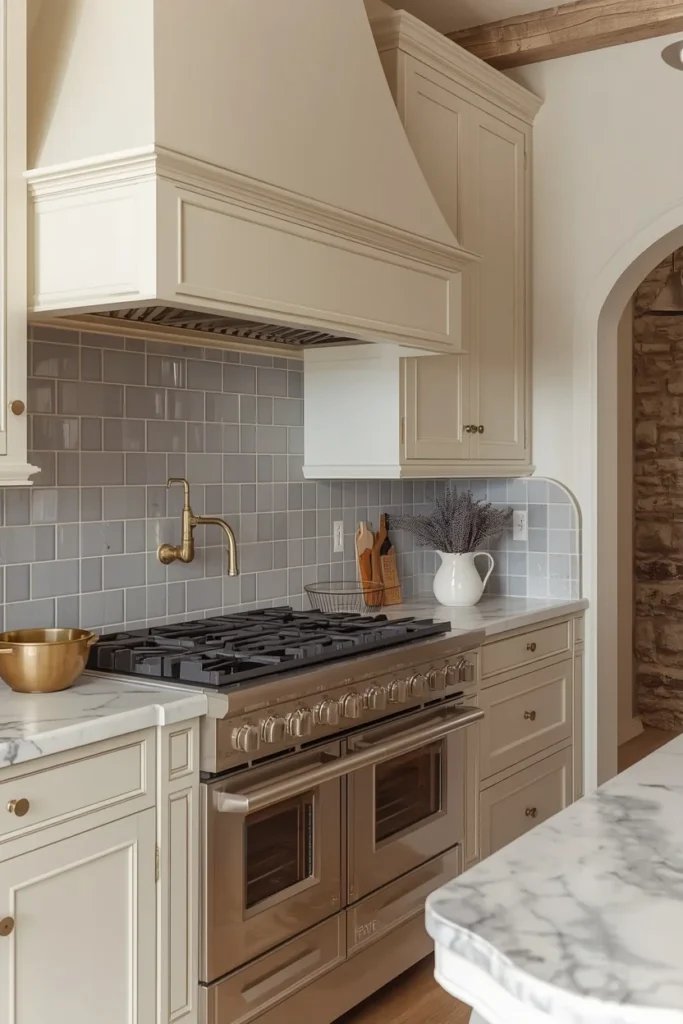
Idea 12 — Tin Ceiling Tiles as an Accent Backsplash
Pressed tin ceiling tiles used as a kitchen backsplash bring a distinctly American country and Victorian farmhouse quality that no other material replicates. They were common in turn-of-the-century American homes, repurposed originally from decorative ceiling applications into kitchen backsplash use — and the result has a wonderfully nostalgic, slightly industrial-farmhouse character.
Painted in cream, soft white, or even a muted sage green, pressed tin backsplash tiles create a beautifully patterned, textured surface with raised geometric or floral medallion motifs. The pattern repeats across the wall in a way that is both orderly and visually rich.
Designer Susan Rhodes recently described installing a tin backsplash embossed with a decorative medallion pattern in a French country kitchen — and noting that the client now considers it the most distinctive feature in the whole house.
Where to source: American Tin Ceilings, Shanko, and W.F. Norman Corporation all offer authentic pressed tin tiles in a wide range of patterns, including many heritage designs from the 19th century.
Installation: Pressed tin tiles can be nailed directly to a wood backer board or adhered with construction adhesive. They are one of the more DIY-accessible backsplash options.
Painted vs. unpainted: Painted in a semi-gloss white or cream, tin tile backsplash blends with the kitchen while adding texture. Left in a raw or antique-silver finish, it adds industrial farmhouse drama.
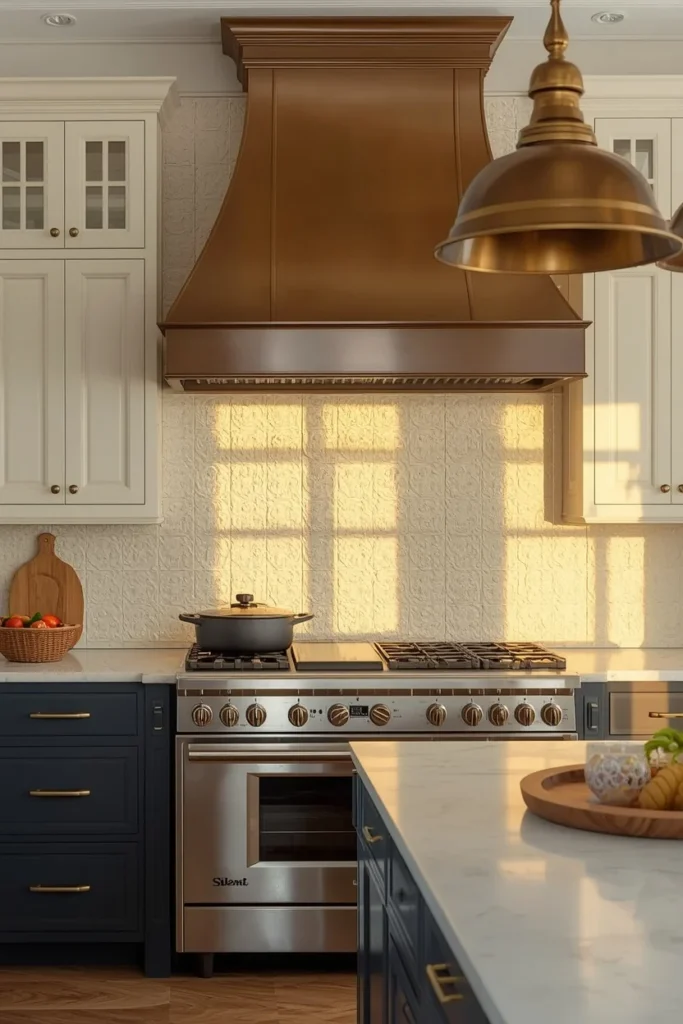
Idea 13 — Herringbone White Marble Subway Tile
Herringbone pattern white marble subway tile occupies the exact intersection where country style meets quiet luxury — and it is one of the most beautiful country kitchen backsplash options that exists at any price point.
The herringbone layout — each tile set at 45 degrees to the next, creating a continuous zigzag pattern — adds enormous visual movement and sophistication to a standard rectangular tile. In white marble, with its natural grey veining, each tile is subtly different from every other one, creating a surface with genuine depth and variation.
The country vs. contemporary balance: Standard horizontal running bond subway tile is more modern. Herringbone layout is more traditional and ornate — which is why it reads as country rather than contemporary. The imperfection of marble veining adds to this warmth.
Grout recommendation: Light warm grey or barely-there grey grout that disappears into the marble rather than competing with it. White grout works but makes the pattern look slightly more graphic and less flowing.
Budget-conscious alternative: Marble-look porcelain tile in herringbone layout costs significantly less than real marble and is more durable and stain-resistant. In herringbone layout, the difference between real marble and high-quality marble-look porcelain is nearly imperceptible.
Cabinet pairings: Cream, warm white, sage green, soft navy, or natural wood open shelving. The marble herringbone pattern is sophisticated enough to elevate any cabinet color.
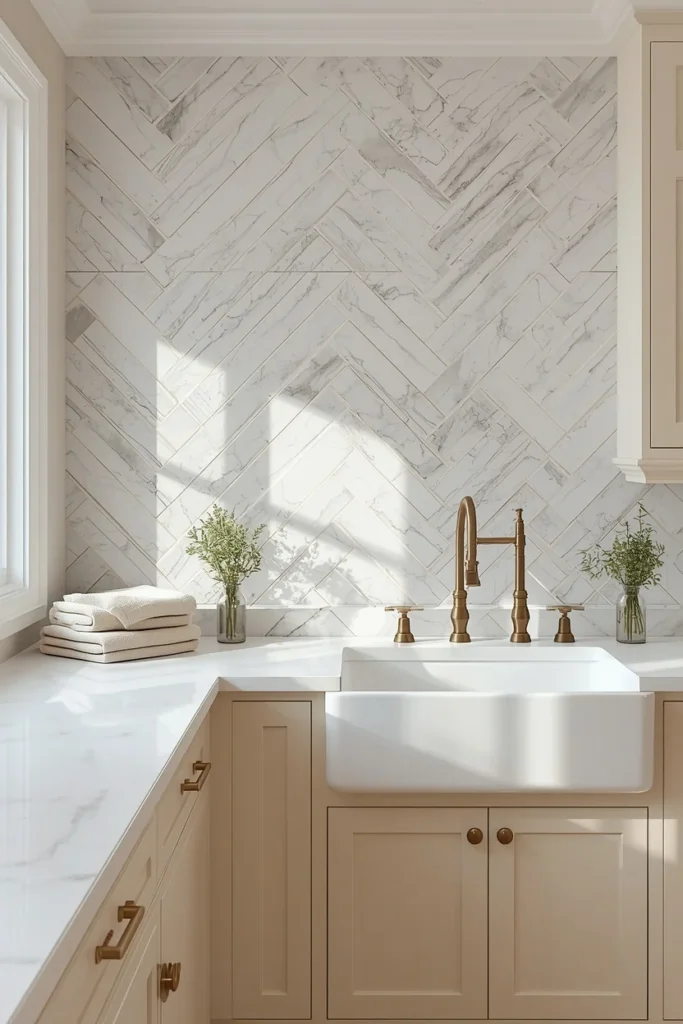
Idea 14 — Sage Green Zellige With Cream Cabinets Full Coverage
Full-coverage sage green zellige from countertop to ceiling is the most dramatic and beautiful country kitchen backsplash idea in this entire list. It is also the one that requires the most commitment — and rewards that commitment with a kitchen that looks genuinely extraordinary.
When zellige covers the entire wall surface — not just the standard backsplash zone but all the way up to the ceiling, wrapping around windows and between shelves — it creates what interior designers call a “jewel box” effect. The kitchen is enveloped in colour, texture, and reflected light. The walls stop being walls and become a feature.
Why this works in country kitchens specifically: The handmade imperfection of zellige — the slight variation in tile size, the uneven glaze, the organic colour movement — is the opposite of industrial or corporate. It is deeply human, deeply artisan, and deeply warm. These qualities are exactly what country kitchen design is built around.
Lighting note: Zellige reflects light. This means your kitchen lighting matters more when this backsplash is installed. Warm bulbs (2700K to 3000K) make the sage green glow amber-warm. Cool bulbs (4000K and above) make it read as cooler and greener. For a country kitchen, warm bulbs always.
Cost reality: Full-coverage zellige is a significant investment — $15 to $35 per square foot for tile alone, plus installation by an experienced tile setter. Budget $3,000 to $8,000 for a full kitchen wall in most homes.
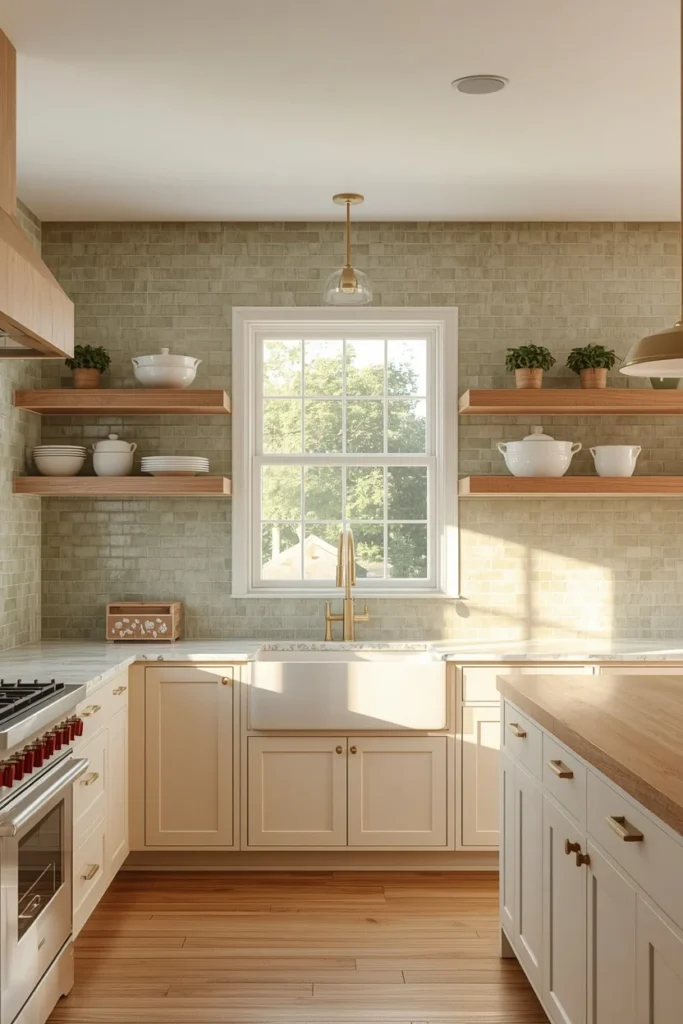
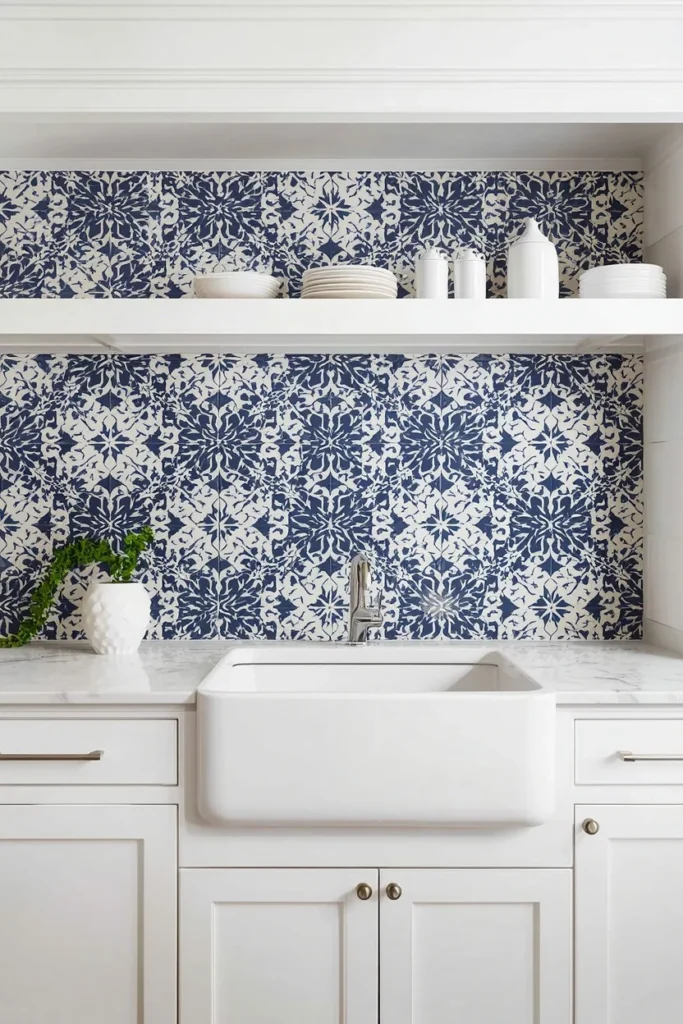
Idea 15 — Patterned Moroccan-Inspired Tile in Navy and White
Moroccan-inspired tile in navy and white brings a pattern confidence to country kitchens that most other backsplash options simply do not have. These tiles — whether genuine Moroccan zellige mosaics or reproduction encaustic patterned tiles — feature geometric interlocking patterns in deep navy blue against bright white that creates a backsplash with genuine visual presence.
The styling rule that makes this work: Because the tile is already doing everything visually, the rest of the kitchen must be stripped back to the simplest possible version of itself. Plain white upper cabinets. Plain cream or white countertops. Simple hardware in a single metal finish. No competing pattern anywhere else. The tile is the whole point.
Full backsplash vs. accent only: Both work. As a full backsplash, the pattern is maximalist and bold. As an accent behind the stove only, with simple subway tile elsewhere, it is jewel-box beautiful and slightly more manageable stylistically.
Color note: Navy and white is the most classic and most photogenic combination for Moroccan-inspired tile. But dusty blue and cream is softer and more country in feel. Terracotta and cream is warmer and more Mediterranean. All three work in country kitchens.
Idea 16 — Whitewashed Brick for Soft Cottage Warmth
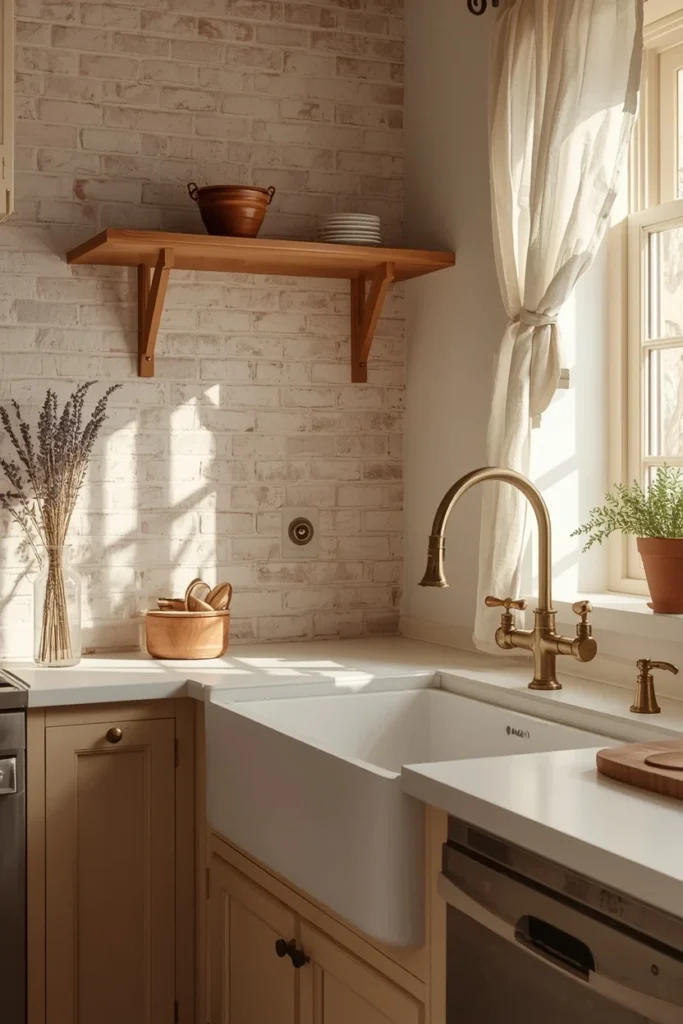
The difference between exposed brick (Idea 6) and whitewashed brick is the difference between a rustic farmhouse and a romantic French cottage. The whitewash treatment — thin diluted white paint worked into the brick surface and partially wiped away — softens the red-orange of the brick to a soft cream-pink-taupe that is deeply warm without being heavy.
Whitewashed brick backsplash creates a kitchen that feels genuinely old in the most beautiful sense — like a Normandy farmhouse kitchen, a Cotswolds cottage, or an old Charleston townhouse. The mortar lines remain visible but the whole surface reads as one soft unified tone rather than individual bricks.
DIY feasibility: Whitewashing brick backsplash is one of the more accessible DIY backsplash transformations. Mix one part white latex paint with one part water. Apply with a brush, working into the brick surface. Wipe back with a damp rag before it dries to achieve the desired level of opacity. Fully wiped back = barely there. Less wiping = more coverage.
Colour variations: Traditional white gives the warmest, most romantic result. Pale cream gives a slightly more refined result. Sage green diluted as a wash over brick gives a remarkably beautiful result that reads as simultaneously rustic and unexpected.
Idea 17 — Natural Slate in Charcoal and Bronze Tones
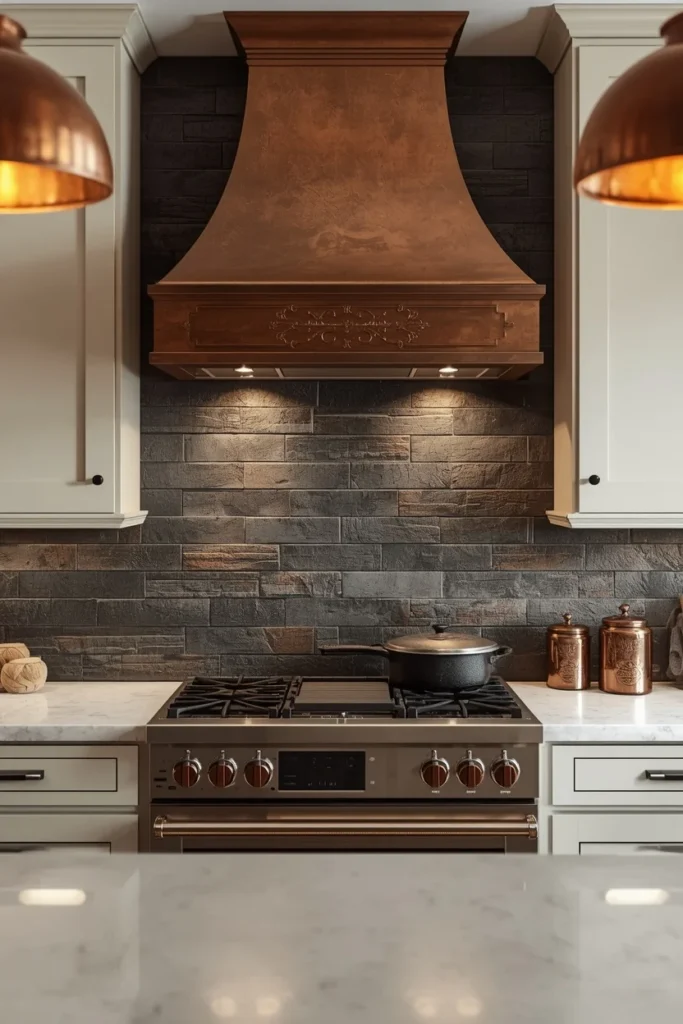
Natural slate is underused in country kitchen backsplashes — which is exactly why it is worth considering seriously.
Slate’s surface quality is unlike any other stone. The natural cleavage planes in the stone create a slightly layered, rippled surface that catches light differently than the flat face of most tile. In charcoal and bronze tones — the most common colours for kitchen-grade slate — the effect is moody, earthy, and deeply beautiful.
Behind a stove with a bold range hood, slate backsplash creates a completely distinctive country kitchen look. It reads as neither farmhouse nor cottage nor French country — it creates its own category of rugged, elemental country style that is deeply compelling.
Cabinet pairings: Cream, warm white, or natural wood. Slate’s dark tones need lightness elsewhere to keep the kitchen from feeling heavy.
Practical notes: Slate is relatively porous compared to porcelain and must be sealed. However, sealed slate is durable, heat-resistant, and very easy to maintain. It does not show grease splatter as readily as light-coloured backsplash materials.
Grout recommendation: Matching dark grey or charcoal grout so the individual pieces read as one continuous rocky surface rather than individual tiles.
Idea 18 — Stacked Stone for a Rustic Fireplace-Kitchen Moment
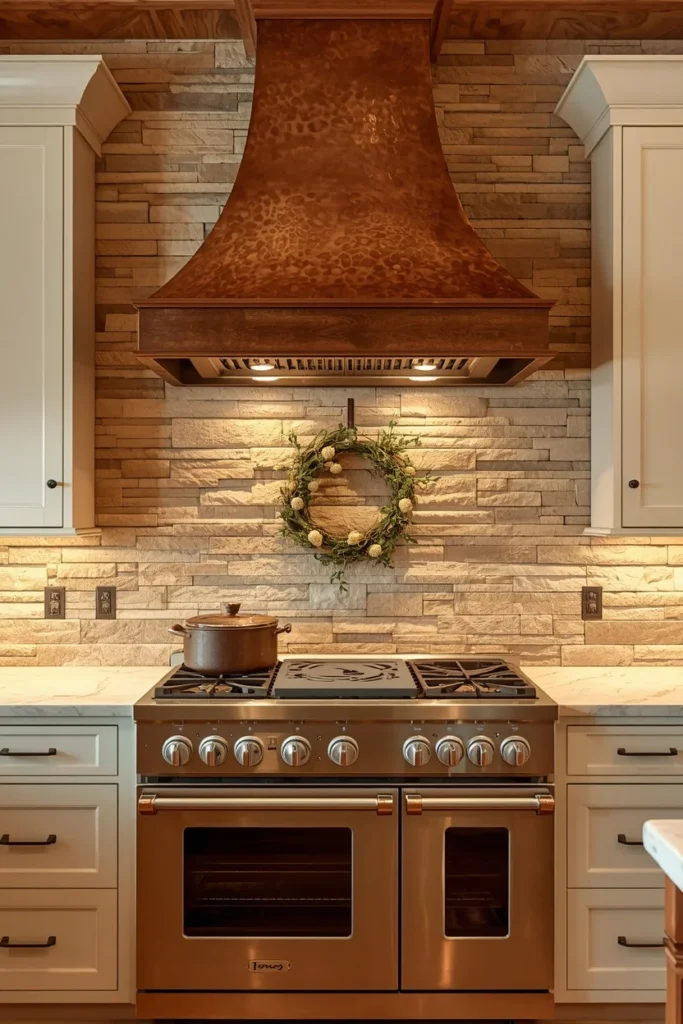
Stacked stone — thin natural or cultured stone panels installed in a rough horizontal layered pattern — brings a quality to a country kitchen backsplash that is more architectural than any tile can achieve.
In the zone directly behind and above a range, stacked stone creates something that reads less like a backsplash and more like a fireplace surround — the most primal and cozy association possible in a kitchen that wants to feel warm and sheltering.
Natural vs. cultured stone: Genuine stacked stone sourced from a quarry is heavier, more expensive, and requires a more robust wall structure to support it. Cultured stone — manufactured stone panels — are significantly lighter, easier to install, and visually convincing for most applications. For a backsplash specifically, cultured stone is the more practical choice.
Color palettes available: Warm cream and buff for Tuscany farmhouse feel. Grey and charcoal for more rugged mountain lodge feel. Warm brown and taupe for classic Americana country look.
Grout note: Stacked stone panels are typically installed without visible grout — the pieces interlock and the joints are tight or filled with matching stone dust. This creates the most authentic rough-stone appearance.
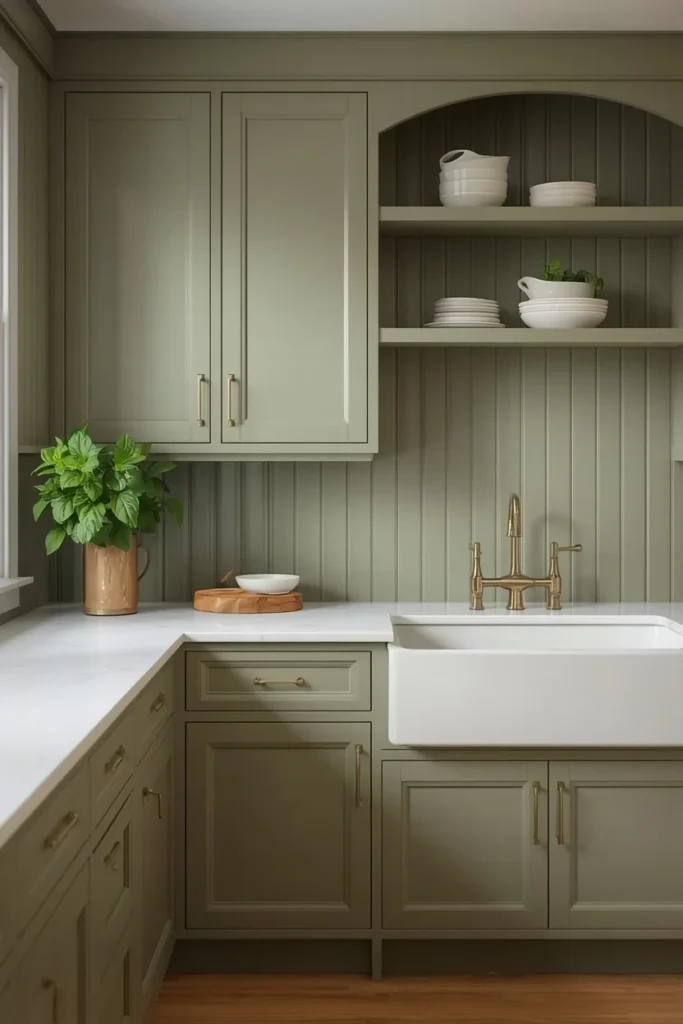
Idea 19 — Color-Drenched Beadboard Matching the Cabinets
One of the strongest backsplash trends emerging in 2025 and 2026 is the color-drenched approach — where the backsplash is painted in the exact same color as the surrounding cabinetry, creating a seamless enveloping effect that makes the whole kitchen feel deeply considered and cohesive.
In a country kitchen, this works beautifully when beadboard is used as the backsplash material. Beadboard painted in the exact same sage green, deep navy, or forest green as the cabinets creates a kitchen where the walls, the cabinets, and the backsplash are one continuous color field. The visual effect is both calming and sophisticated.
Why this works: The subtle texture difference between beadboard and cabinet doors — both painted the same color — creates visual interest through texture rather than color contrast. The result is a kitchen that feels designed at a whole-room level rather than element by element.
Best colors for this approach: Sage green (Benjamin Moore Saybrook Sage), Deep navy (Benjamin Moore Hale Navy), Forest green (Farrow & Ball Calke Green), Dusty teal (Sherwin-Williams Mountain Air), Warm cream (Benjamin Moore White Dove).
Hardware note: When the whole kitchen is one color, hardware becomes the jewelry. Choose one beautiful finish — aged brass, unlacquered brass, or oil-rubbed bronze — and use it consistently throughout.
Idea 20 — Hand-Thrown Artisan Tile in Earthy Cream and Warm White
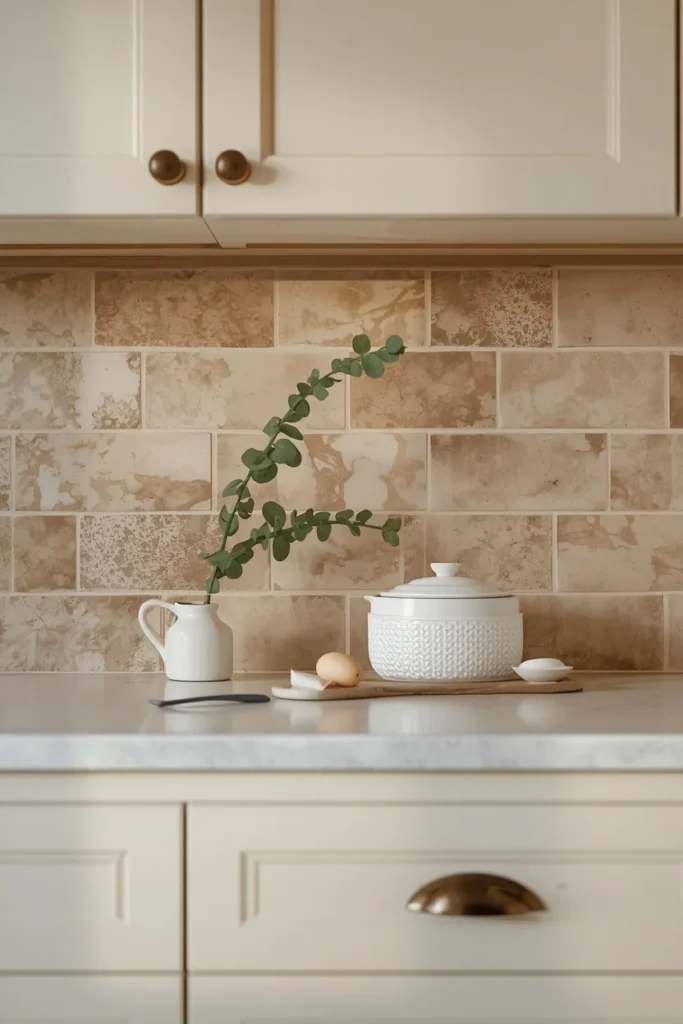
The final type of tile backsplash in this list is also the most quietly beautiful — hand-thrown artisan ceramic tile in earthy cream and warm white tones.
Unlike hand-painted tile (which derives its character from pattern) or zellige (which derives its character from light-catching irregularity), hand-thrown artisan tile derives its character from form. Each tile is slightly different in shape — a little thicker at one edge, a little more rounded at a corner, the glaze slightly thicker at the bottom where it pooled during firing. The variation is subtle. The beauty it creates is not.
In earthy cream and warm white glazes, a backsplash of hand-thrown artisan tiles creates what might be described as the most sophisticated humble surface possible. It does not announce itself. It rewards attention. And it makes every other element in the kitchen look more beautiful for being behind it.
Where to source: Etsy ceramic artists are among the best sources for small-batch hand-thrown tiles. Search for “handmade ceramic tile backsplash” and filter by makers with 50-plus sales and portfolio photos that show actual installed kitchens.
Cost note: Hand-thrown tiles are labor-intensive and priced accordingly — often $20 to $60 per tile. Consider using them only in the most visible zone — behind the stove or sink — and using a simpler tile elsewhere.
Idea 21 — Shiplap in Taupe for a Refined Country Kitchen
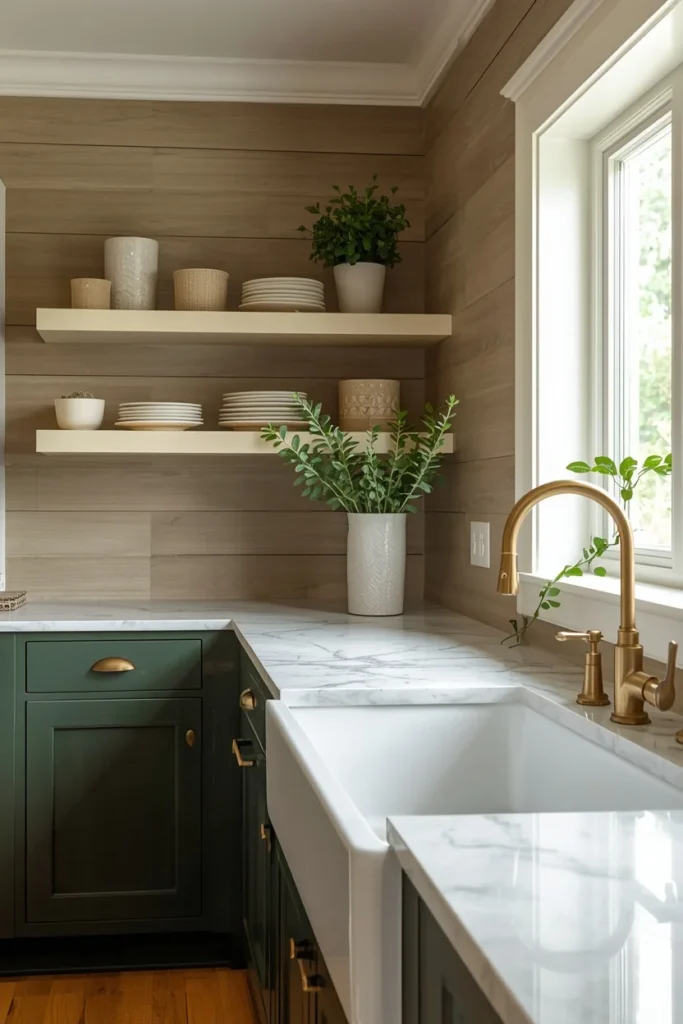
The final idea takes shiplap — already visited in cream — and shifts it to taupe for a result that is noticeably more refined, more formal, and more quietly luxurious than the standard cream farmhouse version.
Taupe shiplap sits between cream and grey in tone — warmer than grey, more sophisticated than cream, more flexible than either. It works with every cabinet color without effort. It hides small marks better than white or cream (a practical advantage in a working kitchen). And it reads as a deliberate design decision rather than a simple neutral.
In a country kitchen with green, navy, or dark cabinet colours, taupe shiplap backsplash creates a beautiful bridge between the richness of the cabinet color and the lightness of the ceiling — making the whole room feel taller and more cohesive.
Best taupe paint colours for shiplap backsplash:
- Benjamin Moore Pale Oak (warm taupe with gentle rose undertone)
- Sherwin-Williams Accessible Beige (most flexible taupe available)
- Farrow & Ball Elephant’s Breath (sophisticated grey-taupe with great depth)
- Benjamin Moore Revere Pewter (the classic American warm grey-taupe)
Hardware note: Taupe shiplap pairs beautifully with every hardware finish. Aged brass adds warmth. Matte black adds contrast and edge. Brushed nickel keeps it clean and refined.
How to Choose the Right Backsplash for Your Country Kitchen?
With 21 options in front of you, the natural question is: which one is right for your specific kitchen?
Work through these four questions before making any decision:
1. What is your cabinet colour? Light cream or white cabinets give you the most freedom — they pair with every backsplash option in this list. Coloured cabinets need a quieter backsplash (shiplap, limestone, herringbone marble) unless you are comfortable with a bold all-in approach like color-matched beadboard or the zellige-cream combination.
2. How much natural light does your kitchen have? Dark kitchens need light-reflecting backsplashes — zellige, glossy glazed ceramic, or white subway tile with dark grout. Dark materials like slate or stacked stone are beautiful in well-lit kitchens but can feel heavy in low-light spaces.
3. What is your maintenance comfort level? If you cook daily and heavily, you need materials that clean easily — glazed ceramic tile, sealed porcelain, and shiplap in semi-gloss paint. If you cook occasionally or mostly light meals, you have more freedom to use higher-maintenance materials like natural stone, terracotta, and reclaimed wood.
4. What is your actual budget? Be honest about this before falling in love with zellige or handmade artisan tile. The budget options — shiplap, beadboard, basic subway tile — are genuinely beautiful and have been used in country kitchens for generations. There is no shame in the budget choice. There is only shame in the backsplash you cannot afford and therefore never install.
Styling Tips to Make Your Backsplash Pop
Keep countertops clear in front of a statement backsplash. A zellige or patterned tile backsplash is a visual feature. A counter crowded with appliances, cutting boards, and miscellaneous objects blocks the view. Clear the counter and let the backsplash breathe.
Match your grout to your countertop tone, not your tile. This creates a subtle connection between the two surfaces that makes the kitchen feel designed rather than assembled.
Use lighting to activate texture. Zellige, slate, stone, and brick all change completely under different light. Install under-cabinet lighting to graze the backsplash surface with warm light — this reveals the texture in a way overhead lighting never does.
Add one living element in front of the backsplash. A small potted herb on the windowsill, a single stem in a ceramic vase, a trailing plant on the shelf above — one plant in front of any backsplash makes the whole surface look more beautiful and more intentional.
Choose hardware that bridges the backsplash and the cabinets. Unlacquered brass works with every warm-toned country backsplash. Matte black works with darker, more dramatic options. Chrome and brushed nickel work best with lighter, more refined options.
Common Mistakes to Avoid
Mistake 1 — Choosing a backsplash tile before deciding on cabinet colour. The cabinet colour is the largest visual element in the kitchen. The backsplash responds to the cabinets, not the other way around. Always finalise your cabinet colour first.
Mistake 2 — Ignoring grout colour until the last minute. Grout is not an afterthought. In a country kitchen backsplash, grout colour changes the entire character of the installation. Choose it at the same time as the tile.
Mistake 3 — Not sealing porous materials. Terracotta, limestone, slate, encaustic cement tile, reclaimed wood, and natural brick all require sealing before use in a kitchen. Unsealed porous materials absorb oil, water, and food stains within weeks. Sealing is not optional.
Mistake 4 — Choosing the same tile as a neighbour or a magazine and ignoring your own kitchen’s scale. A tile that looks magnificent in a large kitchen with 10-foot ceilings can look fussy and overwhelming in a small kitchen with 8-foot ceilings. Always consider the scale of your specific space.
Mistake 5 — Skipping a sample installation. Order samples of your final two or three tile options and tape or stick them to your actual kitchen wall in the actual space. Live with them for a week — in morning light, evening light, artificial light, overcast light. The tile you love online may look wrong in your actual kitchen. Find out before ordering 200 square feet.
Mistake 6 — Underestimating installation complexity. Zellige, encaustic tile, natural stone, and hand-thrown artisan tile all require an experienced tile installer. Attempting these as a DIY project without significant tiling experience frequently results in an uneven installation that looks worse than what it replaced.
Budget-Friendly Alternatives
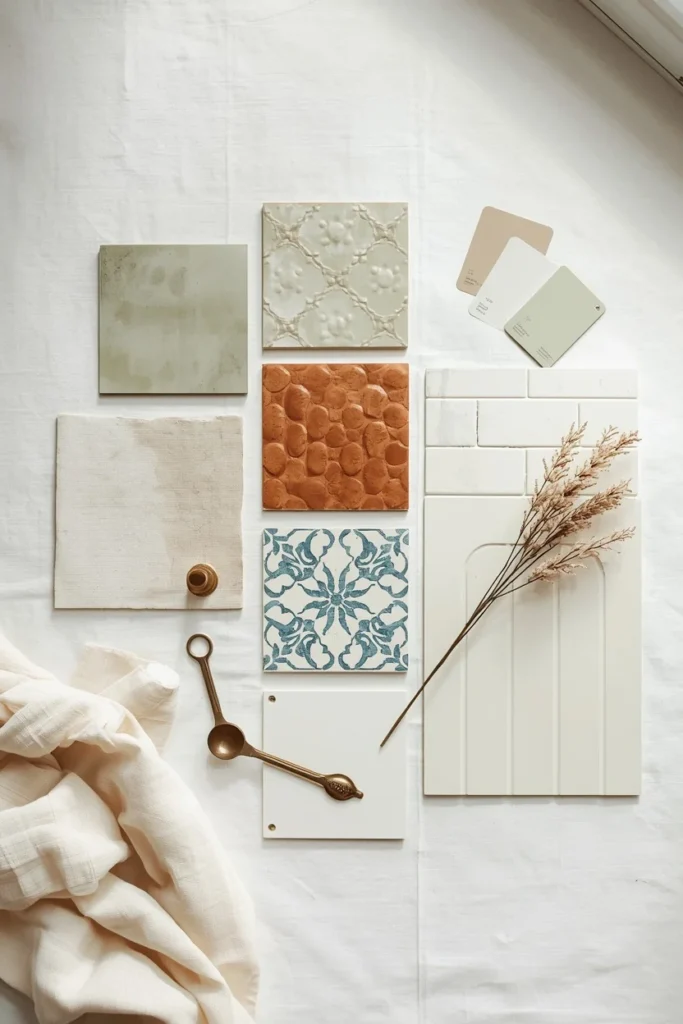
Under $200 total: Beadboard panel sheets from a hardware store, painted in any country colour. Full backsplash installation possible in a single weekend by a confident DIYer.
$200 to $600: Basic white subway tile from a home improvement store in standard 3×6 format with charcoal grout. Classic, durable, and genuinely beautiful. Has outlasted every backsplash trend since 1905.
$600 to $1,500: Reproduction encaustic tile from Cement Tile Shop or Granada Tile in a patterned style. Or natural slate tile in a smaller format. Or terracotta penny rounds properly sealed.
$1,500 to $4,000: Entry-level zellige tile from domestic suppliers. Handmade ceramic tile in an artisan glaze. Natural limestone in a simple format.
$4,000 and above: Full-coverage premium zellige. Authentic encaustic cement tile from specialty artisan suppliers. Hand-thrown artisan tile across the full backsplash.
Small Kitchen Backsplash Solutions
Small country kitchens need backsplashes that add character without adding visual weight.
Light-reflecting choices win: Zellige, glazed ceramic, and white subway tile all reflect light back into a small space. Dark materials like slate and stacked stone can work in small kitchens but require excellent lighting.
Vertical tile layouts make kitchens taller: Standard subway tile laid in a vertical stacked bond rather than horizontal running bond orientation draws the eye upward and makes a small kitchen feel noticeably taller.
One material across the whole backsplash creates calm: In a small kitchen, mixing backsplash materials or using a busy pattern creates visual noise that makes the space feel smaller. One tile, one material, one grout colour, wall to wall.
Take the backsplash to the ceiling: In a small kitchen, a backsplash that runs from countertop to ceiling rather than stopping at the standard 18-inch height makes the kitchen feel larger by treating the whole wall as a cohesive designed surface.
Pro Designer Recommendations
Interior designers working in country and farmhouse kitchen design consistently make these specific recommendations:
Invest in the best installation you can afford, not the most expensive tile. A beautifully installed basic subway tile looks significantly better than a poorly installed premium zellige. The installer’s skill matters more than the tile’s price point.
Do not match your backsplash to your countertops. Matching creates flatness and makes both surfaces disappear. A small amount of contrast — warm countertop against cool tile, light countertop against textured shiplap — makes both surfaces more beautiful.
Install the range hood before the backsplash tile. Tile around a range hood that was installed afterward always looks slightly off. The hood should be in place so the tile can be cut to meet it cleanly.
Use a pot filler if your budget allows. A wall-mounted pot filler above the range is not only genuinely useful — it gives the backsplash another visual element that frames the most important zone in the kitchen beautifully.
Give your backsplash good light. Under-cabinet lighting transforms any backsplash from a background element to the most beautiful surface in the room. Budget for it from the beginning, not as an afterthought.
FAQs
Conclusion
Your kitchen backsplash is the smallest wall in the room with the biggest personality.
In a country kitchen — where warmth, character, authenticity, and a sense of history matter more than sleekness or trends — the backsplash is not decoration. It is the soul of the room.
The 21 ideas in this article cover every style, every budget, and every material that works in a country kitchen, from the simplest painted beadboard to the most extraordinary full-coverage zellige. What they share is an honesty about materials — a commitment to surfaces that are genuinely beautiful rather than just convenient, and that will look even better in ten years than they do today.
Pick the one that fits your kitchen. Test a sample in your actual space. Find an installer you trust. And then commit to it fully.
A country kitchen with the right backsplash does not just look beautiful. It feels like home the moment you walk in. And that — above every trend, every material recommendation, every designer tip in this article — is the point.