17 Farmhouse Kitchen Ideas That Feel Like a Warm Hug Every Morning
There’s a specific kind of kitchen that makes you want to wake up earlier.
Not to be productive. Not to check your phone. Just to be in it — hands wrapped around a mug, morning light coming through the window, the smell of coffee mixing with whatever you baked the night before. Maybe a playlist of something slow and familiar. Maybe just quiet.
That kitchen has a feeling. And that feeling has a name.
Farmhouse kitchen ideas have been at the top of Pinterest searches for years — and in 2025, they’re not just back. They’re evolving. The searches for “dark rustic kitchen” jumped 290% among younger decorators in early 2025 alone. “Farmhouse kitchen brick backsplash” searches went up by 704%. The new generation isn’t looking for the clean, curated, all-white farmhouse of a decade ago. They want warmth that feels genuine. Character that feels earned. Kitchens that look like they’ve been cooked in and loved.
That’s exactly what these 17 farmhouse kitchen ideas deliver.
Some are moody and dramatic — dark cabinet finishes, exposed brick, raw wood islands, and lantern pendants that cast amber at night. Some are soft and sunlit — sage green shakers, butcher block, brass, and bunches of dried herbs on a peg rail. Some are small and clever. Some are full renovations. All of them have that one thing that no amount of money can manufacture but the right design choices always create: the feeling of warmth that meets you the second you walk in.
Table of Contents
- The Classic White Farmhouse Kitchen — Timeless Done Right
- Sage Green Cabinets with Butcher Block and Brass
- Dark Rustic Farmhouse Kitchen — Black Cabinets and Exposed Brick
- The Apron Sink Kitchen — Making One Element the Star
- Open Shelving Farmhouse Kitchen — Beautiful and Actually Functional
- Exposed Wood Beam Farmhouse Kitchen
- Moody Forest Green Farmhouse Kitchen with Warm Wood Island
- The Brick Backsplash Farmhouse Kitchen
- Butter Yellow Farmhouse Kitchen — Sunny, Sweet, and Utterly Charming
- Navy Blue Farmhouse Kitchen with Unlacquered Brass Hardware
- The Butcher Block Island Farmhouse Kitchen
- Shiplap Wall Farmhouse Kitchen — Texture That Changes Everything
- Cottagecore Farmhouse Kitchen — Wildflowers, Pottery, and Pure Warmth
- Two-Tone Cabinet Farmhouse Kitchen — Lower Dark, Upper Light
- Small Farmhouse Kitchen Ideas — Big Character in Limited Space
- Modern Farmhouse Kitchen — Clean Lines with Rustic Soul
- Budget Farmhouse Kitchen Makeover — The Biggest Impact Per Dollar
What Makes a Kitchen Truly “Farmhouse”?
Before diving into the ideas, it helps to understand what makes a kitchen feel farmhouse — because it’s not just a checklist of materials.
A farmhouse kitchen feels lived-in rather than staged. It has warmth built into the materials themselves — natural wood, aged metals, handmade ceramics, stone that shows its history. It prioritizes comfort and gathering over perfection. It has texture that catches the light differently in the morning than it does at night.
The core elements that create this feeling:
Materials: Raw wood (butcher block, reclaimed planks, open shelves), natural stone or brick, painted cabinetry with visible brushstroke or shaker detail, aged metals in brass, bronze, copper, or unlacquered finishes
Color approach: Creamy whites, warm greiges, sage greens, dusty navies, butter yellows, deep forest green, charcoal black — never cold grays, never sterile
Signature pieces: The apron-front farmhouse sink, open wood shelving, exposed ceiling beams, shiplap or beadboard, patterned or brick backsplash, vintage-style pendant lighting
The feeling it creates: Slow mornings. Long dinners. The sense that something good just came out of the oven. A kitchen that invites people to stay.
The Ideas
Idea 1: The Classic White Farmhouse Kitchen — Timeless Done Right
The white farmhouse kitchen has a reputation for being predictable — and in the wrong hands, it can be. But done with intention, it’s one of the most beautiful kitchen styles that exists.
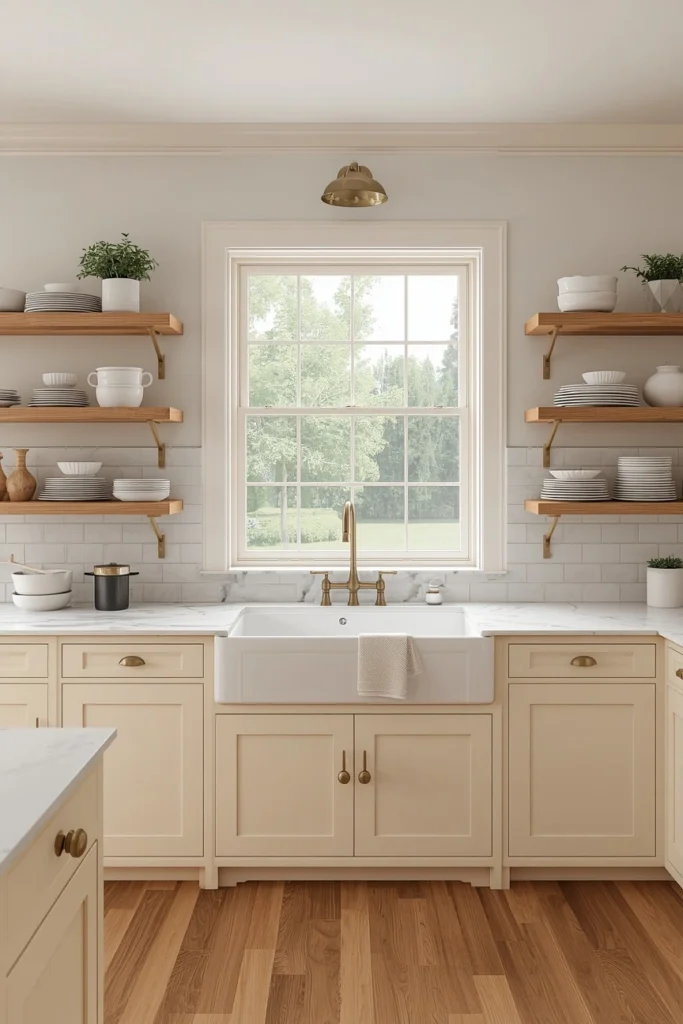
The key is not to go stark white. Stark white reads clinical. You want warm white — the kind that has just enough cream or golden undertone to look like it was painted with afternoon light in mind. Sherwin-Williams Alabaster, Benjamin Moore Simply White, or Farrow & Ball All White all land in this zone.
Layer textures heavily to keep it from going flat. White cabinets with visible shaker panel detail. A marble or white quartz countertop with soft gray veining. Open wooden shelves in natural oak above the counter. A creamy subway tile backsplash in a handmade, slightly irregular style rather than perfect machine-made. Unlacquered brass hardware that will age and develop patina.
The apron sink in white ceramic is the anchor. The worn wooden floor is the warmth underneath everything.
The single most important white farmhouse kitchen decision: Don’t use the same shade of white on the walls and the cabinets. The wall should be warmer or slightly deeper. The contrast gives the cabinets definition and the room visual depth.
Idea 2: Sage Green Cabinets with Butcher Block and Brass
This combination has been called the farmhouse kitchen pairing of the decade — and nothing about 2025 is challenging that title.
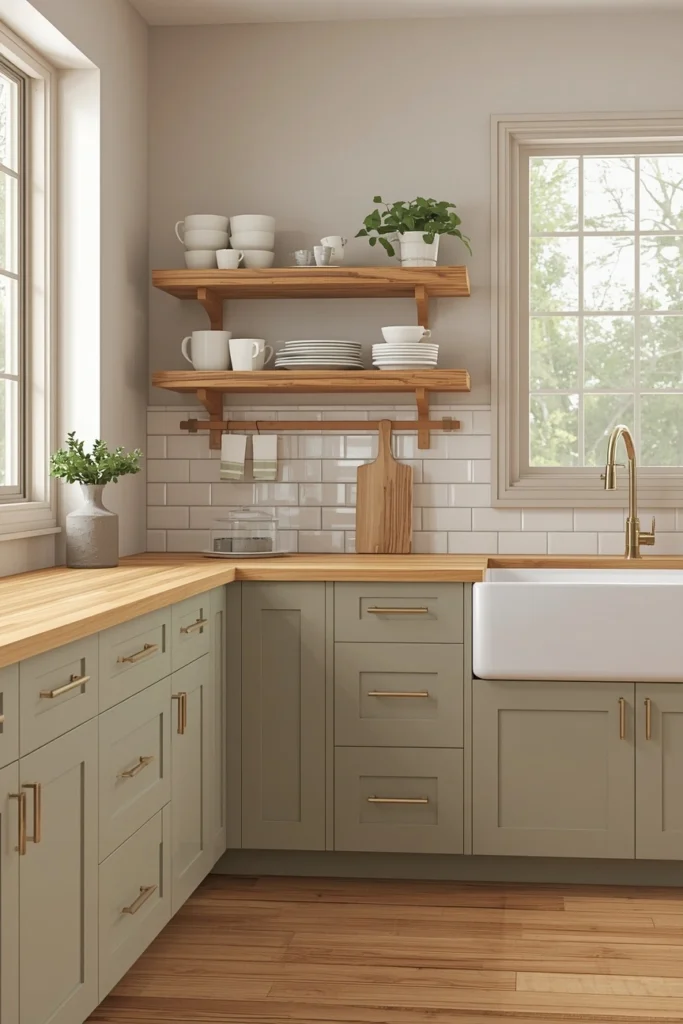
Sage green cabinets have a specific quality that very few colors share: they read warm in natural light but cool in artificial light, which means they never feel monotonous. They shift with the time of day. Morning light makes them feel fresh and garden-like. Evening lamplight makes them feel rich and herbaceous.
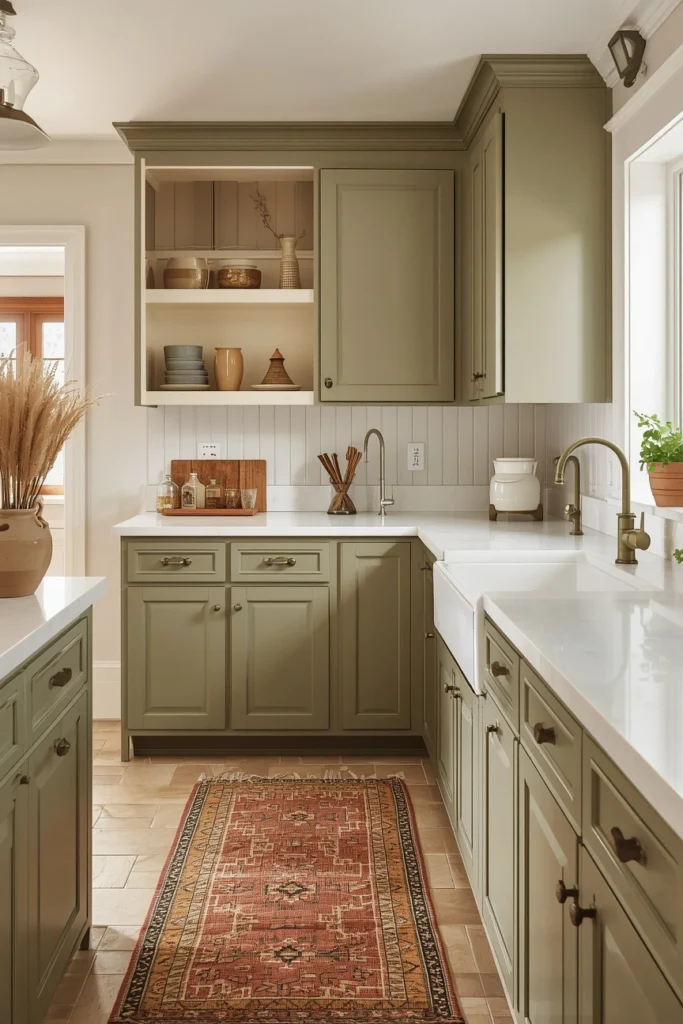
Pair sage green with butcher block countertops — not the light blonde IKEA version, but a proper warm honey or amber-toned block that shows grain and character. Add brushed brass hardware. A white ceramic apron sink. Cotton dish towels in faded stripes of cream and sage hanging from a wooden peg rail mounted on the backsplash wall.
This kitchen doesn’t shout. It whispers — and every person who walks into it immediately feels comfortable.
Best sage green cabinet colors for kitchens:
- Sherwin-Williams Evergreen Fog (the one everyone references — for good reason)
- Benjamin Moore Saybrook Sage (warmer, more olive-toned)
- Farrow & Ball Mizzle (lush, complex, changes dramatically with light)
- Clare Paint Sprig (bright enough to stay fresh without reading mint)
Countertop pairing note: Butcher block requires oiling every 1–3 months and should be kept dry around the sink area. For lower maintenance, a honed Calacatta marble or warm cream quartz gives a similar aesthetic with less upkeep.
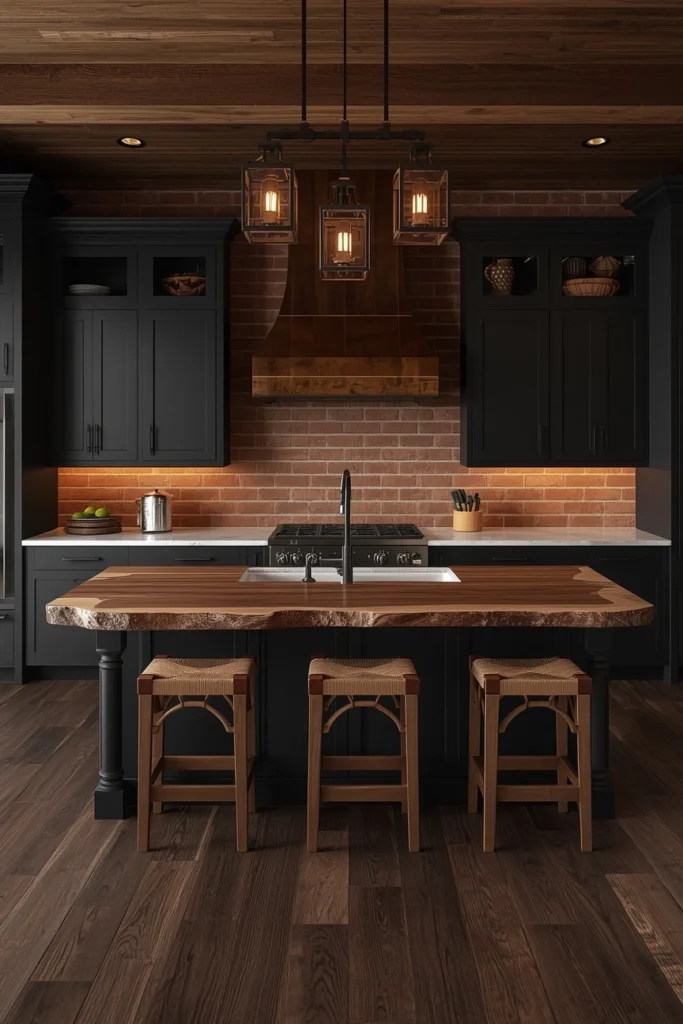
Idea 3: Dark Rustic Farmhouse Kitchen — Black Cabinets and Exposed Brick
This is the farmhouse kitchen idea that’s exploding on Pinterest in 2025 — and it looks absolutely nothing like what people expect when they think of farmhouse style.
Black matte cabinets. An exposed brick wall behind the range. A raw-edge wood island with bar stools in woven leather. A hammered copper or aged brass range hood that becomes the room’s focal point. Lantern-style pendant lights hanging at different heights over the island.
It’s moody. It’s dramatic. It’s the opposite of the crisp white farmhouse kitchen — and it’s completely irresistible.
The brick is the element that keeps the darkness from going cold. Warm clay-toned bricks behind the range or as a full backsplash introduce earth and texture that softens the black cabinetry and makes the whole kitchen feel like a mountain retreat or an old European farmhouse — somewhere that has always existed, somewhere that immediately feels like home.
The white marble countertop rule in dark farmhouse kitchens: In a kitchen with very dark cabinetry, a white or near-white marble countertop does the essential work of keeping the space from feeling oppressive. The contrast is not just beautiful — it’s structurally important.
Hardware for dark farmhouse kitchens: Aged brass or unlacquered brass reads warmest against black cabinetry. Matte gold is a sharper, more modern option. Avoid chrome and brushed nickel — they read cold in a kitchen that’s specifically trying to feel warm.
Idea 4: The Apron Sink Kitchen — Making One Element the Star
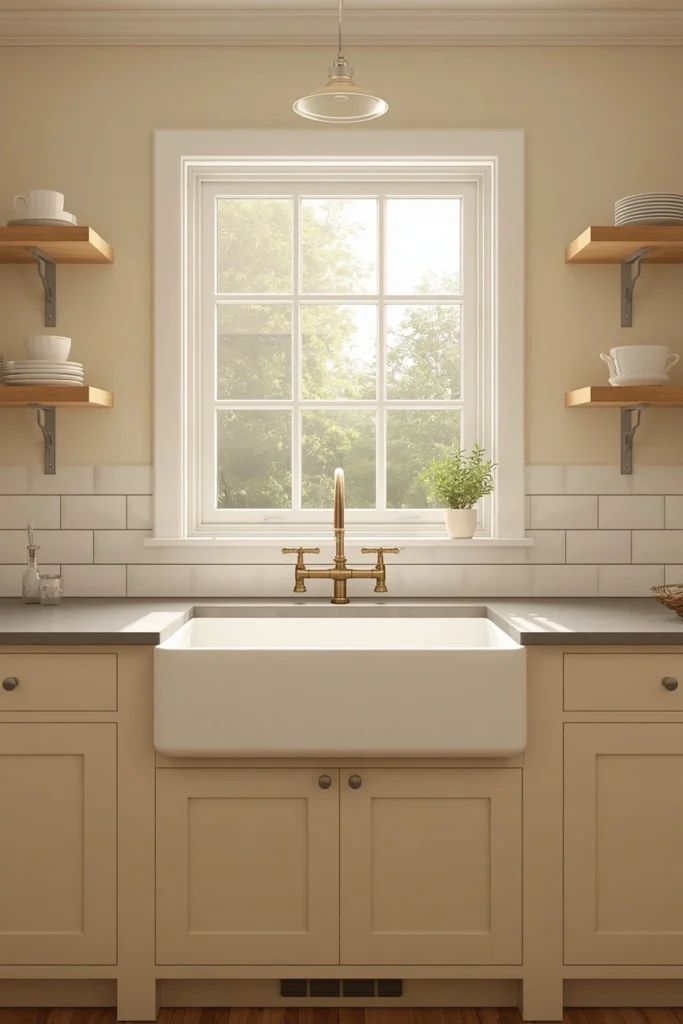
Every great farmhouse kitchen has a focal point — and nothing anchors the space quite like an apron-front farmhouse sink.
The apron sink (also called a fireclay sink or Belfast sink) is the oldest kitchen element still in continuous use — and it’s still the most distinctive. Its exposed front face, deep basin, and slightly rounded corners give it a quality that undermount and top-mount sinks simply don’t have: presence.
In a smaller kitchen especially, building the entire design around a beautiful apron sink is the right move. Position it below a window if possible — the combination of a deep ceramic sink and an outdoor view while doing dishes is a comfort that’s genuinely hard to replicate any other way.
Apron sink material guide:
- Fireclay: The most durable, the most beautiful. Chip-resistant, stain-resistant, and the sound is completely different from stainless — quieter and more solid. Higher price point ($500–$1,500+) but built to last decades.
- Cast iron with enamel: Very durable, very heavy (requires reinforced cabinetry). Chips are visible when they occur. Beautiful vintage quality.
- Stainless steel: Most affordable, highly durable, quieter with sound-deadening coating, slightly more modern look.
- Copper: Extremely distinctive. Self-sterilizing surface. Develops beautiful patina. Very specific aesthetic — works best in rustic or global-inspired farmhouse kitchens.
Faucet pairings: A bridge faucet in unlacquered brass is the most classically farmhouse choice. A gooseneck single-hole faucet in bronze reads slightly more rustic. A cross-handle bridge style is the most European farmhouse of all.
Idea 5: Open Shelving Farmhouse Kitchen — Beautiful and Actually Functional
Open shelving gets a bad reputation — and usually from people who haven’t committed to making it work.
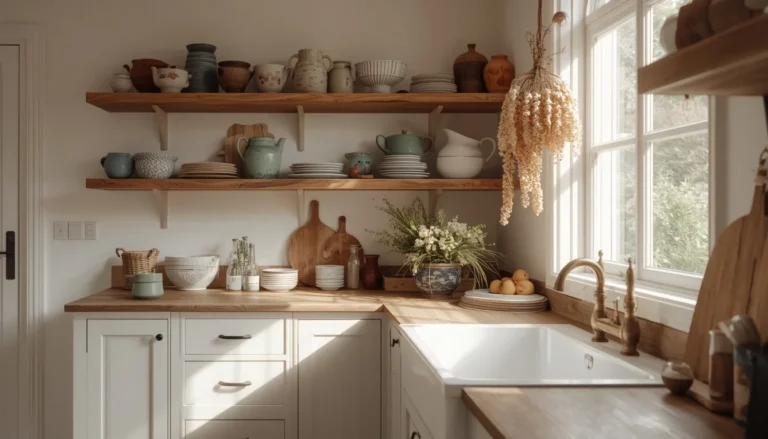
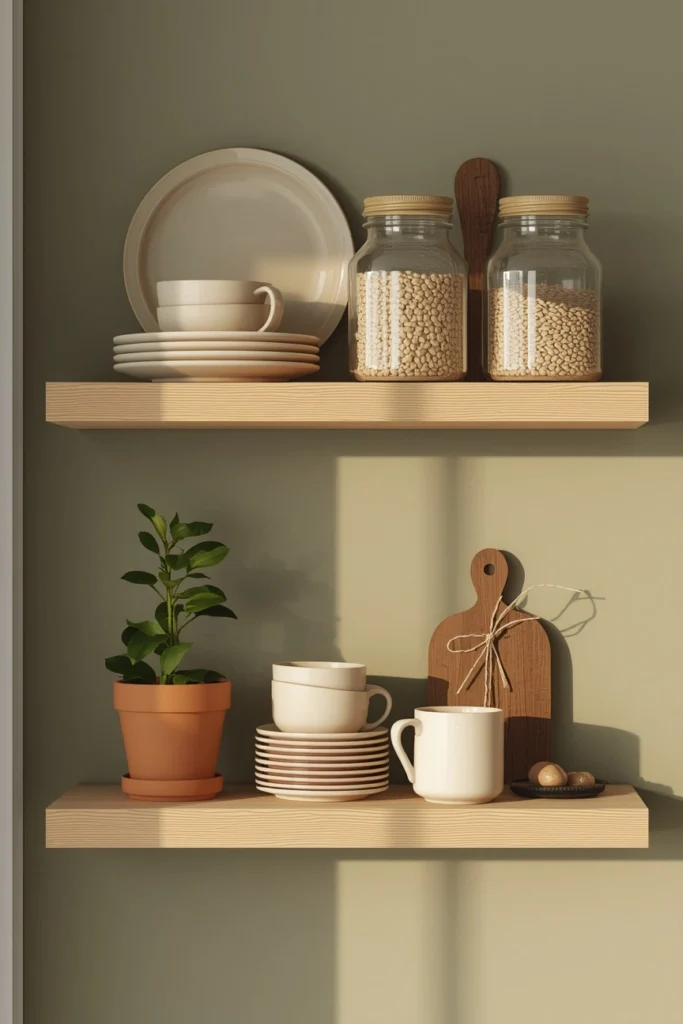
When it works, it’s one of the most genuinely beautiful things in a kitchen. The combination of natural wood shelves against a painted wall, holding a curated mix of everyday dishes, handmade pottery, glass jars, and living plants creates a layered, personal quality that no amount of closed cabinetry can replicate.
The secret: you don’t have to open-shelf everything. Replacing just the upper cabinets on one wall — the wall you see first when you enter the kitchen — with open shelving is enough to transform the room’s personality. Keep closed cabinetry below for the genuinely messy items.
How to style open farmhouse shelves so they look designed, not chaotic:
- Use a consistent color story in your dishes (all white, all cream, or a single accent color throughout)
- Stack plates at the back, position mugs and glasses mid-shelf, keep frequently-used items at the front
- Add at least one living element per shelf — a small herb pot, a trailing plant, a stem of something seasonal
- Group items in odd numbers — three stacked bowls, five mugs in a row, one large vase
- Leave some breathing room — a stuffed shelf reads cluttered; a shelf with a single empty section reads curated
Shelf depth and material: 10–12 inches is the sweet spot for kitchen open shelving — enough depth for most plates and bowls without protruding so far it interrupts the counter workflow. Solid wood (oak, walnut, or maple) in a natural or lightly-oiled finish holds up to kitchen humidity better than MDF and looks genuinely good over time.
Idea 6: Exposed Wood Beam Farmhouse Kitchen
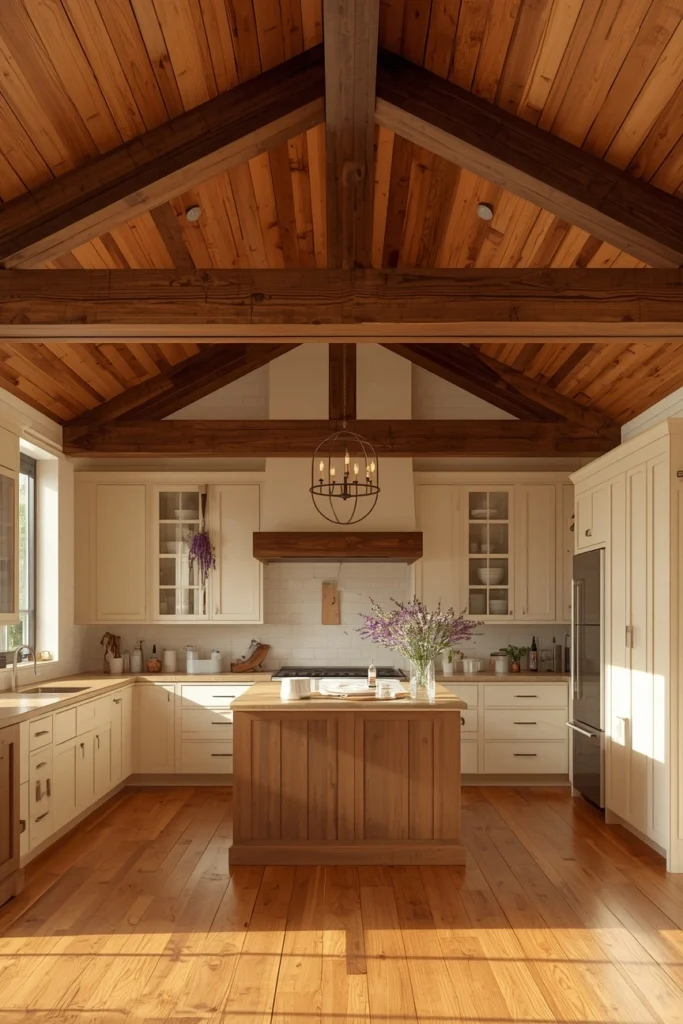
Exposed ceiling beams are one of those architectural details that don’t just add character to a kitchen — they change the room’s fundamental personality.
Original reclaimed beams have a quality that nothing else matches: the grain shows the age of the wood, the color has developed over decades, the marks and notches in the surface tell a history. If your home has original beams hiding behind a drywall ceiling, revealing them is one of the highest-ROI farmhouse kitchen moves imaginable.
If the beams are not original, adding faux wood beams — hollow structures made from reclaimed wood planks or high-quality polyurethane that has been stained and distressed — is a legitimate solution. Done well, from standing height, they’re indistinguishable from structural beams.
Styling rule for beam kitchens: The beams should be the room’s strongest visual element. Don’t compete with them using equally dramatic wall treatments or cabinetry. Let the beams carry the drama; keep everything else warm and quiet beneath them.
Color to paint a ceiling with exposed beams: The ceiling should be as light as possible — warm white or very pale cream. This makes the beams stand out dramatically against a light field, which is far more beautiful than dark beams against a darker ceiling.
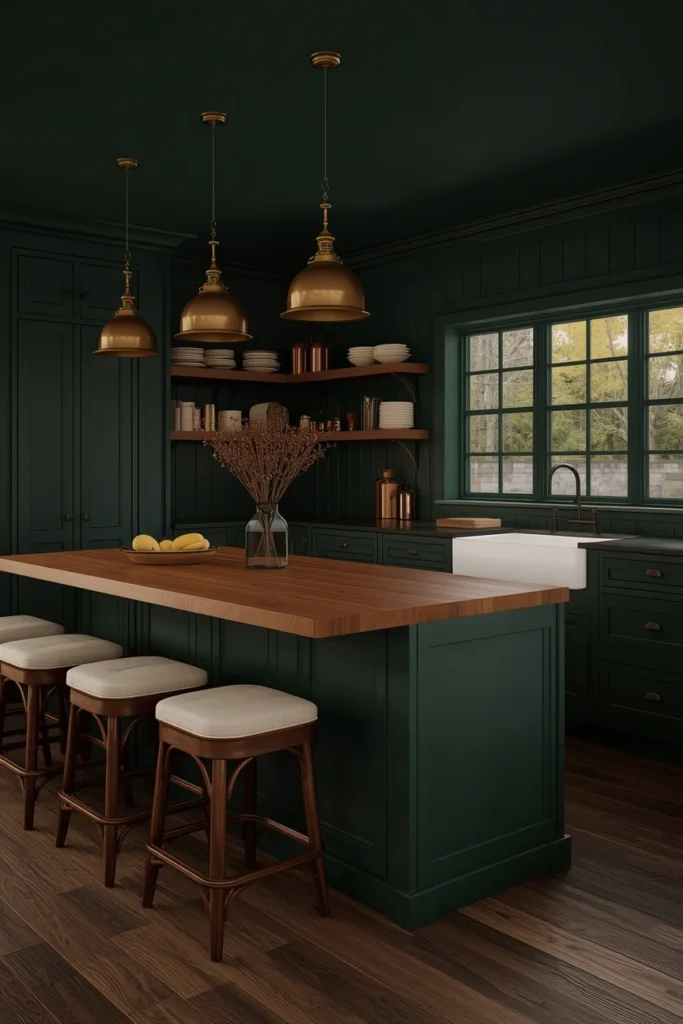
Idea 7: Moody Forest Green Farmhouse Kitchen with Warm Wood Island
Forest green farmhouse kitchens have a specific quality that sage green and navy both lack: they feel ancient. Not in a dated way — in the way that a centuries-old library or a beloved garden feels old. Rooted. Trustworthy.
Deep forest green cabinetry — matte finish, shaker style — paired with a warm walnut or butcher block island creates one of the most visually satisfying kitchen combinations currently on Pinterest. The green reads dark in shade and almost jewel-toned in direct light. The warm wood island balances it with natural warmth.
Add unlacquered brass hardware. A cream or off-white apron sink. A pendant light in aged brass or blackened steel above the island. And if you can — one large window above the sink that brings actual greenery in to echo the cabinet color.
Farrow & Ball Calke Green is the reference color here — rich, deep, slightly blue-toned green that photographs beautifully in every light condition. Sherwin-Williams Shade-Grown and Benjamin Moore Tarrytown Green are strong alternatives at a lower price point.
Idea 8: The Brick Backsplash Farmhouse Kitchen
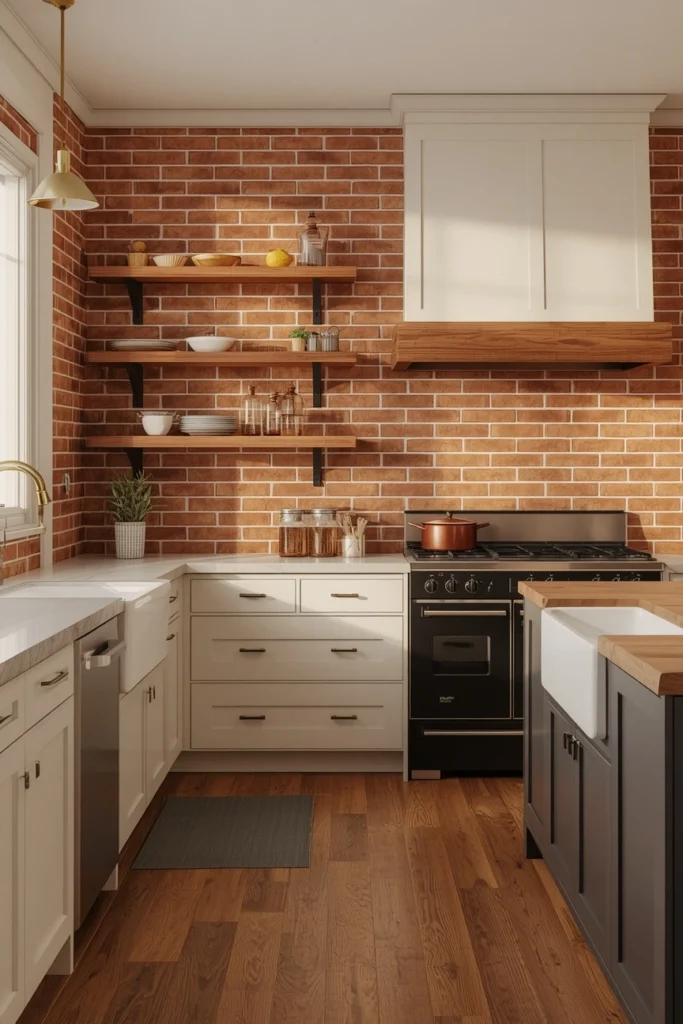
Nothing ages a kitchen better than brick. And nothing makes a farmhouse kitchen feel more immediately authentic.
The brick backsplash — whether original exposed brick uncovered during renovation, a new thin-brick installation, or high-quality faux brick panels — introduces a texture and warmth that tile simply cannot replicate. Each brick is slightly different in color and surface. The mortar lines create shadow and depth. The whole thing catches light differently in the morning than at noon than at night.
Brick backsplash searches on Pinterest were up 704% in early 2025. This is not a trend — this is a correction back toward material authenticity after years of perfectly smooth, perfectly white kitchen surfaces.
Brick backsplash color guide:
- Classic red-orange brick: Most rustic and dramatic. Beautiful against white or cream cabinetry.
- White-washed brick: Lighter and softer. Works in kitchens where brick texture is wanted without the full color intensity.
- Gray or charcoal brick: More modern farmhouse. Pairs beautifully with dark cabinetry.
- Pale buff or sand brick: Quieter and very European in feel. Works with sage green or navy cabinets particularly well.
Sealing brick in a kitchen: Any brick used as a backsplash should be sealed with a penetrating masonry sealer before cooking begins. This prevents grease and moisture from staining the brick while leaving the texture completely visible.
Idea 9: Butter Yellow Farmhouse Kitchen — Sunny, Sweet, and Utterly Charming
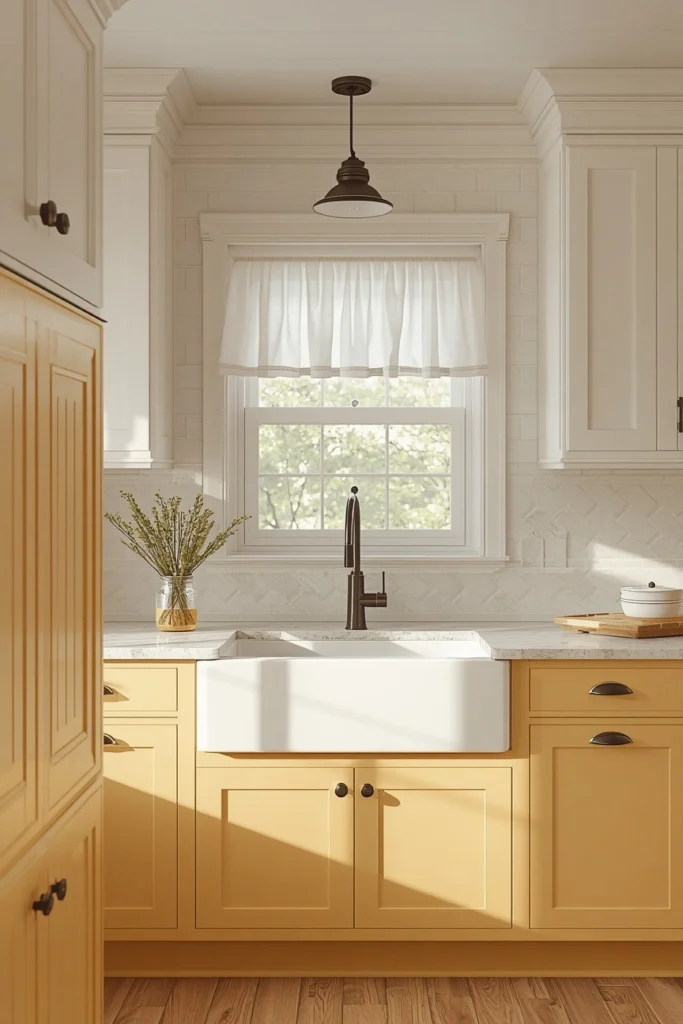
Butter yellow is the underdog of farmhouse kitchen colors — and it deserves every bit of its growing popularity.
Not lemon yellow, not mustard, not goldenrod. Butter yellow: the specific warm, creamy, golden tone of good butter in the morning light. It’s a color that makes a kitchen feel immediately cheerful without being loud. It reads as vintage in a way that feels genuinely nostalgic rather than retro-themed.
Cabinet color in butter yellow — either full kitchen or just lowers — works particularly well with white upper cabinets (or open shelves), white or cream subway tile, and aged iron or matte black hardware. The contrast of the warm yellow against white makes both colors look better.
This is a great farmhouse kitchen color for east-facing or north-facing kitchens that don’t get much natural light. Butter yellow adds its own warmth that sunlight would normally provide.
The color that makes butter yellow kitchens work: White trim, ceiling, and upper cabinets. Without white as a foil, butter yellow can overwhelm. With white as a frame, it glows.
Idea 10: Navy Blue Farmhouse Kitchen with Unlacquered Brass Hardware
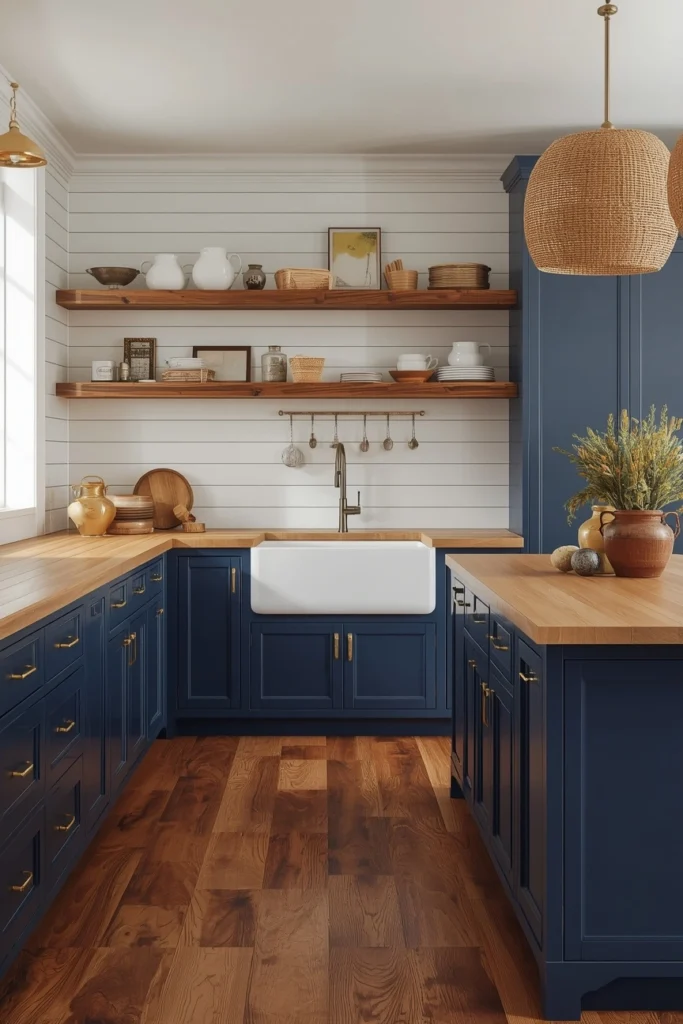
Navy in a kitchen does something extraordinary: it grounds everything. It gives the space a quality of seriousness and depth that white and cream simply can’t achieve — while remaining deeply warm because of its blue undertones.
The key to navy being farmhouse rather than modern is in the pairings. Unlacquered brass hardware — not polished gold, not matte gold, but the specific warm amber-toned brass that hasn’t been coated and will develop a patina over time — is the most important supporting element. Pair with butcher block or creamy marble countertops. A farmhouse apron sink. Warm wood floating open shelves. Vintage-inspired light fixtures in aged brass or oil-rubbed bronze.
Navy farmhouse kitchens read as sophisticated without being cold. The brass warms the navy the way candlelight warms a blue room — unexpected and completely beautiful.
Paint picks for navy farmhouse kitchens:
- Farrow & Ball Hague Blue (rich, slightly teal-leaning navy)
- Benjamin Moore Hale Navy (the classic, slightly grayer)
- Sherwin-Williams Naval (warm and deep, reads slightly purple in some lights)
- Benjamin Moore Newburyport Blue (softer, more coastal farmhouse)
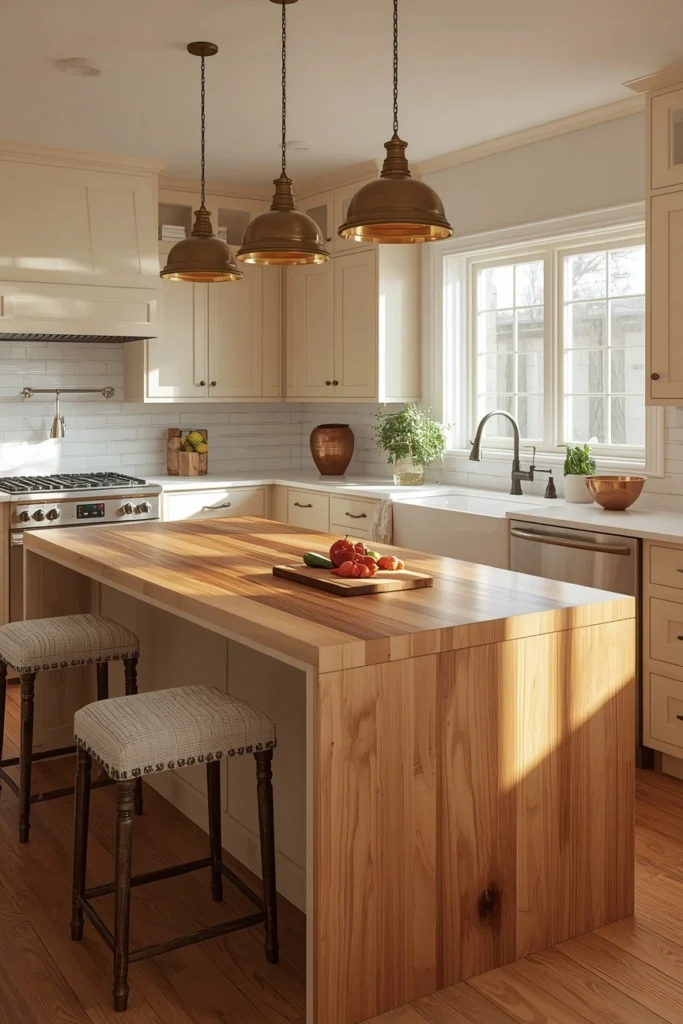
Idea 11: The Butcher Block Island Farmhouse Kitchen
If you can only add one element to make a kitchen feel farmhouse, make it a butcher block island.
The warm, honey-toned grain of a properly oiled butcher block countertop is one of the most organically beautiful surfaces in home design. It ages in a way that synthetic materials never can. It shows the marks of years of cooking — a slight darkening where the knife has been used most, a warmer glow at the center where the oil soaks in — and those marks are beautiful rather than damaging.
A butcher block island doesn’t require a full kitchen renovation. Many homeowners add it to an existing island by replacing just the island countertop while keeping the surrounding quartz or granite perimeter counters. The contrast of butcher block island against stone or quartz surroundings is itself a classic farmhouse move.
Butcher block maintenance simplified: Food-grade mineral oil applied with a cloth, left to soak in for a few hours, then wiped off. Do this when the wood looks dry or every 1–3 months. Sand away scratches with 120-grit sandpaper, re-oil, and the counter looks new. Avoid leaving standing water near the sink area — use a trivet or cutting board for protection.
Best wood species for butcher block: Hard maple is the most durable and food-safe. Walnut is darker and more dramatic, showing less staining. Teak is naturally oily and highly water-resistant — excellent for kitchen use.
Idea 12: Shiplap Wall Farmhouse Kitchen — Texture That Changes Everything
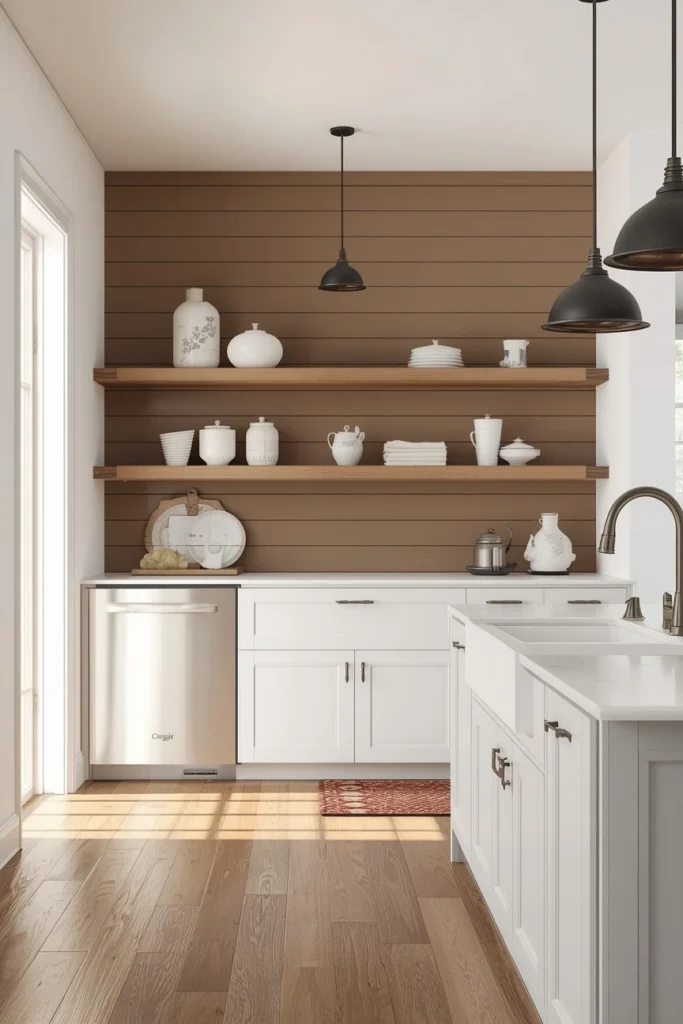
Shiplap has been overused — and underused at the same time. Overused in the all-white, all-over-the-house, Fixer Upper interpretation. Underused as a considered design element in kitchens where it can genuinely earn its place.
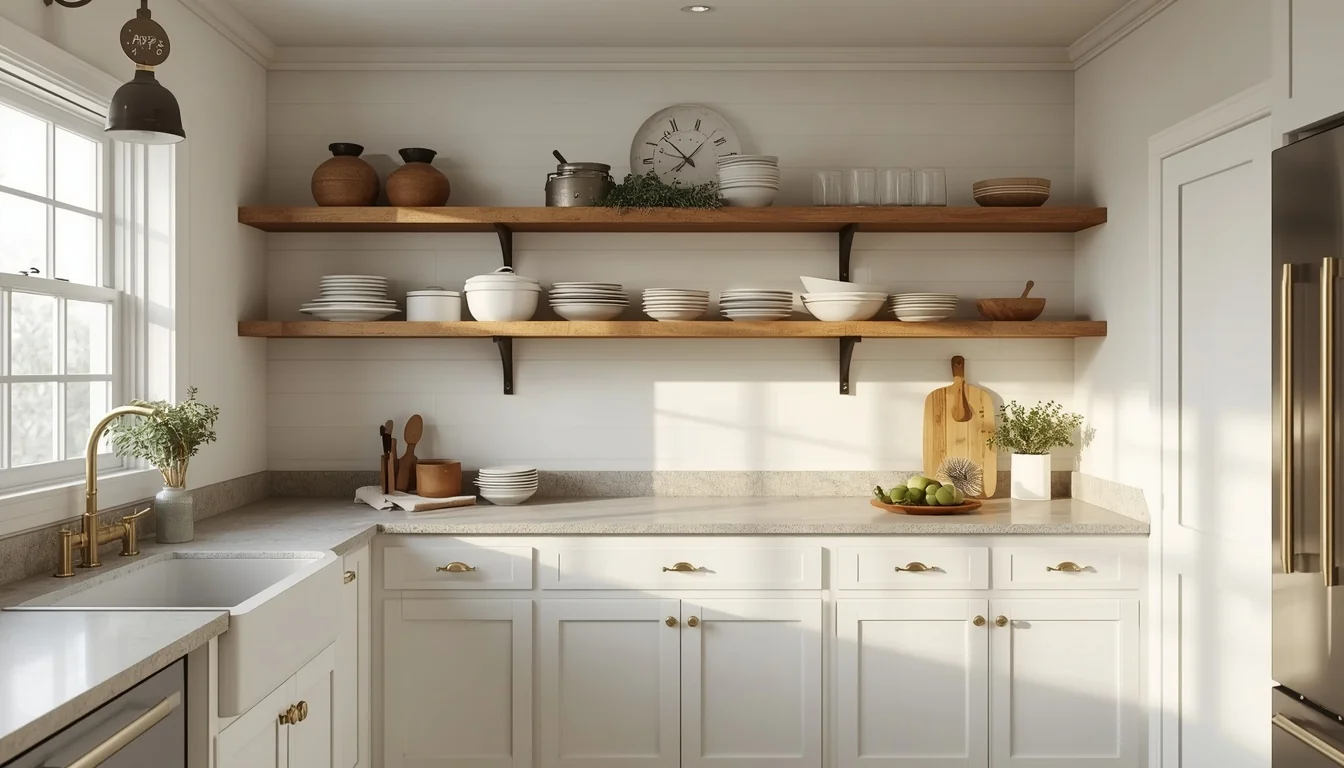
In a farmhouse kitchen, a single shiplap accent wall — behind the open shelves, as a backsplash behind the range, or on a breakfast nook end wall — adds horizontal texture that the eye finds deeply satisfying. It creates depth. It makes the space feel handbuilt rather than assembled.
The critical decision: do not paint it white. White shiplap in a kitchen reads as a reference to a trend rather than an authentic material choice. Paint it a color — warm greige, dusty sage, terracotta, deep charcoal. A colored shiplap wall is architectural. A white shiplap wall is a backdrop.
Shiplap alternatives for kitchens:
- Beadboard paneling (vertical lines instead of horizontal — more Victorian farmhouse energy)
- Board and batten (wider planks, simpler profile — modern farmhouse lean)
- Nickel gap shiplap (a slightly cleaner look with thin shadow lines — works in more modern kitchens)
Idea 13: Cottagecore Farmhouse Kitchen — Wildflowers, Pottery, and Pure Warmth
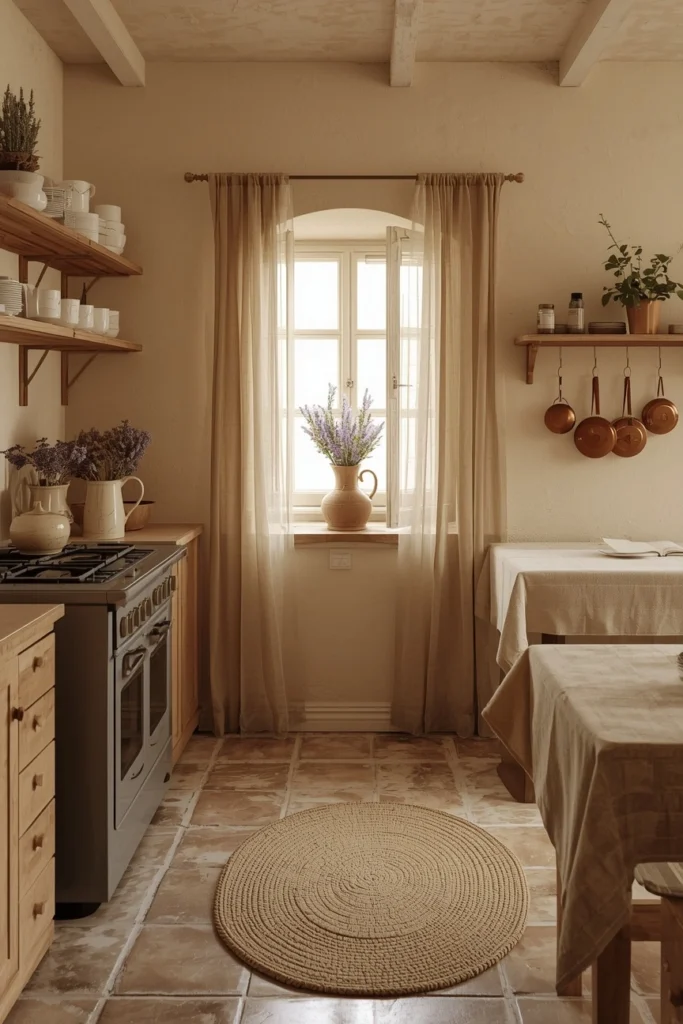
The cottagecore farmhouse kitchen is where practicality meets pure romanticism — and the result is the most personal, most human-feeling kitchen style of all.
This is the kitchen where wildflowers from the garden live in a cracked ceramic pitcher on the windowsill. Where handmade pottery with slight imperfections fills the open shelves. Where a braided rug softens the stone floor. Where the curtains are linen and have been washed so many times they’re almost translucent in the light.
Nothing in a cottagecore farmhouse kitchen looks bought all at once. It looks gathered over time — a piece of pottery from a craft fair, a vintage scale found at an estate sale, a copper pot inherited, a plant propagated from a cutting. The beauty is in the accumulation.
The most important cottagecore kitchen element: Fresh or dried botanicals, everywhere and always. A bunch of lavender drying from a beam. A jar of foraged rosehips on the shelf. A single branch of something blooming in a crock by the window. Plants signal life and slowness and intention in a way no designed element can.
Idea 14: Two-Tone Cabinet Farmhouse Kitchen — Lower Dark, Upper Light
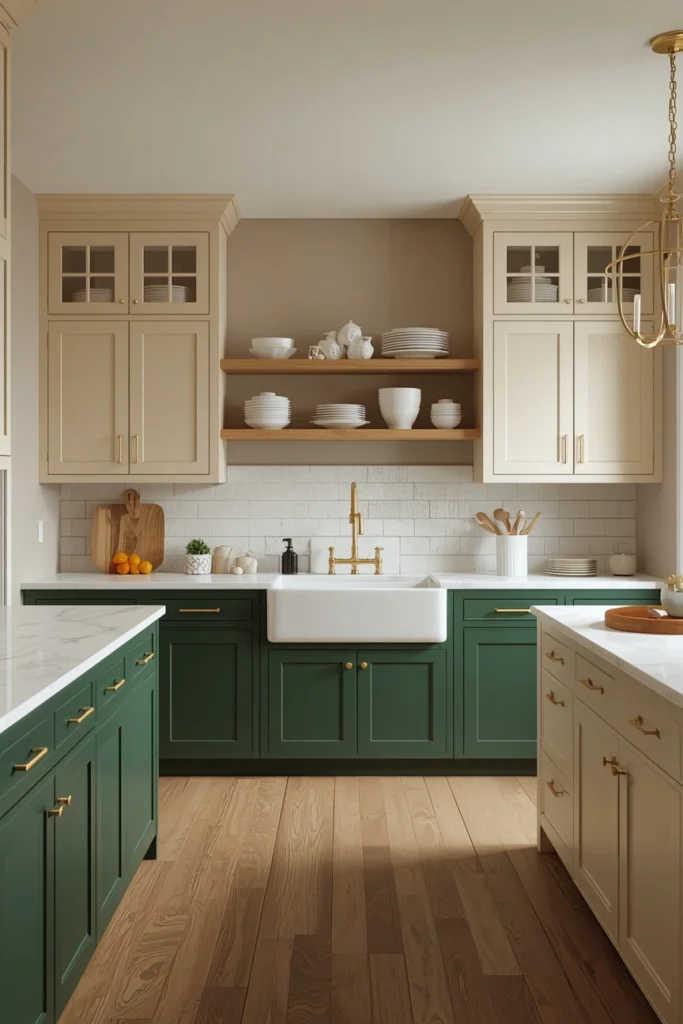
Two-tone cabinets are one of the most effective design moves in a farmhouse kitchen — particularly in smaller or lower-ceiling spaces where all-dark cabinetry would feel heavy.
The formula: lighter cabinetry or open shelving on top, darker cabinetry below. The light upper zone draws the eye up and opens the room visually. The dark lower zone grounds the space and adds richness at the base. The contrast between the two creates exactly the kind of visual interest that a single-color kitchen often lacks.
The best farmhouse two-tone pairings:
- Deep hunter green lowers + cream white uppers
- Navy blue lowers + warm greige uppers with open shelf section
- Dark charcoal lowers + soft sage uppers
- Warm walnut stained lowers + painted white uppers
- Black lowers + warm white upper open shelves
The transition hardware trick: Use the same hardware finish on both upper and lower cabinets. This is what makes two-tone cabinets read as one designed system rather than two separate decisions.
Idea 15: Small Farmhouse Kitchen Ideas — Big Character in Limited Space
A small kitchen can be the most charming one in the house — if the farmhouse elements are chosen with the space in mind rather than copied from a large open-plan renovation.
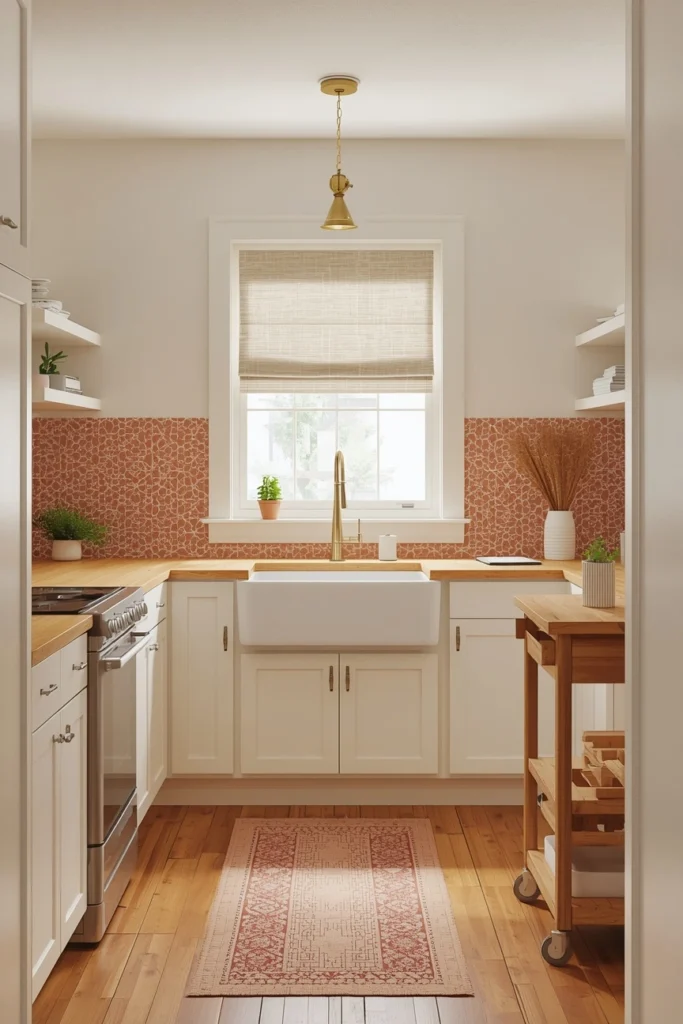
In a small farmhouse kitchen, every element needs to pull double duty. Open shelving instead of upper cabinets keeps the walls feeling open and airy while providing storage. A single dramatic element — one beautiful range hood, one statement pendant, one patterned tile backsplash — gives the eye a clear focal point in a tight space. Light, warm colors (cream, sage, butter yellow) prevent the space from closing in.
Small farmhouse kitchen rules:
- Go light on upper storage: Upper cabinets in a small kitchen make the room feel like a box. Open shelving or glass-front uppers keep it breathing.
- One dark element maximum: A small dark kitchen feels tight; a small kitchen with one dark anchor element (a navy island, a dark range hood) and light surroundings feels balanced and intentional.
- No overhead clutter: Pot racks look beautiful in large farmhouse kitchens. In small ones, they make the ceiling feel 6 inches lower. Use wall hooks or deep drawers instead.
- Window above the sink is non-negotiable: In a small kitchen, the window above the sink is a visual escape — it adds perceived depth to the whole room. If you have one, keep the window treatment light (no heavy drapes or cafe curtains that block sightlines).
Idea 16: Modern Farmhouse Kitchen — Clean Lines with Rustic Soul
Modern farmhouse kitchen ideas are what happen when farmhouse style grows up without losing its warmth.
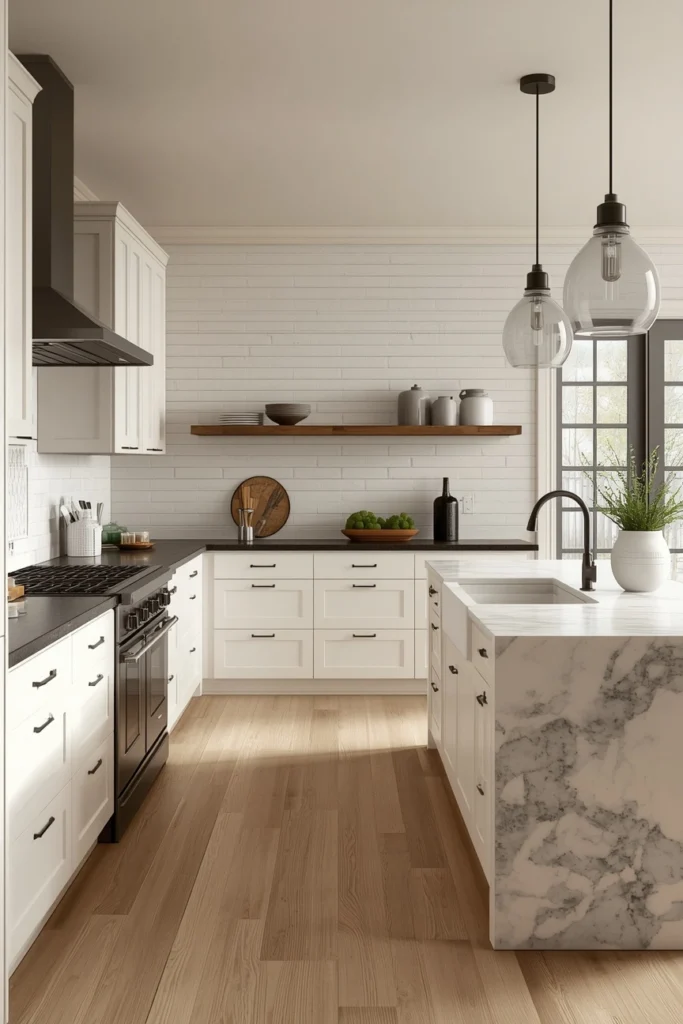
The modern version keeps the materials — wood, natural stone, aged metal — but strips away the decorative excess. Shaker cabinets instead of ornate raised-panel. Clean slab countertops rather than patterned. Minimal hardware rather than elaborate cup pulls. A single statement range hood rather than a cluttered range shelf.
The result reads as sophisticated and current while still feeling unmistakably warm. It’s farmhouse for people who love the feeling but not the fussiness.
The non-negotiable modern farmhouse element: At least one material that feels genuinely old or handmade in an otherwise clean space. A reclaimed wood open shelf. An apron sink with visible age. A vintage light fixture. A handmade ceramic vessel on the counter. Without this element, a modern farmhouse kitchen just becomes a modern kitchen.
Idea 17: Budget Farmhouse Kitchen Makeover — The Biggest Impact Per Dollar
A full farmhouse kitchen renovation costs $25,000–$75,000+. But the specific farmhouse feeling — warm, textured, human, and full of character — can be created for a fraction of that with the right strategic upgrades.
Here’s the honest breakdown of where your budget delivers the most return in a farmhouse kitchen makeover:
1. Paint the cabinets ($200–$600 DIY): This is the single highest-impact change in any kitchen. Painting existing cabinets in a new farmhouse color — sage green, navy, warm cream, forest green, butter yellow — transforms the entire room without touching a single cabinet box. Use a self-leveling cabinet paint and a foam roller. The result is indistinguishable from professional work when done carefully.
2. Replace cabinet hardware ($50–$150): New pulls and knobs in unlacquered brass, aged bronze, or matte black take 30 minutes to install and completely change the personality of the cabinetry. This is the smallest budget item with disproportionate visual return.
3. Open shelving section ($100–$300): Remove one or two upper cabinet doors. Sand and paint the cabinet interiors to match the wall or a contrasting color. Add a thick wood board as a floating shelf in the same opening, or simply style the open cabinet as a display shelf. Instant farmhouse character.
4. A new faucet ($80–$250): A vintage-style brass gooseneck or bridge faucet replaces the existing chrome in under two hours with a wrench and a few minutes of work. It changes the entire personality of the sink area.
5. A patterned rug ($40–$100): A vintage-style Moroccan runner or striped flat-weave cotton rug in front of the kitchen sink or running the length of the galley zone introduces color, warmth, and softness that hard floors can’t achieve alone.
6. Botanicals and ceramics ($20–$60): A bundle of dried pampas or lavender in a ceramic crock. Fresh herbs growing on the windowsill. A handmade ceramic bowl on the counter. These zero-renovation touches cost almost nothing and bring the human, personal quality that farmhouse kitchens are entirely built on.
Total budget makeover cost: $490–$1,460. Total personality transformation: complete.
The Non-Negotiable Elements of Every Great Farmhouse Kitchen
These are the details that separate a farmhouse kitchen that genuinely feels warm from one that just looks like farmhouse-themed decor.
Natural materials, always. Synthetic surfaces — plastic hardware, laminate in wood-print, faux stone vinyl — immediately undercut the authentic quality that farmhouse design is built on. The farmhouse style is fundamentally about honest materials. Wood, stone, metal, ceramic. You don’t have to use them everywhere, but where you do, use the real thing.
Aged metal, not polished. Unlacquered brass, oil-rubbed bronze, aged iron, matte black, hammered copper — these finishes all have in common that they accept and show age rather than resisting it. The fingerprint on unlacquered brass disappears into the patina. The scratch on aged iron becomes part of the texture. This is the opposite of polished chrome, which shows every mark and keeps screaming “new.”
At least one imperfect thing. A handmade ceramic jug with a slight lean. A shelf made from a reclaimed plank that’s not quite straight. A vintage hook that’s been painted over three times. Perfection kills the warmth of a farmhouse kitchen. Imperfection gives it personality.
Textiles, not just hard surfaces. Cotton dish towels hanging from a peg rail. A braided or woven rug underfoot. A linen valance above the sink window. Farmhouse kitchens that feel genuinely warm always have soft elements mixed into the hard materials of counters, tile, and cabinetry.
Botanical life. Fresh herbs growing in pots on the windowsill. Dried lavender from last summer hanging from a beam. A branch of something seasonal in a ceramic vase on the open shelf. Farmhouse kitchens are connected to the natural world — and a kitchen that has no growing things in it, or nothing dried or gathered from outside, doesn’t quite get there.
Farmhouse Kitchen Color Guide: Which Shade for Which Kitchen?
Small kitchen with low light: Butter yellow or warm cream cabinets. Light colors make a small space feel more expansive without being stark.
Medium kitchen with good natural light: Sage green is your best option — it comes alive in sunlight and deepens beautifully when the light fades.
Large open-plan kitchen: This is where navy, forest green, or dark charcoal can really breathe. Large kitchens can absorb dark color without feeling heavy.
Kitchen facing east (morning light): Any warm color — butter yellow, terracotta, warm cream — will glow magnificently in morning sun. Avoid cool blues or grays that morning light doesn’t flatter.
Kitchen facing north (limited light): Warm, light colors. Cream, sage, warm gray. The kiss of death for north-facing kitchens is cool neutrals that read dingy in low light.
Rental kitchen you can’t paint: Focus on hardware swaps, removable wallpaper on a single backsplash area, open shelves added over existing upper cabinets, and botanicals, rugs, and textiles that transform the feeling without touching the surfaces.
Common Farmhouse Kitchen Mistakes to Avoid
Over-theming. A kitchen with rooster figurines, “Live Laugh Love” signs, barnyard imagery, and mason jars full of decorative corn is farmhouse-themed. A kitchen with sage green cabinets, a butcher block island, an apron sink, and open shelves of real dishes is actually farmhouse. The difference is restraint — and genuine function.
All white everything. White shiplap, white cabinets, white countertops, white subway tile, white open shelves. Without contrast, warmth, or textural variation, this reads as blank rather than clean. Layer a warm wood tone, a colored textile, or a single dark element in.
Ignoring the floor. The floor in a farmhouse kitchen is doing as much work as any other element. Bare laminate or cold tile undermines every beautiful element above it. Wide plank hardwood, terracotta tile, cement tile, or even a good quality luxury vinyl plank in a warm wood tone — the floor must contribute.
Mixing too many metal finishes without intention. Brass cabinet pulls, chrome faucet, stainless appliances, brushed nickel light fixture, and black range hood all in one kitchen reads as chaotic rather than collected. Pick two finishes and repeat them deliberately. Everything else gets subordinated.
Staging instead of living. The most beautiful farmhouse kitchens have things in them that suggest actual cooking. A cutting board left on the counter. Real herbs growing on the sill. A cookbook open on a stand. A cast iron pan on the range. A kitchen that looks too perfect to cook in misses the entire emotional point of the farmhouse style.
FAQs
Conclusion
A farmhouse kitchen isn’t something you build — not really.
It’s something you come back to. Every morning, when the light comes through that window above the sink. Every evening, when the amber from a pendant light makes the wood counters glow. Every time someone wanders in while you’re cooking and just… stays.
That’s the whole point. That’s what farmhouse kitchen ideas are actually reaching for. Not a style. Not a trend. A feeling.
It doesn’t matter whether your version is a moody dark kitchen with exposed brick and black cabinets, or a soft sage green one with butter-yellow accents and open shelves full of imperfect pottery. What matters is that it feels like yours — warm, human, full of the details and textures and objects that mean something to you.
Build it slowly. Choose materials that age well. Add one handmade thing. Grow something on the windowsill. And every morning, when you walk in and feel that warmth — you’ll know you got it exactly right.