25 Japandi Living Room Designs That Are Minimalist, Peaceful & Stunning
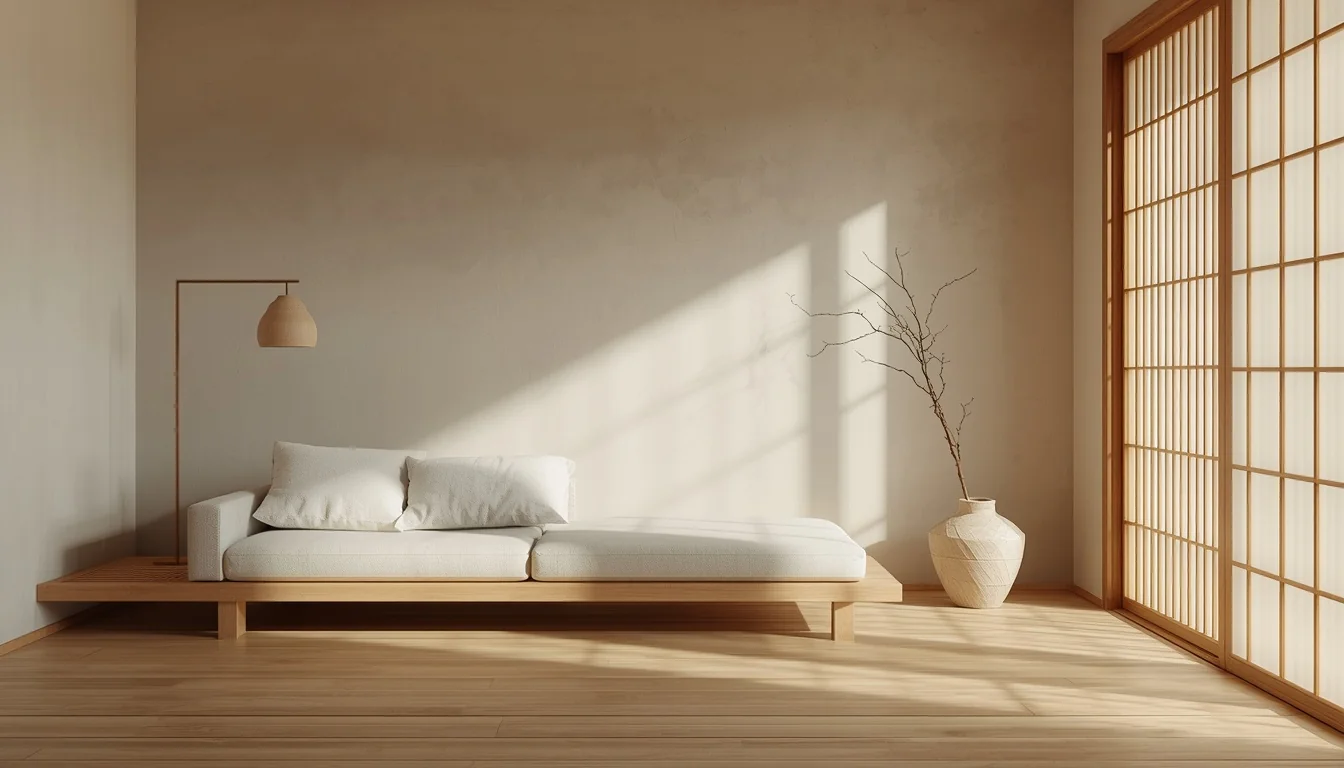
There’s a type of living room that stops you mid-scroll.
You don’t know exactly what it is. The room isn’t empty — but it feels spacious. It isn’t cold — but it’s completely uncluttered. Every surface seems deliberately placed, yet nothing feels stiff or staged. You feel calmer just looking at it.
That’s Japandi.
And once you understand the philosophy behind it, that feeling stops being a mystery and starts being something you can actually create.
Japandi is the design fusion of Japanese minimalism and Scandinavian warmth — two cultures that have spent centuries refining the art of intentional living. From Japan comes the concept of wabi-sabi: finding beauty in imperfection, in natural materials, in things that age gracefully. From Scandinavia comes hygge: that quality of deep, unhurried coziness that makes a home feel genuinely welcoming.
Together, they create something neither style achieves alone — a living room that is calm without being cold, minimal without being empty, and beautiful without trying too hard.
In 2026, Japandi isn’t just trending — it’s being recognized as genuinely timeless. Interior designers, homeowners across the USA and UK, and Pinterest creators alike have embraced it as the antidote to the overwhelming, cluttered, over-decorated homes so many of us have accidentally built.
This guide gives you 25 real, detailed Japandi living room design ideas — each one with the specific reasoning behind what makes it work, not just a pretty picture. Whether you’re starting from scratch, doing a seasonal refresh, working with a small apartment, or trying to stay on budget, there’s something here for you.
Let’s begin.
12. TABLE OF CONTENTS
- What Is Japandi Style? The Philosophy That Makes It Work
- The Japandi Color Formula — Getting the Palette Exactly Right
- Design 1–5: Foundation Designs — Where to Start
- The Japandi Furniture Rule You Need to Know
- Design 6–10: The Warmth Designs — Cozy Without Clutter
- Natural Materials: The Complete Japandi Texture Playbook
- Design 11–15: The Light & Space Designs
- Japandi Lighting Guide: How to Get That Perfect Warm Glow
- Design 16–20: The Detail Designs — Small Decisions, Big Impact
- Small Space Japandi: The Apartment Strategy
- Design 21–25: The Statement Designs — Bold Within Restraint
- Designer Secrets: What the Professionals Do Differently
- Budget Japandi: Achieving the Look Without the Price Tag
- Common Mistakes (And Exactly How to Avoid Them)
- Shopping Priorities: What to Buy First
- FAQs
- Conclusion
- Continue Reading
What Is Japandi Style? The Philosophy That Makes It Work
Before you buy a single piece of furniture, understand this: Japandi isn’t a look. It’s a way of thinking about space.
Most interior design styles ask “How can I make this room look better?” Japandi asks a different question: “What does this room actually need?” That shift — from decoration to intention — is where everything changes.
The Two Philosophies Behind Japandi
Japanese design is guided by wabi-sabi, a philosophy that finds beauty in imperfection, incompleteness, and the natural passage of time. A hand-thrown ceramic bowl with an uneven rim isn’t a flaw — it’s evidence of human craft. A wooden table that has aged and developed a patina isn’t worn out — it’s deepened. Wabi-sabi teaches us to stop editing nature out of our spaces and start welcoming it in.
Scandinavian design operates through hygge (pronounced “hoo-gah”) — the Danish and Norwegian concept of creating warmth, comfort, and togetherness. It’s the reason Scandi homes feel like places you actually want to stay in, not just admire. Hygge brings the linen throws, the warm candlelight, the deep sofas, the textures that invite you to sit down and exhale.
Japandi takes the discipline of wabi-sabi and softens it with the warmth of hygge. The result is a living room that’s minimal but never cold, serene but never sparse, and beautiful in a way that deepens over time rather than chasing trends.
Why Japandi Works in Western Homes?
Pure Japanese interior design can feel austere in a Western context — lower furniture, darker woods, more empty space than most homeowners are comfortable with. Pure Scandi can tip into something almost too clean, too bright, too catalog-perfect. Japandi finds the livable middle ground.
It works in apartments and large family homes. It works in bright, south-facing rooms and darker, north-facing spaces. It works on a tight budget with IKEA pieces and on a generous budget with artisan furniture. That flexibility is the real reason this style has lasted — and why designers confirm it will remain relevant well beyond 2026.
Designer Note: The single most important mindset shift in Japandi is this: negative space is not wasted space. The empty corner, the clear shelf, the bare wall — these are as much a part of the design as the sofa and the rug. Resist the urge to fill.
The Japandi Color Formula — Getting the Palette Exactly Right
Color is where most Japandi attempts go wrong. Not because people choose the wrong shades — but because they don’t understand how the shades need to relate to each other.
The 60-30-10 Japandi Formula
Think in proportions, not individual colors.
- 60% — The Canvas: Your wall color and largest rug. This should be a warm off-white, light greige (beige-grey with a brown undertone — not a blue one), or warm oat tone. This is what makes the room breathe.
- 30% — The Structure: Your larger furniture pieces and natural wood. This adds the Scandinavian grounding weight. Think light ash, pale oak, or medium walnut.
- 10% — The Soul: Your accent. One muted tone only — dusty sage green, soft terracotta, or matte black. This tiny percentage provides the visual contrast that makes the other 90% look intentional.
The Undertone Rule
This is the single most important technical detail in Japandi color. Every shade in your palette must share the same undertone — warm. Cool blue-based greys will fight against warm oak furniture and make the room feel unsettled. A warm greige wall with the same oak furniture creates an instant sense of calm.
Think of your wall and your wood as being in a constant conversation. When their undertones match, the room exhales. When they clash, even expensive furniture looks wrong.
The Japandi Palette: Specific Hues That Work
- Warm off-white (not pure white — too clinical)
- Sandy beige and oat tones
- Warm greige (not pewter grey — too cold)
- Soft mushroom and warm stone
- Dark charcoal as a grounding note (not true black)
- Muted sage green (accent only)
- Dusty terracotta (accent only — used very sparingly)
- Natural wood tones: pale ash, white oak, medium walnut
What to Avoid?
- Saturated or primary colors — they’re too high-energy for Japandi’s calm
- Pure bright white — it lacks the warm undertone needed to harmonize with wood
- Cool pewter greys — they fight warm wood tones
- Pink, orange, or red tones (except very muted terracotta as a 10% accent)
Quick Tip: Test your wall paint sample in the actual room at different times of day. A north-facing room receives cool, blue-tinted light — you’ll need an even warmer greige to compensate. A south-facing room gets warm golden light and can handle slightly cooler neutrals.
DESIGN 1: The Foundation Neutral — Warm Greige Walls + Pale Oak
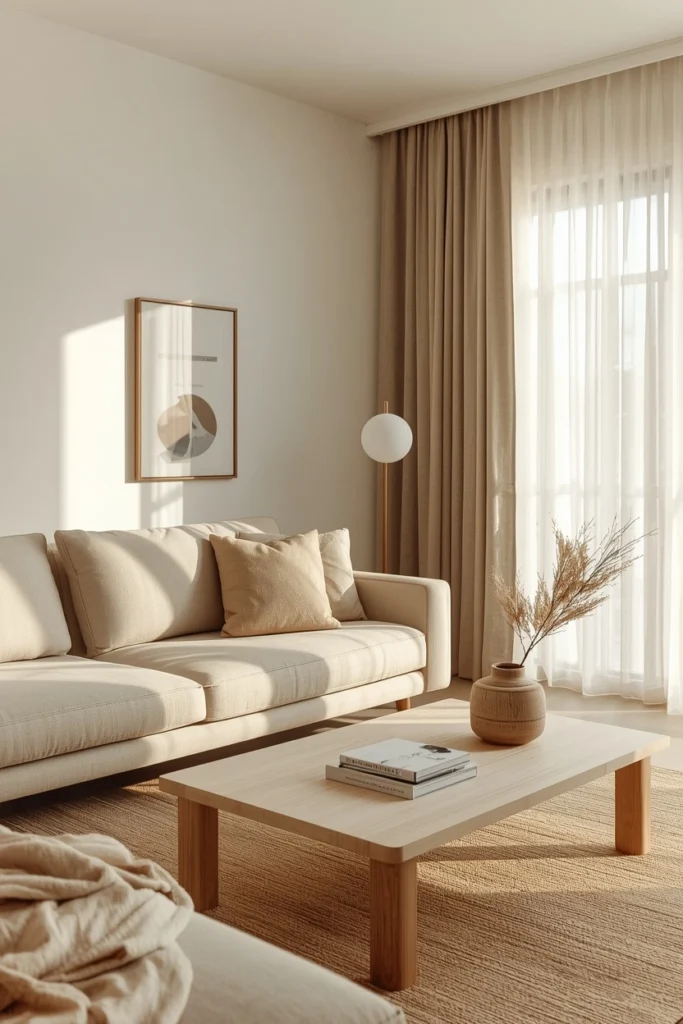
The starting point for most successful Japandi living rooms is deceptively simple: warm greige walls paired with pale oak furniture.
What makes this work isn’t the individual shades — it’s the tonal relationship. Both shades draw from the same warm, earthy undertone family, so the room reads as cohesive rather than color-blocked. The wall recedes quietly, the wood comes forward naturally, and the overall effect is spacious and grounding simultaneously.
Keep accessories to a minimum here. One linen throw on the sofa arm. A single ceramic object on the coffee table. A low sculptural plant — a bonsai or a trailing pothos in a matte clay pot. That’s genuinely enough.
Why it works: The warm greige wall handles the “Scandi lightness” while the pale oak delivers “Japanese grounding.” Neither element fights the other. The room feels unified because it is unified — at the undertone level.
DESIGN 2: The Ink + Ivory Contrast
For those who find all-neutral Japandi too quiet, this design introduces bold contrast the right way.
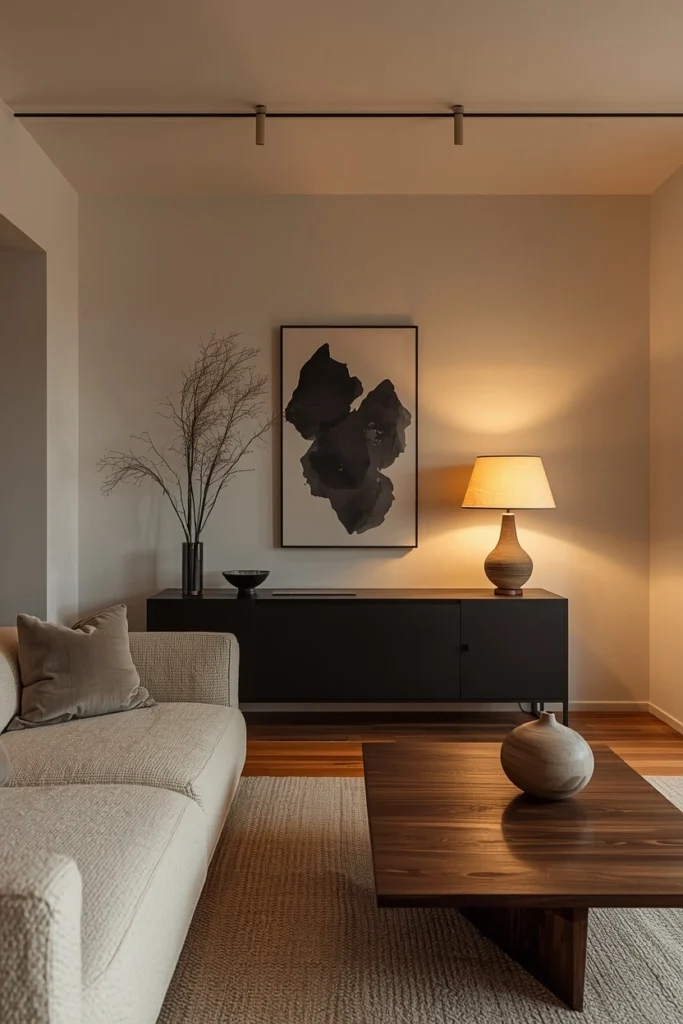
Charcoal or near-black furniture — a low ebony-stained credenza or matte black side table — against warm ivory walls creates the kind of visual punctuation that makes a room feel considered rather than accidental. The key is keeping the dark element singular and low-profile.
This version of Japandi draws more heavily from Japanese aesthetics, where deep blacks and near-blacks appear in lacquered details, ink paintings, and black stones in zen gardens. The warm ivory walls provide the Scandi softness that prevents the room from feeling heavy.
What to add: One piece of Japanese ink art above the credenza. A cream linen sofa. A washi paper pendant light. The contrast does the work; everything else stays quiet.
DESIGN 3: Earthy Japandi — Terracotta Accent Edition
The 10% accent rule is best understood through this design.
The room is built entirely on warm oat and sand tones — walls, sofa, rug. Then, one terracotta accent is introduced: a single throw pillow. One terracotta ceramic vase. That’s it. Two terracotta items maximum.
This is a version of Japandi that became particularly relevant in 2025, when Pantone’s Color of the Year (Mocha Mousse) pushed warm, earthy brown tones into the mainstream. The terracotta accent extends naturally from that palette while staying true to Japandi’s restrained principles.
Who this works best for: People who find pure neutral Japandi too flat. The terracotta provides personality without disrupting calm.
DESIGN 4: Wabi-Sabi Japandi — The Beauty of Imperfection
This is Japandi at its most philosophical.
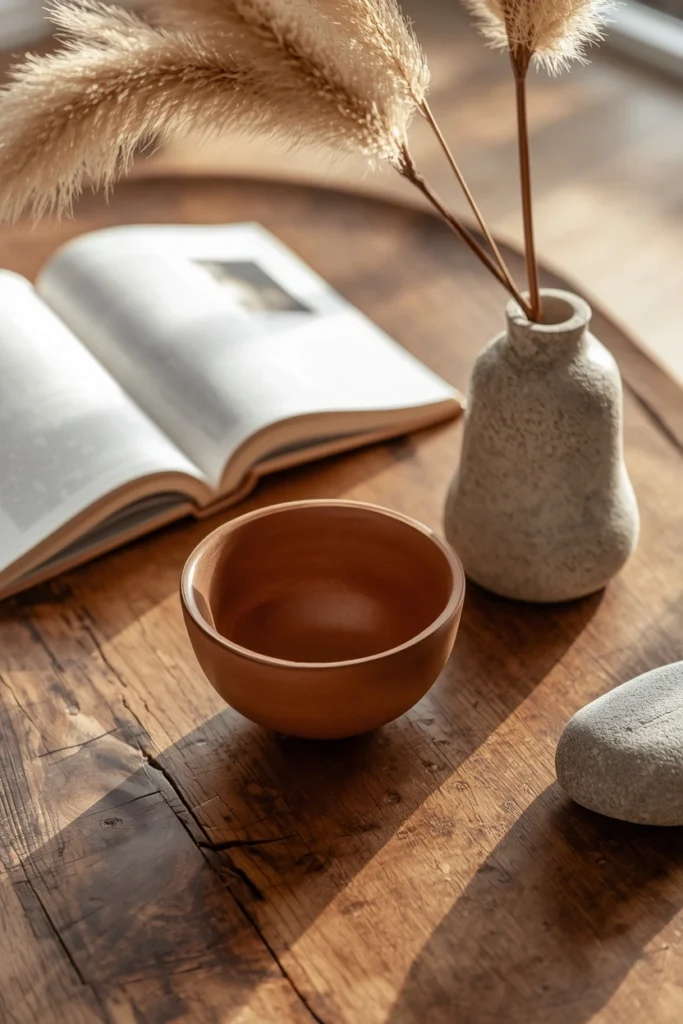
Choose furniture and objects that show evidence of time and craft. A reclaimed wood coffee table with visible knots and grain. Hand-thrown ceramic vessels with slight asymmetry and tool marks. A linen sofa that gently wrinkles when you sit. A bamboo floor lamp whose weave is slightly irregular.
None of these “imperfections” are flaws. In the wabi-sabi view, they’re proof that the object was made by human hands from natural materials — and that’s precisely what makes it beautiful.
The practical styling guide: Keep surfaces even cleaner when using wabi-sabi pieces. The intentional imperfection of one hand-thrown vase reads as beautiful. Combine it with clutter and it reads as mess.
DESIGN 5: The Biophilic Japandi — Bringing Nature Fully Inside
In 2025 and 2026, Japandi’s relationship with nature deepened significantly. Rather than a small plant on a shelf, biophilic Japandi brings nature in as a central, structural element of the room.
A large Ficus Audrey or olive tree in a matte clay pot becomes the room’s focal point — positioned near the window where it can cast natural shadows on the floor throughout the day. A single trailing pothos hangs from a wall-mounted bracket. A small indoor rock arrangement sits on the windowsill.
The plants serve both the Japanese principle (connection to nature, zen garden references) and the Scandi principle (warmth, organic texture, life). And unlike decorative objects, they’re never static — they grow, shift, and change with the seasons.
Plant choices for Japandi: Bonsai, Ficus Audrey, fiddle leaf fig, olive tree, peace lily, single orchid, trailing pothos, pampas grass in a vase, dried branches.
The Japandi Furniture Rule You Need to Know
Before selecting a single piece, understand the core furniture principle: low, natural, purposeful.
Low: Japandi furniture sits close to the ground. Low-profile sofas (no more than 30 inches high), low coffee tables, floor-level cushions as accent seating — these choices make ceilings feel higher, rooms feel more spacious, and the overall atmosphere more grounded. It’s a distinctly Japanese aesthetic that Scandinavian functionality embraces completely.
Natural: Wood, bamboo, rattan, stone, linen, wool, cotton. No chrome. No high-gloss lacquer. No mirrored surfaces. Matte finishes and visible grain are what give Japandi furniture its character. Choose pieces where the material itself is the design feature.
Purposeful: Every piece of furniture in a Japandi room should have a clear reason for being there. This doesn’t mean rooms have to be spartan — it means accidental accumulation is the enemy. Before buying something, ask: does this serve a function AND add to the visual calm of the space?
The Japandi Sofa Formula
The sofa anchors everything. For Japandi, choose:
- Low-profile, clean lines (no tufting, no ornate legs)
- Neutral upholstery: linen, cotton blend, or boucle in oat, cream, warm grey, or sage
- Wide seats for genuine comfort (hygge demands you actually want to sit there)
- Legs in pale wood, matte black, or no legs at all (platform-style)
Avoid: curved maximalist shapes, velvet in jewel tones, metal legs, anything that looks “designed” rather than crafted.
The Coffee Table
Round or oval wood with visible grain. Natural edge or slight imperfection is welcome. Keep the surface nearly empty: one book, one small vessel, one candle. Leave 14–18 inches of clearance between table and sofa edge.
Designer Secret: If your sofa is light-colored, choose a slightly darker wood coffee table — walnut over oak, for example. This contrast keeps the room from reading as a single flat tone. The shadow beneath the table adds visual depth.
DESIGN 6: The Linen Sofa Room
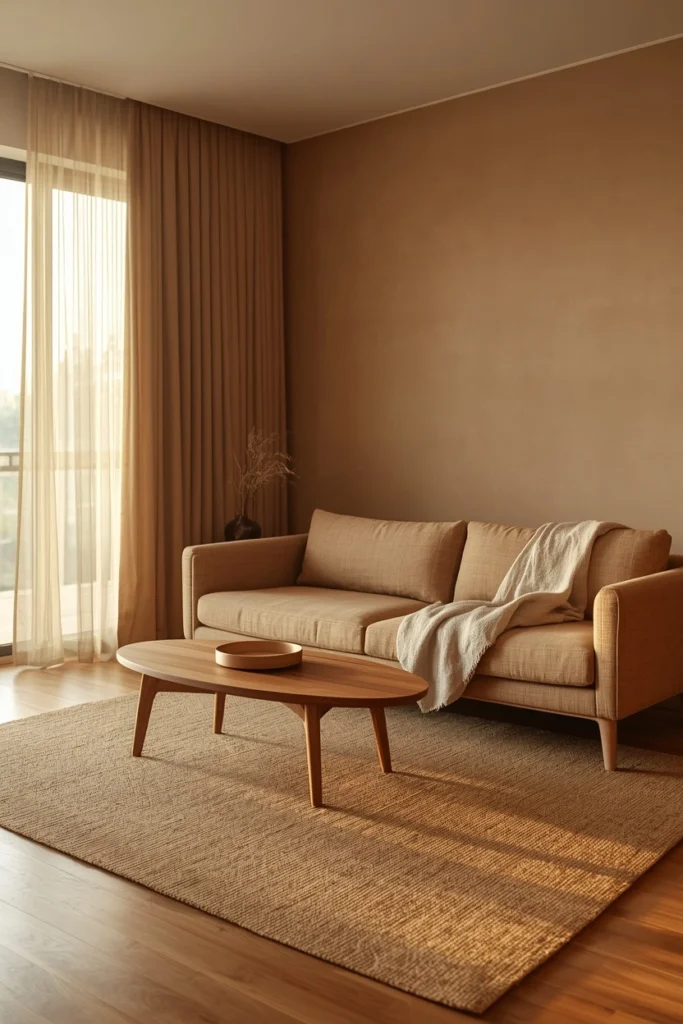
The linen sofa is possibly the most important single purchase in a Japandi living room. Why linen specifically?
Linen has a natural texture that reads beautifully even in minimal spaces. It wrinkles slightly — and that natural imperfection is wabi-sabi made functional. It breathes in summer and feels warm in winter. And in off-white, oat, or natural beige, it anchors the room’s color story without competing with anything else.
Style a linen sofa with: one boucle throw in warm grey or cream, two linen cushions (slightly mismatched sizes, same color family), a low side table with a warm-toned lamp at the sofa’s end.
The no-cushion-overload rule: Two or three cushions maximum on a Japandi sofa. More than three starts reading as Boho, not Japandi.
DESIGN 7: The Walnut Anchor Room
Walnut is to Japandi what charcoal is to fashion: it grounds everything.
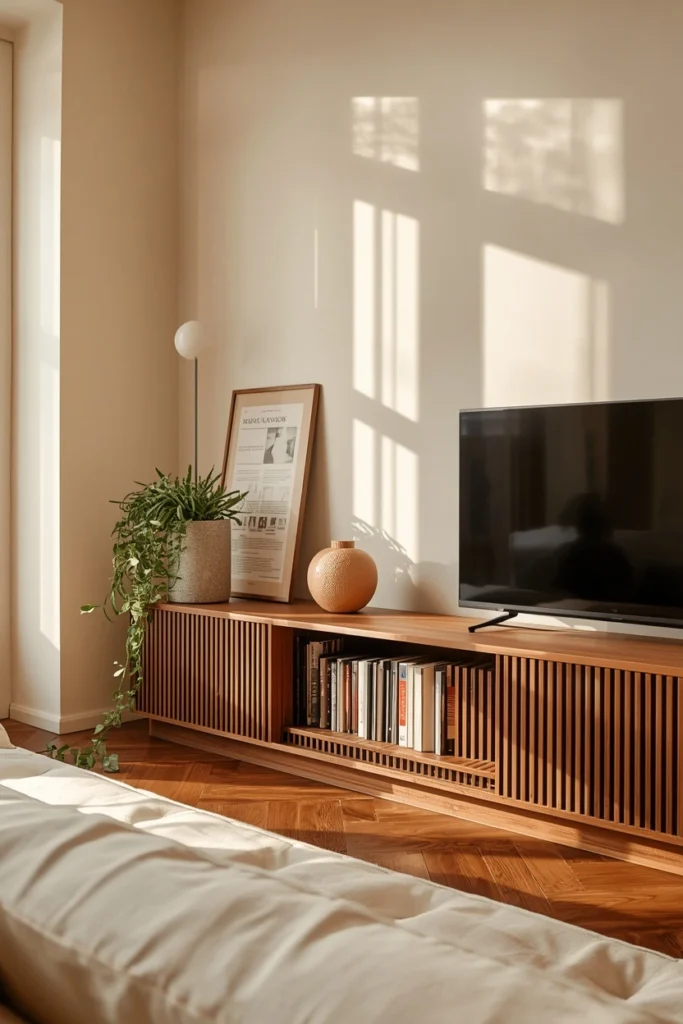
A walnut media unit or sideboard running the full length of one wall creates a dark, low anchor that makes the rest of the room — lighter walls, pale upholstery, natural fiber rug — feel more composed by contrast. This is one of the most pinned Japandi configurations because it works in almost every room size.
Fill the walnut unit with intention: books arranged by color (spines in one direction), one sculptural object per shelf section, no more. The 40% shelf rule applies here: 40% of shelf space should hold items, 60% should remain empty.
DESIGN 8: The Rattan Accent Room
Rattan is Japandi’s secret texture weapon.
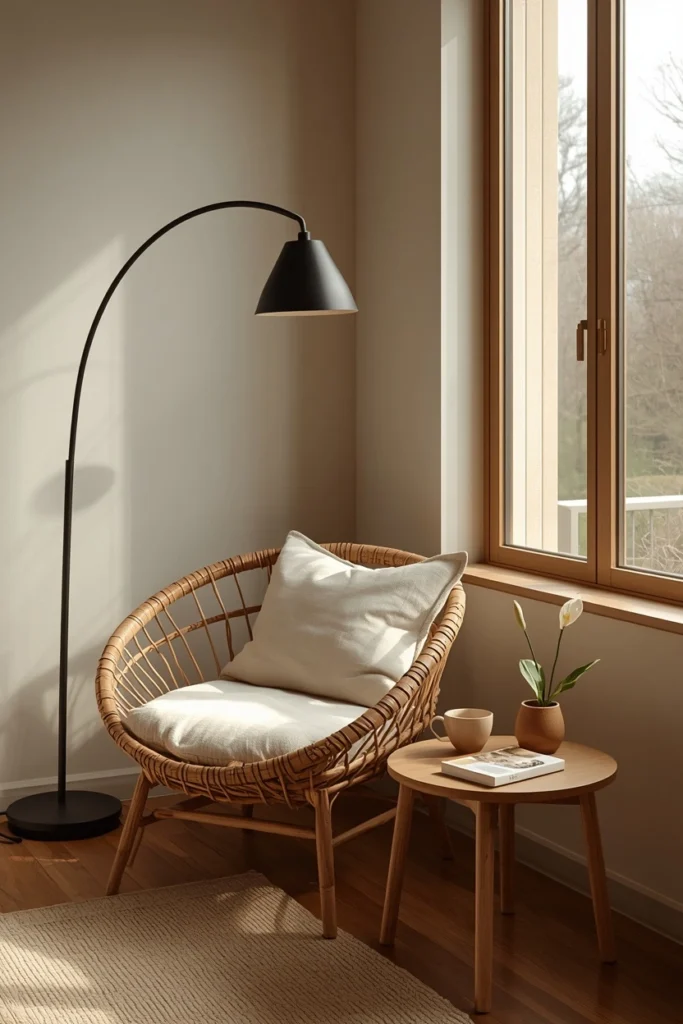
A single rattan accent chair — low, organic in shape, with a loose woven cushion — introduces a layer of organic texture that wood alone can’t provide. The irregular weave pattern creates visual interest without adding color. The curves soften the clean lines of the sofa and table.
Position it at an angle to the sofa, near the window. Add one small side table beside it — stone or ceramic top, natural wood base. A single floor lamp behind it completes a perfect reading nook that looks designed but feels completely natural.
Why rattan specifically works in Japandi: It’s a natural material with visible craftsmanship. Every piece has slight variation. It references both Japanese craft traditions and Scandinavian natural material sensibility.
DESIGN 9: The Boucle + Dark Wood Pairing
This is the Japandi combination that consistently generates the most saves on Pinterest — and for good reason.
Cream or warm-white boucle upholstery (sofa or accent chair) paired with medium-to-dark wood (walnut coffee table, ebony side table, or teak floor lamp base) creates a luxurious contrast that reads as high-end without requiring high-end prices.
The boucle’s looped texture catches light in a way that changes throughout the day — soft and diffused in morning light, warm and dimensional in evening lamp glow. The dark wood grounds it. Together, they exemplify the Japandi balance: warmth meeting restraint.
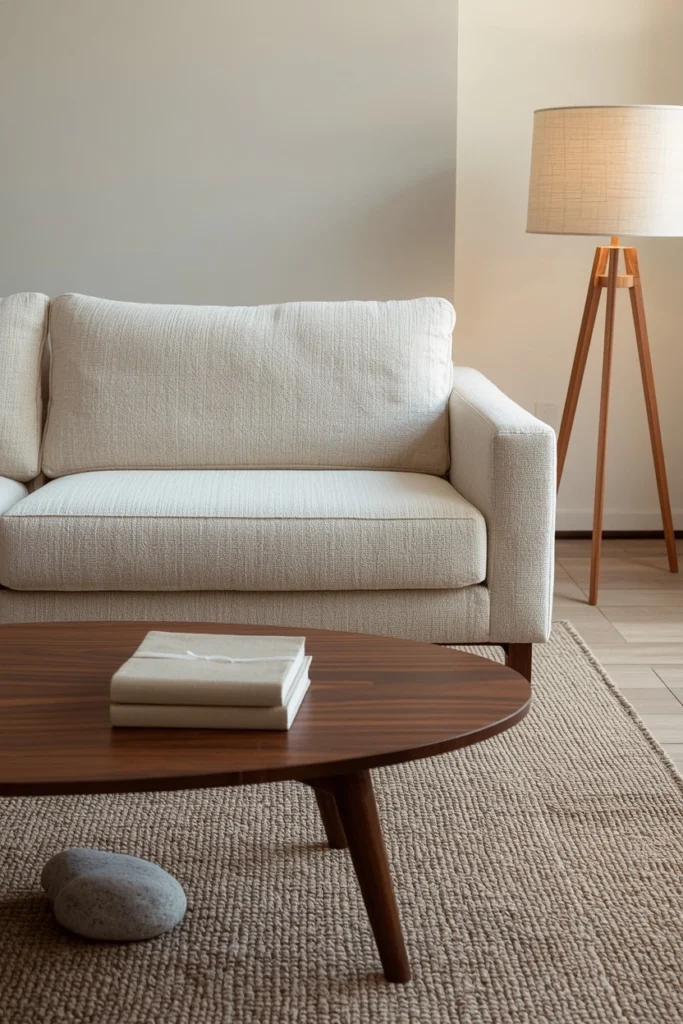
DESIGN 10: The Modular Hygge Room
Hygge, at its core, is about gathering — about creating spaces where people naturally want to sit together.
A modular, low-profile sectional sofa in warm oat linen achieves this beautifully in Japandi terms. Its generous size signals comfort; its clean lines maintain the minimalist aesthetic. Configure it in an L-shape, anchor it with a large jute or wool rug, and center a low round coffee table in the composition.
This is also the most practical Japandi configuration for family living. The generous sofa accommodates everyone. The low coffee table is toddler-safe. The jute rug handles everyday use. And the minimal accessories mean there’s very little that can get cluttered or damaged.
Natural Materials — The Complete Japandi Texture Playbook
The difference between a Japandi room that feels flat and one that feels genuinely alive is almost always texture. Not pattern — texture.
The Material Hierarchy
Prioritize in this order:
- Wood — The backbone of Japandi. Oak, ash, walnut, bamboo, and teak all work. Stick to two wood tones maximum, both from the same undertone family (warm or cool, never mixed).
- Natural fiber textiles — Linen, wool, cotton, hemp, jute. No synthetic blends, no shiny fabrics.
- Stone — Travertine, marble (sparingly), slate, concrete. Use in trays, coasters, small tables, or planters. Provides cool textural contrast to warm wood.
- Ceramics — Hand-thrown pieces in clay, stoneware, or matte-glazed finishes. The wabi-sabi element.
- Rattan and bamboo — Accent pieces only. A pendant light, a side table, a storage basket.
- Metal — Bronze, brass, or matte black. Used only in lighting, hardware, or small decorative elements. Never chrome, never high-gloss.
The Texture Pairing Formula
Always pair rough with smooth. A woven jute rug under a smooth-legged coffee table. A matte ceramic vase on a polished stone tray. A rough linen cushion against a smooth linen sofa. These micro-contrasts are what give a Japandi room its quiet visual richness.
Designer Secret: Run your hand over every surface in your Japandi room. If everything feels identical, the room will photograph well but feel flat in person. Introduce at least four distinct textures: one smooth (wood or stone), one soft (linen or wool), one rough (jute or rattan), one handmade (ceramic).
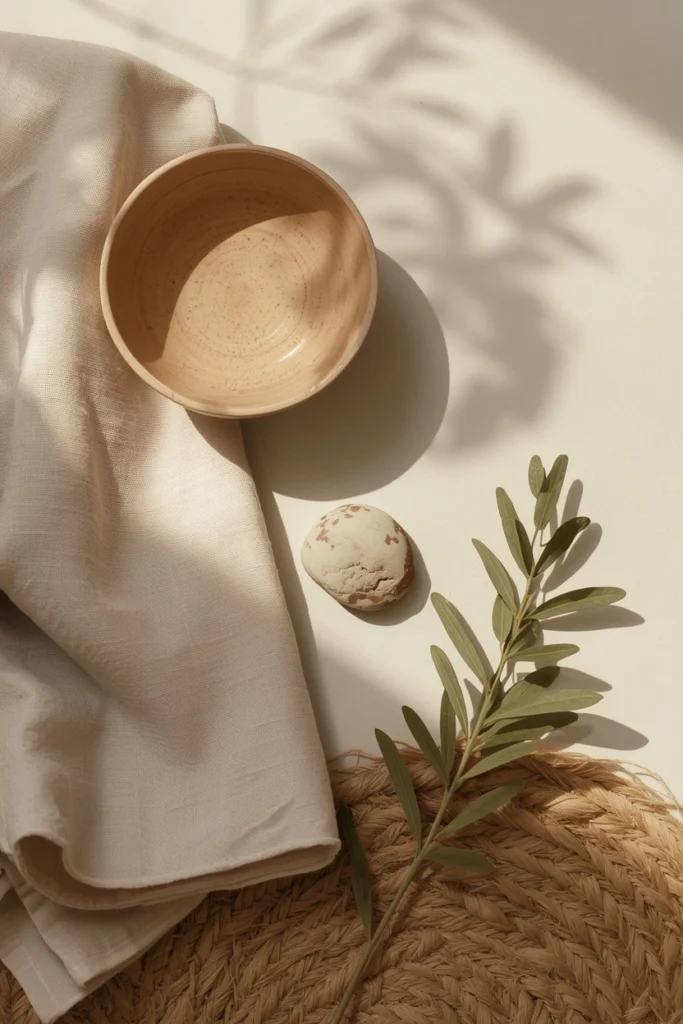
DESIGN 11: The Limewash Wall Room
In 2025-2026, limewash walls became the Japandi signature detail that changed everything.
Limewash paint leaves a matte, slightly mottled, layered surface that reads as texture rather than flat color. In warm greige, it makes a plain wall interesting enough that the furniture can sit simpler — because the wall is already doing quiet work.
The beauty of limewash is that it’s inherently imperfect. The application process creates natural variation — lighter in some areas, slightly deeper in others. That variation catches light throughout the day, making the room feel dimensional even when it contains very little furniture.
How to achieve the look: DIY limewash kits are widely available in the USA and UK from brands like Portola Paints, Rust-Oleum, and Annie Sloan. Apply in two thin, slightly overlapping coats with a wide brush in a crosshatch pattern.
DESIGN 12: The Gallery-Free Accent Wall
One of the most radical Japandi wall ideas is also the simplest: one piece. Not a gallery wall. Not a cluster. One.
A single framed piece of Japanese sumi-e ink art (black brushwork on warm white paper) hung at eye level on an otherwise bare wall makes a statement that a gallery wall of twenty pieces never could. The negative space around it amplifies its presence.
Alternatively: a single vertical textile panel in natural linen or neutral wool creates warmth and texture without a frame. Or a single ceramic wall piece — round, hand-made, slightly irregular.
The Rule: One wall, one piece. The restraint is the point.
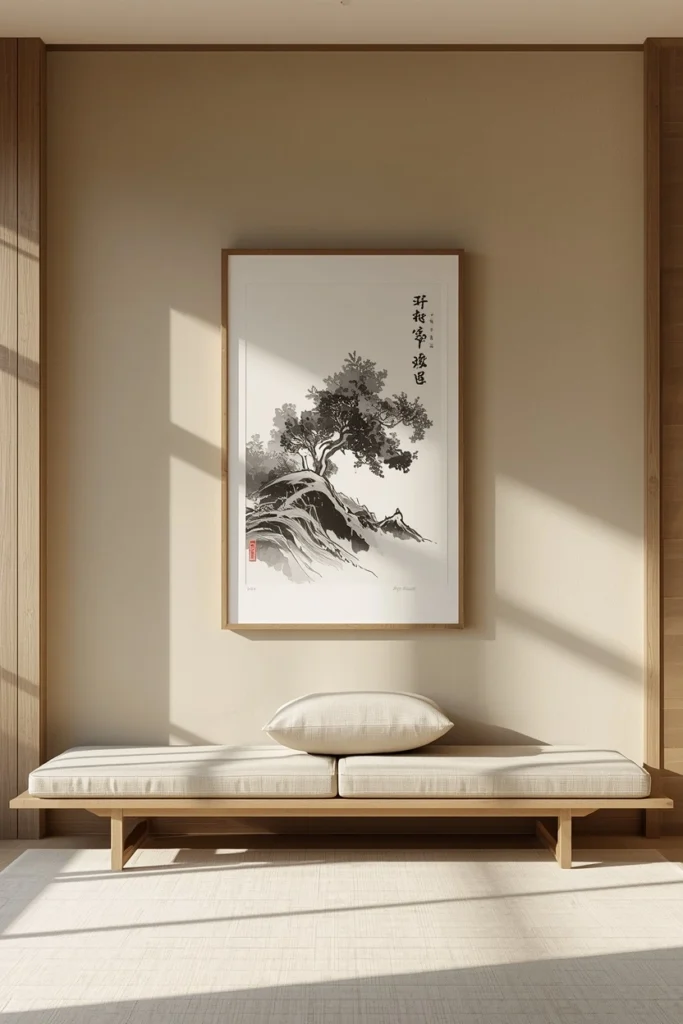
DESIGN 13: The Natural Light Room
In Japandi philosophy, natural light is not simply functional — it’s a design element in its own right.
A south-facing Japandi living room with sheer linen curtains uses the curtains not to block light but to diffuse it — creating that soft, warm, golden quality of light that reads in photographs as calm and aspirational. The curtains should hang from ceiling to floor, creating visual height and movement.
Arrange furniture to serve the light: never position the sofa with its back directly against the window. Instead, angle it to receive the light from the side, which creates the soft directional shadows that give Japandi rooms their distinctive, photographable quality.
Window treatment formula: Floor-to-ceiling sheer linen (light filtering, not blackout). In a USA/UK living room, natural linen or cotton in warm white or oat is ideal. Hang the rod 4–6 inches above the window frame and extend it 6 inches beyond each side — this maximizes perceived window size.
DESIGN 14: The Pendant Light Statement
Japandi lighting is one of the most underrated design decisions in the entire style — and getting it right costs far less than most people think.
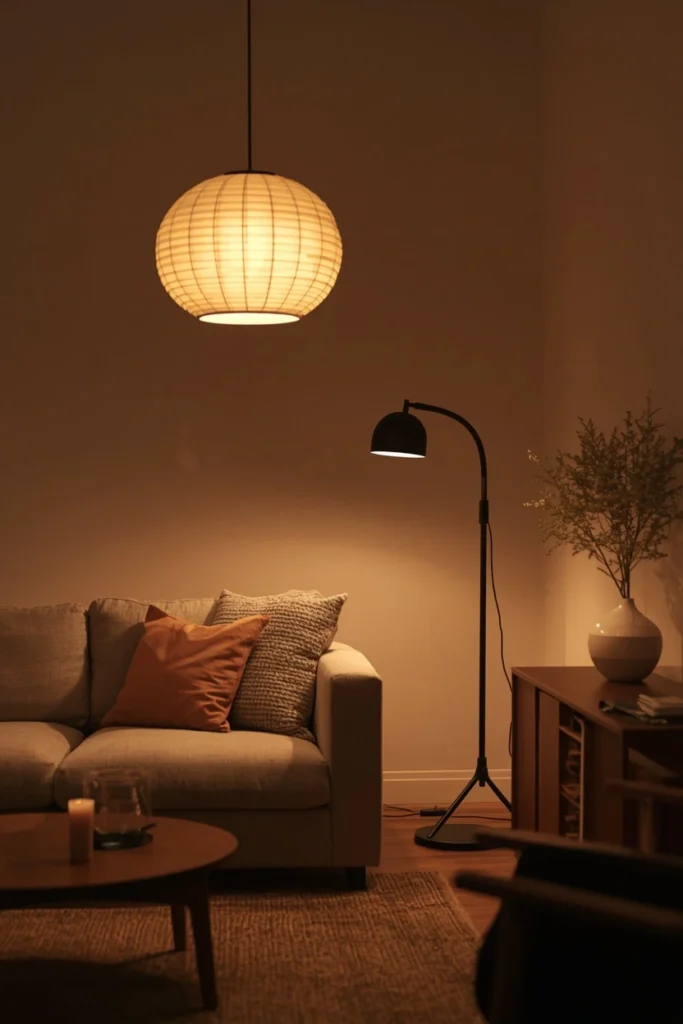
A washi paper pendant light (the classic choice, and for good reason) suspended over the coffee table area creates three things simultaneously: a warm, diffused glow; a visual focal point; and a Japanese craft reference that feels natural rather than themed.
The pendant should hang low — roughly 6 feet from the floor, or just above eye line when seated. This keeps it intimate, pools the light where people actually are, and reinforces the low-profile, close-to-earth quality of Japandi space.
Alternatives: a bamboo pendant in a simple drum or orb shape; a Scandinavian paper shade in warm white; a rattan pendant with an open weave that casts patterned shadows on the ceiling.
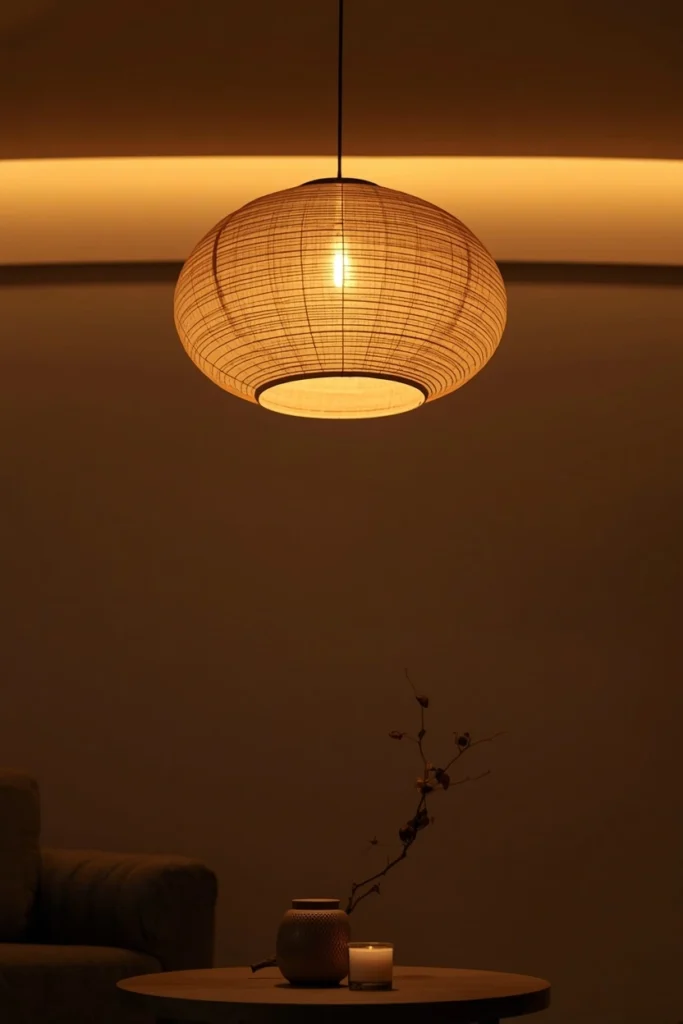
Japandi Lighting Guide — The Warm Glow Formula
Lighting is where the atmosphere of a Japandi room is either made or lost. It’s also the least expensive room upgrade available to you.
The Layered Lighting Approach
Never rely on a single overhead light. Japandi uses three layers:
- Ambient (base layer): Warm, diffused ceiling or pendant light. Switch to warm white bulbs — 2700K is the standard. Avoid daylight or cool white bulbs entirely; they make natural materials look flat and rooms feel institutional.
- Task (middle layer): A floor lamp beside the sofa or reading chair. Choose an arc floor lamp in matte black or a paper-shade design with a natural wood base.
- Accent (warmth layer): Candles, small table lamps, LED candlelight. This layer creates the hygge coziness that makes Japandi rooms feel genuinely inviting in the evening.
The 2700K Rule
Match all your light bulbs to the same color temperature: 2700K warm white. Mixed temperatures (some warm, some daylight) create a disjointed, unsettled feeling that works directly against the Japandi principle of cohesion.
Quick test: Turn on all your lights at night. Does the room feel cozy or harsh? If it feels harsh, you need warmer bulbs or dimmer switches — or both.
Budget Tip: Dimmer switches cost $15–$30 / £12–£25 and transform every room they’re installed in. If you can do only one lighting upgrade, make it dimmers.
DESIGN 15: The Candlelight Japandi Room
Hygge is incomplete without candlelight, and Japandi candlelight has a specific aesthetic language.
Choose matte black or unglazed clay candle holders — never glass or metallic. Group them in odd numbers: three on the coffee table, or five on the console. Vary the heights. Use unscented or very lightly scented soy or beeswax candles (fragrance choice matters too: sandalwood, cedarwood, or hinoki cypress all complement Japandi’s sensory environment).
In the evening, replace overhead lighting entirely with candles and lamps. The shift in atmosphere is dramatic — and it costs nothing after the initial purchase.
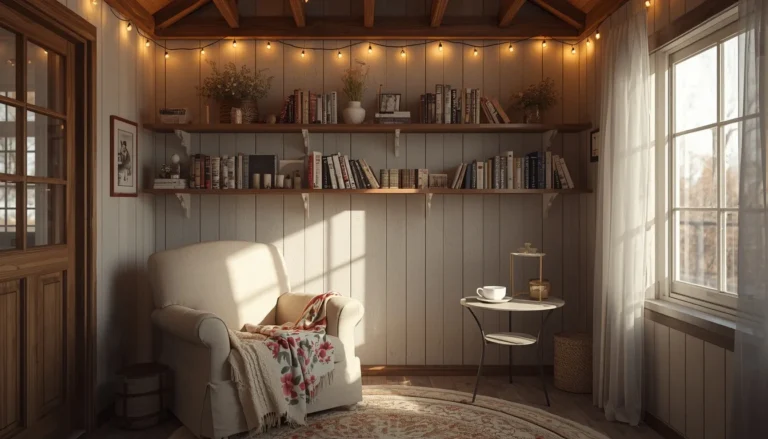
DESIGN 16: The Reading Nook — A Room Within a Room
Every Japandi living room benefits from a reading nook: a distinct zone created not by walls but by deliberate furniture placement.
The formula: rattan accent chair or low linen armchair + floor lamp positioned slightly behind and to the side + small side table + single plant. This grouping creates a sense of enclosure and purpose within a larger open-plan space.
The reading nook serves a practical hygge function (a designated spot for quiet, solitary comfort) while also providing visual rhythm in the room — breaking the single-plane arrangement of sofa, table, TV that most living rooms default to.
DESIGN 17: The Hidden Storage Room
Japandi minimalism is not about owning less (though that helps). It’s about hiding more.
Built-in closed storage — low cabinets with flat matte fronts, no handles (use push-to-open mechanisms), in a tone that blends with the wall — keeps the visual landscape completely clear while accommodating everything a real household requires.
For renters or those without built-ins: lidded woven baskets, natural wood trunks with clean profiles, and media units with closed-door sections achieve the same visual result at a fraction of the cost.
The 70% empty surface rule: In a well-styled Japandi room, 70% of horizontal surfaces should hold nothing. That sounds extreme until you try it — and then you realize it’s precisely that openness that creates the feeling you keep seeing in photos and can never quite replicate.
DESIGN 18: The Shelf Curation Room
Japandi shelving is an art form — and the most common place where beginners go wrong.
The principles:
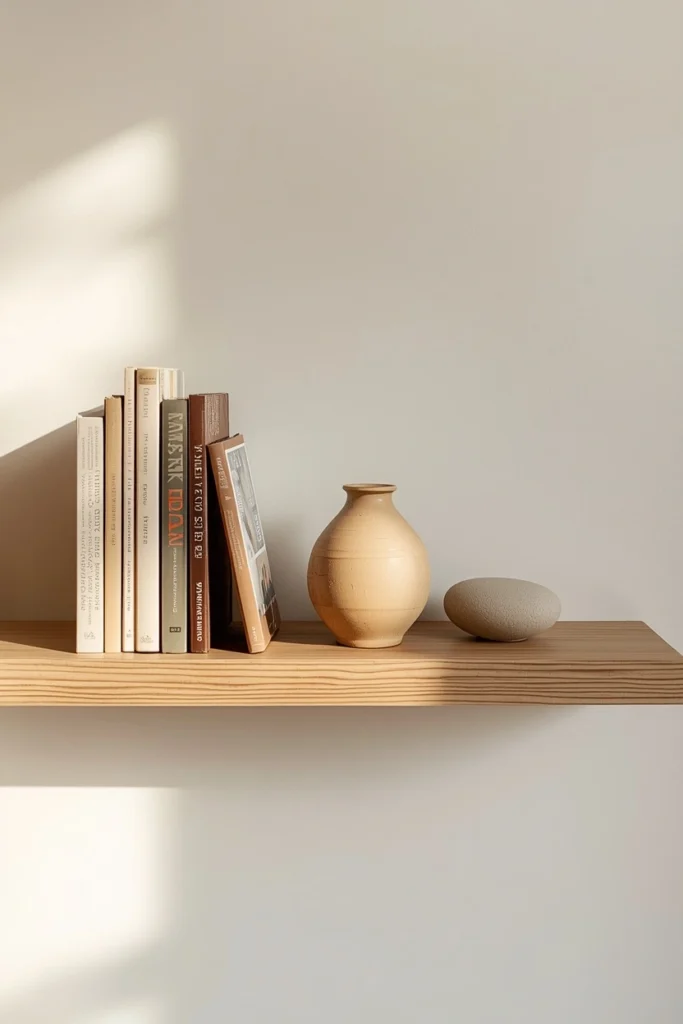
- Fill 40% of shelf space with items; leave 60% empty
- Group books spine-facing inward in a single section (the spines read as neutral texture, not color chaos)
- One object per shelf section: a ceramic piece, a smooth stone, a small plant
- Vary heights within the group: one tall vase, one medium object, one flat item
- Never distribute items evenly across all shelves — cluster, then leave blank
The test: Step back and half-squint your eyes. If anything on the shelves jumps forward visually, it doesn’t belong. Everything should read as quiet, composed, and intentional.
DESIGN 19: The Textile Layering Room
In Japandi, textiles do 90% of the warmth work.
The layering sequence (add in this order):
- Rug first — Jute or wool in natural, oat, or warm grey. Large enough that the front legs of all seating rest on it.
- Sofa throw second — Linen or chunky knit in a slightly different neutral. Draped (not folded) over one arm. Natural, not staged.
- Cushions third — Two or three, maximum. Slightly different sizes. Same color family, subtly different textures (one linen, one boucle).
- Window treatment fourth — Sheer linen or cotton, floor to ceiling.
Each layer should feel like it arrived organically, not that it was coordinated. That’s the distinction between a catalog Japandi and a lived-in one.
DESIGN 20: The Plant-as-Focal-Point Room
This is the most unexpected Japandi design move — and one of the most effective.
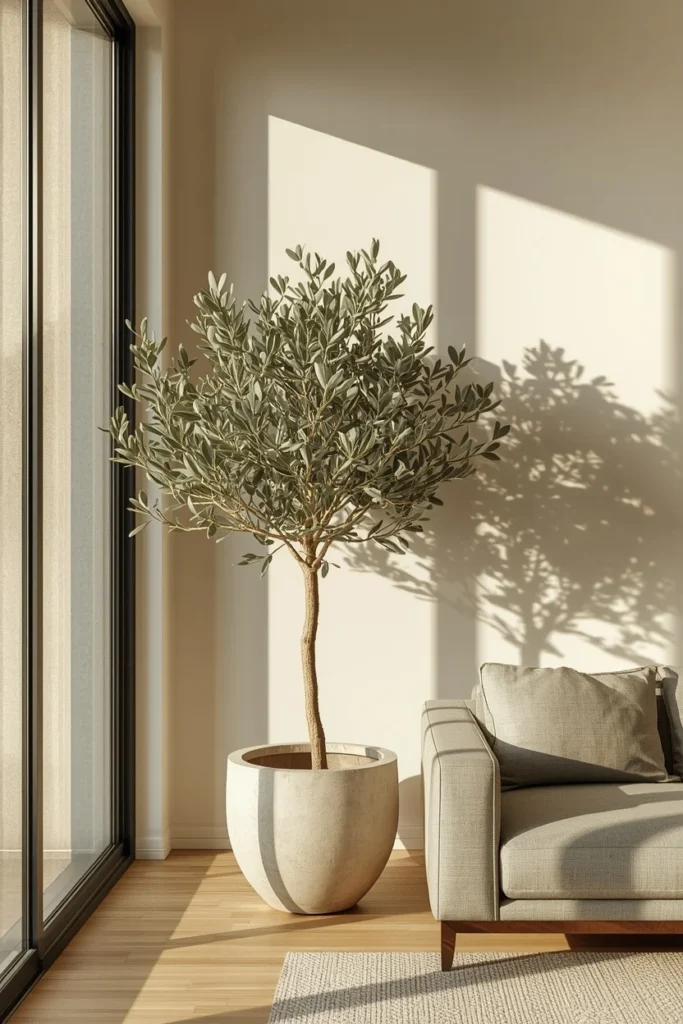
Instead of a piece of art as the room’s focal point, use a single large plant. A mature fiddle leaf fig, an olive tree, or a Ficus Audrey in a generous matte clay or stone pot positioned in the room’s natural visual center.
The plant provides vertical interest (rare in a low-profile Japandi room), organic movement, seasonal change, and a connection to nature that no object can replicate. As it grows, the room grows with it.
Placement rule: Position it where natural light hits it — near the window but not so close it gets burned. Place the pot directly on the floor, not on a plant stand, to maintain the low-ground Japanese aesthetic.
Small Space Japandi — The Apartment Strategy
Japandi doesn’t just work in small spaces — it was practically designed for them.
The Small Japandi Formula
- Go vertical: Low furniture creates the illusion of higher ceilings. A sofa at 28 inches high in a room with 8-foot ceilings makes the room feel like it has 9-foot ceilings. This is not optional in a small Japandi apartment — it’s fundamental.
- Multi-functional furniture only: A low coffee table with hidden drawer storage. A window seat with lift-lid storage beneath. An ottoman that doubles as storage and extra seating. Every piece must earn double duty.
- One focal point rule: In a small room, choose one focal point — a plant, one piece of art, or a statement chair. Everything else supports that element rather than competing with it.
- Mirror as natural material: A simple frameless mirror, or one in a natural wood or rattan frame, on the wall opposite the window doubles the natural light and perceived space — without breaking the Japandi aesthetic.
- Colour unity: Use one palette family throughout the small space. Don’t change the color scheme between rooms — continuity creates flow and makes the whole space feel larger.
Small Space Secret: In a small Japandi apartment, consider removing your largest piece of furniture entirely — usually a large sofa — and replacing it with a sectional configured as an L-shape, or floor-level cushion seating. The open floor space that remains makes the room feel dramatically larger.
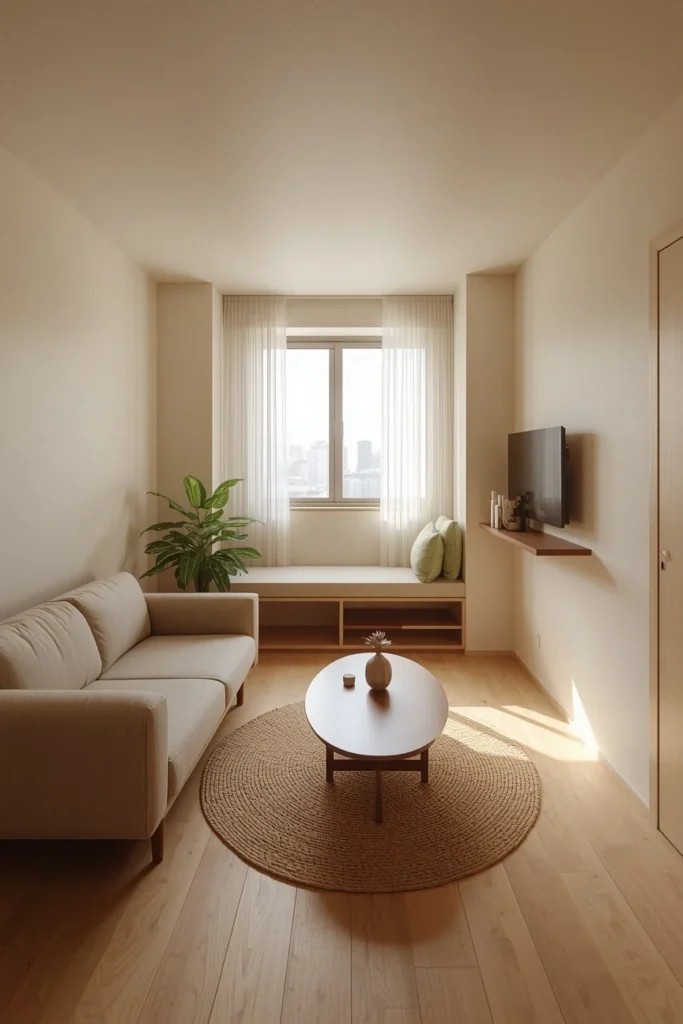
DESIGN 21: The Floor Cushion Room
This is the most Japanese-influenced Japandi design — and the most space-efficient.
Replace the sofa entirely (or supplement it) with a set of large, structured floor cushions in linen or wool. Low wooden platforms — essentially bed-height but used as seating bases — can hold two cushions each and be rearranged for different configurations.
The empty floor space around the cushions becomes part of the composition. A clear floor amplifies the room’s perceived size and creates that distinctly Japanese sense of openness that no amount of furniture can manufacture.
Who this works for: Open-plan spaces, studio apartments, households without young children who need conventional seating, and Japandi enthusiasts who want to lean more heavily into the Japanese aesthetic.
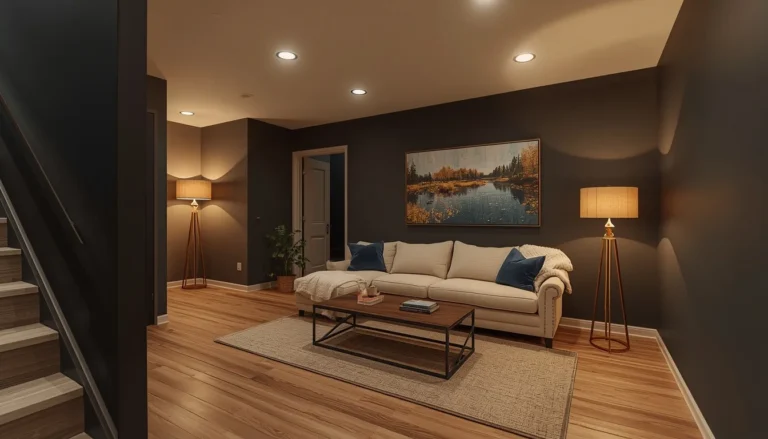
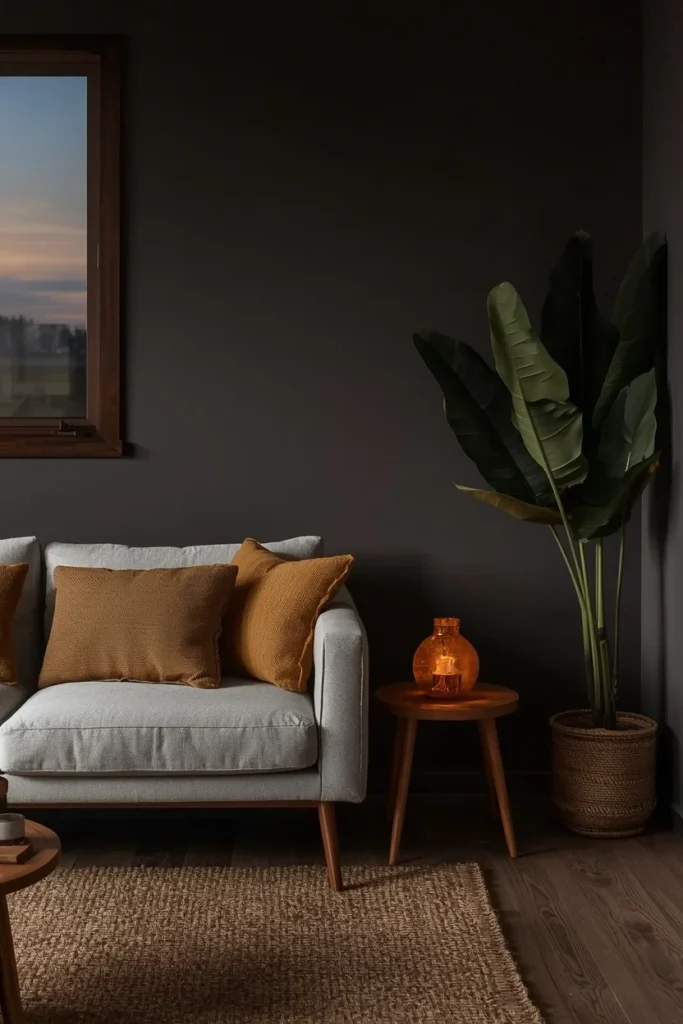
DESIGN 22: The Moody Japandi Room
Japandi needn’t be light and airy. The moody Japandi room is its equally powerful counterpart.
Darker walls — deep charcoal, warm navy, or even a very dark earthy brown — paired with natural wood furniture and warm candlelight creates a more intimate, evening-focused version of the style. It draws more directly from Japanese interiors, where deeper tones appear in lacquered details, earthenware, and shadowed alcoves.
The key: keep the furniture warm and natural. Dark walls work in Japandi specifically because they’re offset by pale wood, natural linen, and organic ceramics. If the furniture is also dark, the room becomes too heavy.
Best for: North-facing rooms (where bright neutrals can look washed out), rooms used primarily in the evening, and homeowners who find all-neutral Japandi too understated.
DESIGN 23: The Zen Garden-Inspired Room
The Japanese concept of the karesansui (dry rock garden) translates beautifully into a Japandi living room arrangement.
A composition of three smooth river stones on the coffee table — in varying sizes, simply placed asymmetrically — is more effective as Japandi décor than any expensive accessory. A small tray of fine-grade sand with a bamboo rake. A single branch (cherry, eucalyptus, or bare structural branches in winter) in a tall, narrow ceramic vase.
These aren’t ornamental choices in the conventional sense. They’re invitations to slow down, to notice texture and weight and stillness. That’s precisely what the best Japandi rooms do.
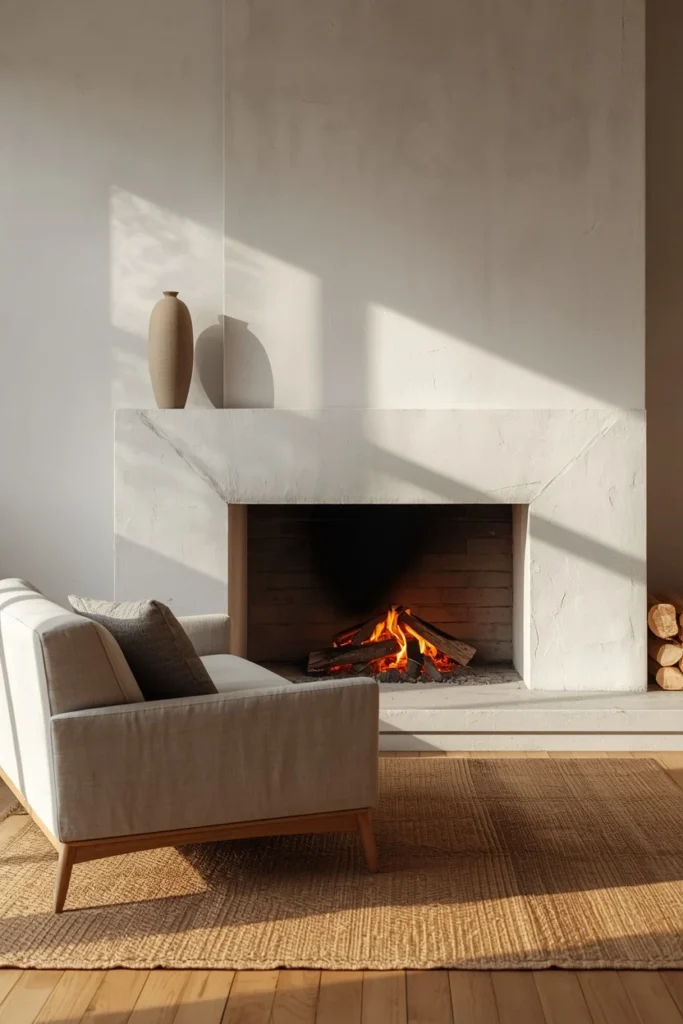
DESIGN 24: The Japandi Fireplace Room
A fireplace — gas or wood-burning — is the ultimate hygge element, and Japandi integrates it without making it the room’s theme.
Keep the fireplace surround simple: bare plaster or limewash in warm white. No mantel clutter. One object only on the mantle: a single tall ceramic vase, or a cluster of candles at varying heights. The fire itself provides all the warmth and movement the room needs.
Arrange seating to face the fireplace at an angle rather than head-on — this creates a more natural, conversational arrangement and ensures the fire is a backdrop rather than a focal point that dominates the room.
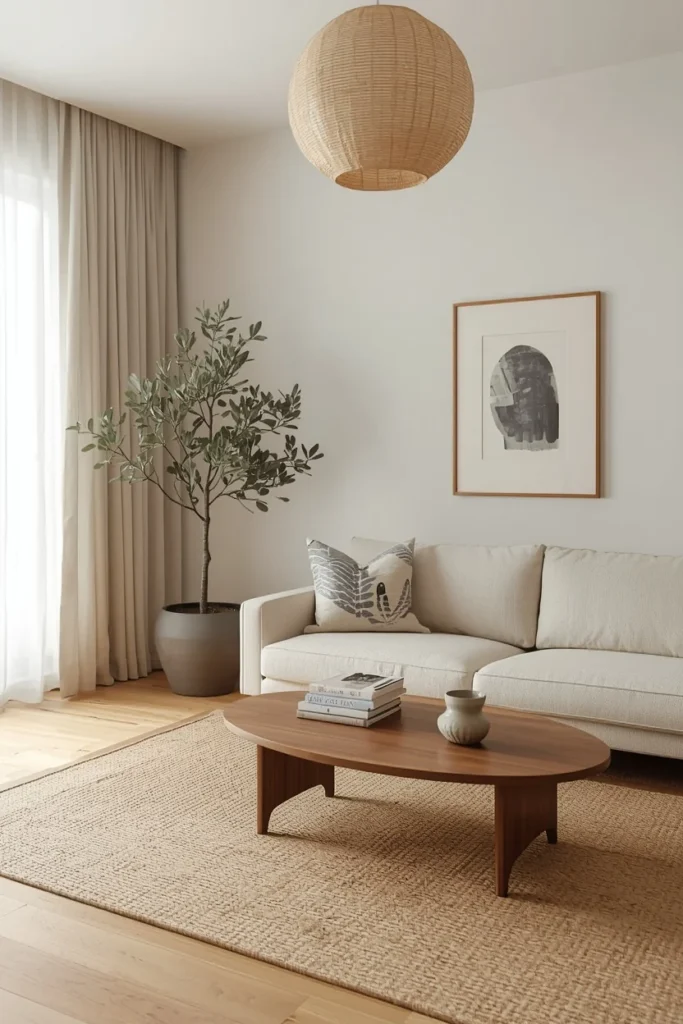
DESIGN 25: The Slow Living Japandi Room
The final — and perhaps most complete — Japandi living room design integrates all the elements not as a decorating exercise but as a philosophical statement.
This room contains: one linen sofa, one walnut coffee table, one large plant, one piece of art, one pendant light, one floor lamp, one handmade ceramic object, and one jute rug. Nothing more.
What it prioritizes: natural light throughout the day. Empty space as an intentional design element. Materials that age well and feel better over time. Furniture that’s actually comfortable. A room where you genuinely want to spend time — reading, thinking, having conversations — rather than one you primarily photograph.
This is Japandi at its most resolved. Not a trend, not a style exercise. A way of living with less that gives you more.
DESIGNER TIPS
Designer Tip #1 — The Imperfection Test Before placing any decorative object in your Japandi room, turn it slightly off-center. A perfectly symmetrical arrangement reads as designed; a slightly imperfect one reads as curated. The difference is subtle but the effect is powerful.
Designer Tip #2 — The Wood Tone Rule Never mix more than two wood tones in a single Japandi room. Both tones must share the same undertone (warm or cool). When in doubt, choose lighter for larger pieces and slightly darker for accent items.
Designer Tip #3 — The Seasonal Refresh Formula Japandi is one of the most seasonally adaptable styles. In autumn/winter: add a chunky wool throw, swap summer ceramics for darker stoneware, add more candles. In spring/summer: remove the heavy throw, add fresh branches or flowers, open the curtains fully. The base room stays the same; only the textiles and accidentals change.
Designer Tip #4 — The Photography Test Take a photo of your Japandi room on your phone. Anything that “jumps out” at you in the photo — stands out, catches the eye unexpectedly — doesn’t belong. A truly Japandi room reads as quiet and cohesive in a photo, not just in person.
Designer Tip #5 — The 20-Minute Declutter Before any gathering, do a quick Japandi reset: remove everything from all horizontal surfaces, then return only what genuinely belongs. This takes 20 minutes and makes the room feel transformed. In a Japandi room, less is never boring — it’s always an upgrade.
BUDGET ALTERNATIVES
| Japandi Look | Splurge Version | Budget Alternative |
| Linen sofa | Custom Benchmade ($2,000+) | IKEA SÖDERHAMN with slipcover ($400–600) |
| Walnut coffee table | Solid walnut artisan piece ($800+) | Oak veneer oval from Wayfair/MADE ($150–300) |
| Washi paper pendant | Artisan Japanese import ($200+) | IKEA REGOLIT paper shade + cord ($15–25) |
| Handmade ceramic vase | Studio pottery piece ($80–200) | Thrift store ceramics + matte spray paint ($5–15) |
| Jute rug | Restoration Hardware ($400+) | Dunelm or IKEA LOHALS ($30–80) |
| Limewash paint | Professional application ($500+) | Rust-Oleum Chalked or Annie Sloan DIY ($40–80) |
| Rattan accent chair | Serena & Lily ($800+) | IKEA KVISTBRO or H&M Home rattan chair ($80–150) |
| Natural linen curtains | Pottery Barn floor-to-ceiling ($300+/panel) | IKEA LISELOTT or Amazon linen-look panels ($25–60/panel) |
The Budget Japandi Priority Order:
- Declutter first (free)
- Switch lightbulbs to 2700K warm white (£5/$6 each)
- Add a jute rug (£30–80/$40–100)
- Buy one linen throw (£20–40/$25–50)
- Find one handmade ceramic piece (thrift, market, or Etsy)
- Add a washi paper pendant light
- Then invest in larger furniture when budget allows
The most expensive upgrade in a Japandi room is decluttering — because it costs you everything you own that shouldn’t be there. Everything else is secondary.
SMALL SPACE ALTERNATIVES
Sofa: Choose a two-seater loveseat with clean lines over a large three-seater. In a room under 200 sq ft, a smaller sofa with empty floor space looks better than a sofa that fills the room.
Coffee table: Replace with a set of two small round side tables that can be pulled apart when needed. Infinitely more versatile in a small space.
Storage: A low, lidded wicker trunk doubles as storage, extra seating, and a coffee table surface. One piece, three functions — quintessentially Japandi.
Rug: Use a smaller rug intentionally positioned to define the seating zone. In a tiny room, a rug that fits under only the front legs of the sofa (rather than the full furniture arrangement) keeps the room from feeling carpeted wall-to-wall.
Plants: Choose one medium plant over multiple small ones. A single peace lily or single trailing pothos has more visual impact and takes up less total footprint.
Lighting: In a small space, an arc floor lamp does the work of both a pendant AND a table lamp — covering more area with one piece.
COMMON MISTAKES
Mistake 1: Going Too Minimal Japandi is not about an empty white box. A room that feels cold or clinical has missed the Scandinavian warmth entirely. The fix: always balance open space with tactile comfort — a throw, a rug, a plant.
Mistake 2: Using Cool Grey Instead of Warm Greige Blue-based grey walls next to warm oak furniture make the room look “off” in a way that’s hard to name but immediately feels wrong. Always verify the undertone of your neutral paint before committing.
Mistake 3: Mixing Three or More Wood Tones Each additional wood tone requires the eye to reconcile a new relationship. Two maximum, same undertone. More than that reads as eclectic, not Japandi.
Mistake 4: Over-Theming the Japanese References A room with a bonsai, bamboo screens, a red lacquer box, and shoji room dividers isn’t Japandi — it’s a Japanese-themed room. One or two Japanese references, used subtly, is the correct approach.
Mistake 5: Overdoing the Accessories The coffee table looks better with two items than with six. The shelf looks better 60% empty than 90% full. Resist the urge to fill surfaces — in Japandi, restraint is the skill.
Mistake 6: Buying Furniture That’s Too Tall Tall sofas, armoires, and bookcases work against the low, grounded, close-to-earth quality that is fundamental to Japandi design. If the seat height of your sofa is above 18 inches, it’s already too tall.
Mistake 7: Ignoring the Lighting A beautiful Japandi room photographed under cool, harsh overhead lighting looks like a completely different space. Warm lighting isn’t optional — it’s structural. Install dimmers on every circuit if possible.
Mistake 8: Using Shiny or High-Gloss Surfaces Lacquered furniture, chrome legs, glossy ceramic tiles — all of these break the matte, organic feel that Japandi requires. Stick to matte, satin, or hand-finished surfaces throughout.
SHOPPING PRIORITIES
Buy These First:
- Warm-toned LED bulbs (2700K) — immediate, low-cost transformation
- A quality jute or wool rug — the room’s foundation
- One linen throw — adds texture and warmth instantly
- A low-profile sofa (if replacing) — the single most impactful furniture decision
Buy These Second: 5. A natural wood coffee table (oval or round, matte finish) 6. One quality ceramic piece from a local market or Etsy 7. A washi paper or bamboo pendant light 8. Floor-to-ceiling sheer linen curtains
Buy These Third (as budget allows): 9. A rattan or natural accent chair 10. Built-in or closed storage furniture 11. A large statement plant 12. Additional textile layers (cushions, additional throws)
Never Buy:
- More decorative objects than you can display with space between them
- Furniture over 30 inches tall for a Japandi living room
- Any material that isn’t natural (no faux leather, no chrome, no synthetic upholstery)
FAQs
CONCLUSION
The living room you’ve been scrolling past on Pinterest isn’t inaccessible or aspirational. It’s the result of a very specific philosophy applied very consistently.
Japandi asks you to make fewer decisions but make them more carefully. To choose one beautiful object over five mediocre ones. To invest in a material that ages well rather than a trend that doesn’t. To edit before you add.
The 25 designs in this guide represent different expressions of the same idea: that a living room built on natural materials, warm neutrals, considered emptiness, and genuine comfort is more beautiful — and more livable — than almost any other approach to interior design.
You don’t need to implement all 25. Start with one: a linen throw draped over your sofa. Switch your lightbulbs to warm white. Clear every surface in the room except for two or three objects you genuinely love.
That’s your Japandi living room. It’s already closer than you think.