19 Kitchen Aesthetic Ideas So Good You’ll Want to Renovate Tomorrow
Every kitchen falls into one of two categories.
The first kind is functional. It has cabinets, a counter, an appliance or two, and a perfectly reasonable layout. It gets the job done. And every single day, you walk into it without feeling anything at all.
The second kind has an aesthetic. It has a point of view. A color story. A texture that makes you want to touch the wall when you pass it. A quality of light at 7am that makes you set your coffee down just to look at it for a second.
That second kind of kitchen? It’s not more expensive. It’s just more intentional.
Kitchen aesthetic ideas are the specific visual language of a kitchen — the combination of color, material, lighting, and style references that gives a space its personality. The conversation around kitchen aesthetics has gotten genuinely exciting. The design world is moving hard away from the safe, predictable, all-white everything of the last decade. Deep warm colors like burgundy, oxblood, and forest green are surging. Dark academia moody kitchens are filling up Pinterest boards. Cottagecore warmth is being layered with dark, gothic-adjacent accents. Old money elegance is replacing maximalist flash. Japandi calm is influencing everything from cabinet profiles to countertop finishes.
The result is a kitchen design landscape that finally feels diverse enough to match the diversity of actual human personalities.
These 19 kitchen aesthetic ideas cover the full range — from moody and dramatic to soft and botanical, from cool minimalist to warm global maximalist. Read through all of them. Find the one that makes you feel something. Then start planning.
Table of Contents
What Is a Kitchen Aesthetic?
A kitchen aesthetic is the cohesive design identity of a kitchen — the specific combination of color palette, material choices, architectural details, lighting, and styling that gives the space a recognizable mood and personality.
Unlike a kitchen style (which describes structural and cabinet choices) or a trend (which describes what’s popular right now), an aesthetic is about feeling. A kitchen with a strong aesthetic makes you feel something specific when you walk into it. That feeling — calm, cozy, dramatic, nostalgic, alive — is the goal.
The strongest kitchen aesthetics have five things in common:
1. A committed color story. Not one color, but a palette of 3–5 tones that relate to each other deliberately — a dominant base, a secondary accent, and one or two supporting tones that appear in small doses.
2. Consistent material language. The materials speak the same dialect — warm wood with aged brass and stone, or cool concrete with blackened steel and raw linen. When materials conflict aesthetically, the space loses its identity.
3. Lighting with personality. Ceiling-height recessed grid lighting kills almost every kitchen aesthetic. Pendant lighting above the island, under-cabinet warm light, and a statement fixture above the table are the tools that give a kitchen its evening atmosphere.
4. Deliberate imperfection. Kitchens that look too perfect feel uninhabited. Every great kitchen aesthetic has at least one element of organic imperfection — handmade ceramics, a slightly uneven tile, a surface that shows its age beautifully.
5. Something alive. Plants, fresh herbs, a seasonal branch in a vase, a bowl of fruit. Kitchens that have nothing living in them feel like showrooms.
The 19 Kitchen Aesthetic Ideas
Aesthetic 1: The Japandi Kitchen — Calm, Warm, Intentional
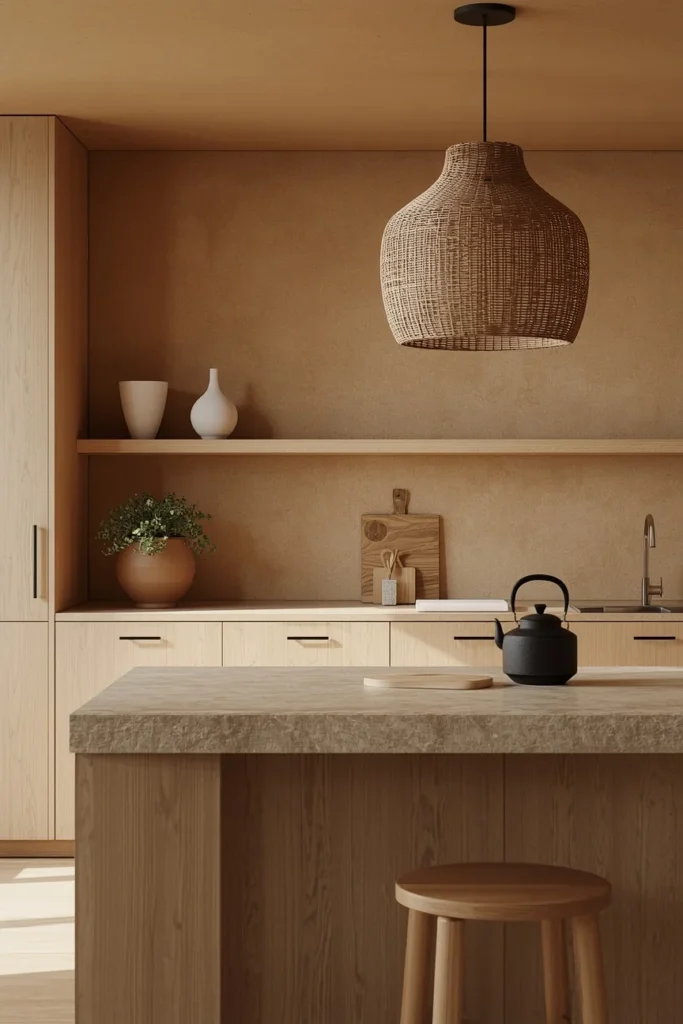
Japandi is the design child of Japanese minimalism and Scandinavian functionality — and in a kitchen, it creates something genuinely rare: a space that feels completely restful without feeling empty.
The Japandi kitchen aesthetic is built on warm neutrals and natural materials. Warm sand or greige walls. Flat-front cabinetry in pale warm oak or matte warm white — no shaker detail, no ornate profile, just clean honest lines. A thin-profile island with a waterfall edge in honed warm stone. Matte black minimal hardware, spaced far apart. Open shelving in natural oak with a single row of handmade ceramics. A single statement pendant above the island in natural rattan or blackened steel.
What makes Japandi special as a kitchen aesthetic is what it removes as much as what it adds. No clutter on the counters. No decorative excess. No competing patterns. The kitchen breathes. And in that breathing space, every material — the wood grain, the stone veining, the ceramic surface — becomes something worth noticing.
The Japandi kitchen rule: Every item on the counter must earn its place. A Japanese cast-iron kettle. A wooden chopping board with character. A single ceramic bowl. Three things maximum. Everything else lives behind a door.
Color palette: Warm sand (walls), pale warm oak (cabinetry), warm greige or honed limestone (countertop), matte black (hardware), natural cream (ceramics)
Aesthetic 2: Dark Academia Kitchen — Moody, Literary, and Completely Beautiful
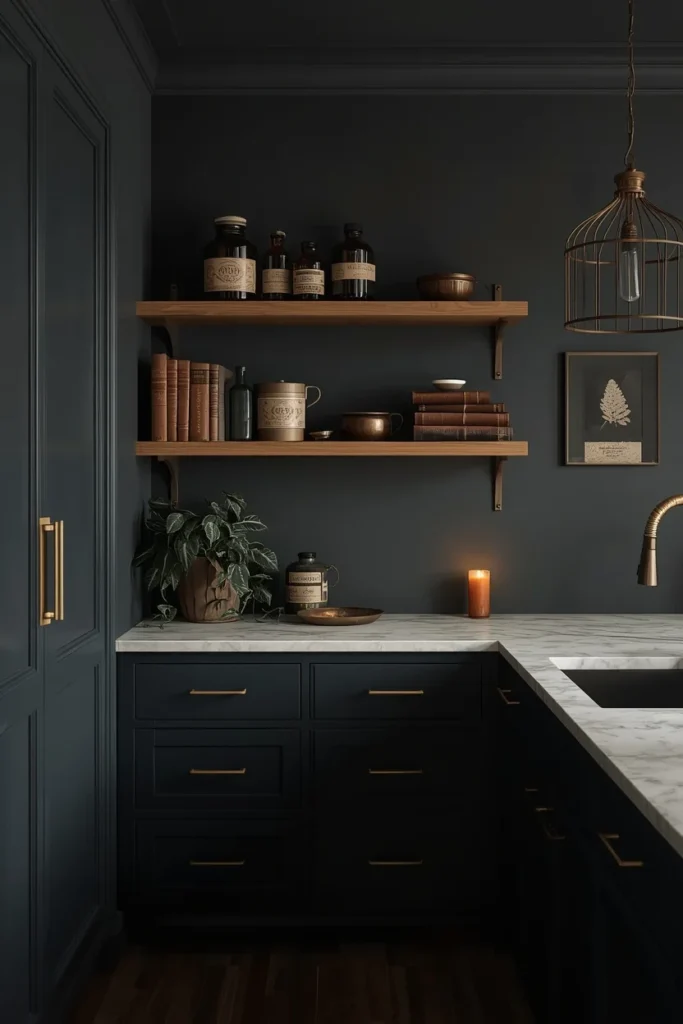
Dark academia is the aesthetic born from dusty libraries, old leather books, candlelit study rooms, and the romantic idea that learning and beauty belong together. In a kitchen, it becomes something you genuinely don’t expect — and cannot stop looking at.
The dark academia kitchen aesthetic is anchored by deep, atmospheric color. Farrow & Ball Down Pipe (deep navy-charcoal), Hague Blue (rich inky blue), or Benjamin Moore Black Pepper (near-black with warmth). These colors go on the cabinetry — ideally with slightly higher sheen than typical matte to catch the light — and often bleed onto the walls in a color-drenched approach.
Against that dark field: warm aged brass hardware. A small antique-style brass or bronze light fixture above the sink. Open shelving with vintage-style glass jars, leather-bound cookbooks propped upright, small brass vessels, apothecary-style bottles in dark amber glass. A collection of handmade ceramic mugs in muted earthy tones. A single architectural plant — a cast iron fern or a dark-leafed monstera.
This is not a kitchen for people who want their space to feel bright and airy. It’s a kitchen for people who find beauty in depth, shadow, and the sense that something interesting has happened in this room for a very long time.
The finishing detail: Frame one small section of wall (near the range or above an open shelf) with picture rail molding and hang two or three small dark-framed prints — botanical illustrations, a vintage map, an old architectural engraving. This is what pushes the aesthetic fully into dark academia territory.
Color palette: Down Pipe or deep navy (cabinetry/walls), aged brass (hardware/lighting), warm cream (countertops), dark amber (glass accessories), charcoal (floor)
Aesthetic 3: Cottagecore Kitchen Aesthetic — Wildflowers, Pottery, and Pure Charm
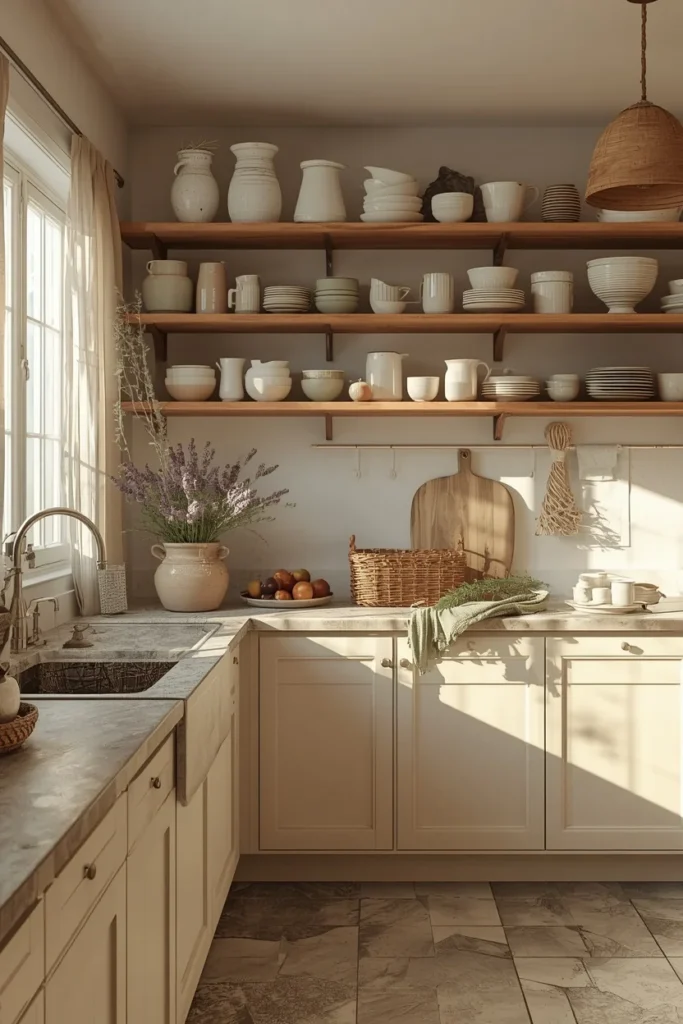
Cottagecore as a kitchen aesthetic is built entirely on the feeling of abundance — not material abundance, but natural abundance. The sense that the garden just came inside. That something has been baking since this morning. That nothing in this kitchen was bought in a set.
The cottagecore kitchen has cream or sage green painted cabinets with slightly imperfect brushwork visible if you look close. Open shelves crowded with mismatched pottery — different sizes, slightly different whites, some with hand-painted details. Wildflowers in a cracked crock on the windowsill. A bunch of lavender drying from a beam. A wicker basket on the counter holding three different kinds of seasonal fruit. A well-worn wooden cutting board permanently on the counter because it’s too beautiful to put away.
The floor is stone tile or warm terracotta. The curtains are sheer linen and never quite fully closed. The lighting is warm, low, and slightly amber — a rattan pendant or an old iron chandelier with small warm bulbs.
What cottagecore kitchen styling is actually about: It’s about choosing imperfect things with intention. The crock that’s slightly lopsided. The shelf that tilts a millimeter. The pottery with the visible thumb mark from the maker. These imperfections are the aesthetic — they’re what makes the kitchen feel lived in and genuinely loved.
Color palette: Cream or soft sage (cabinetry), warm cream/plaster (walls), terracotta or stone (floor), warm amber (lighting), dusty rose and sage green (textiles)
Aesthetic 4: Old Money Kitchen Aesthetic — Quiet Luxury That Whispers Quality
The old money kitchen aesthetic is not about looking expensive. It’s about looking like money was never the point — that the quality was simply always there, accumulated over generations, chosen with taste rather than price tags.
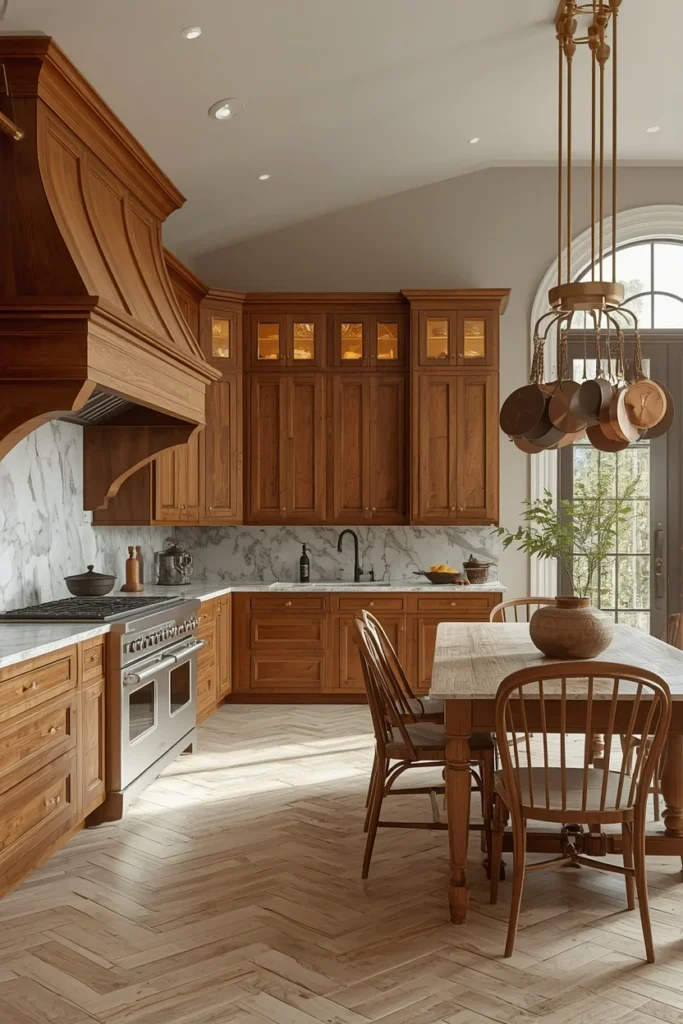
This kitchen has custom cabinetry in warm deep wood tones — not painted, not glossy, but brushed and hand-rubbed, with visible grain and subtle variation. Architectural details that speak of craftsmanship: arched cabinet doors, inset panel construction, pilasters at the corners, a range hood carved or paneled rather than purchased. Countertops in honed marble or leathered granite — never polished. Hardware in unlacquered brass or oil-rubbed bronze.
The floor is stone — herringbone marble, limestone, or wide plank oak that has developed a genuine patina. The window over the sink has no treatment at all, or a simple Roman shade in ecru linen. A large French pot rack hangs from the ceiling with copper and cast iron pans that show real use. An antique farmhouse table sits in the kitchen eating area rather than a modern breakfast bar.
Nothing in this kitchen is new-looking. Everything in it was clearly chosen with absolute conviction.
The one rule of the old money kitchen aesthetic: Never let anything look like it’s trying. The moment a kitchen element is drawing attention to itself — a fussy backsplash, a statement lighting fixture fighting with the range hood, cabinets with too much hardware — it stops feeling old money and starts feeling new rich.
Color palette: Deep warm wood (cabinetry), honed stone cream (countertops), warm ecru (walls), oil-rubbed bronze or unlacquered brass (hardware), limestone or herringbone marble (floor)
Aesthetic 5: Mediterranean Kitchen Aesthetic — Sun-Baked, Earthy, and Full of Life
The modern Mediterranean kitchen aesthetic has moved far beyond the ornate Tuscan kitchen of the early 2000s — and the result is one of the most beautiful, most livable kitchen identities trending design.
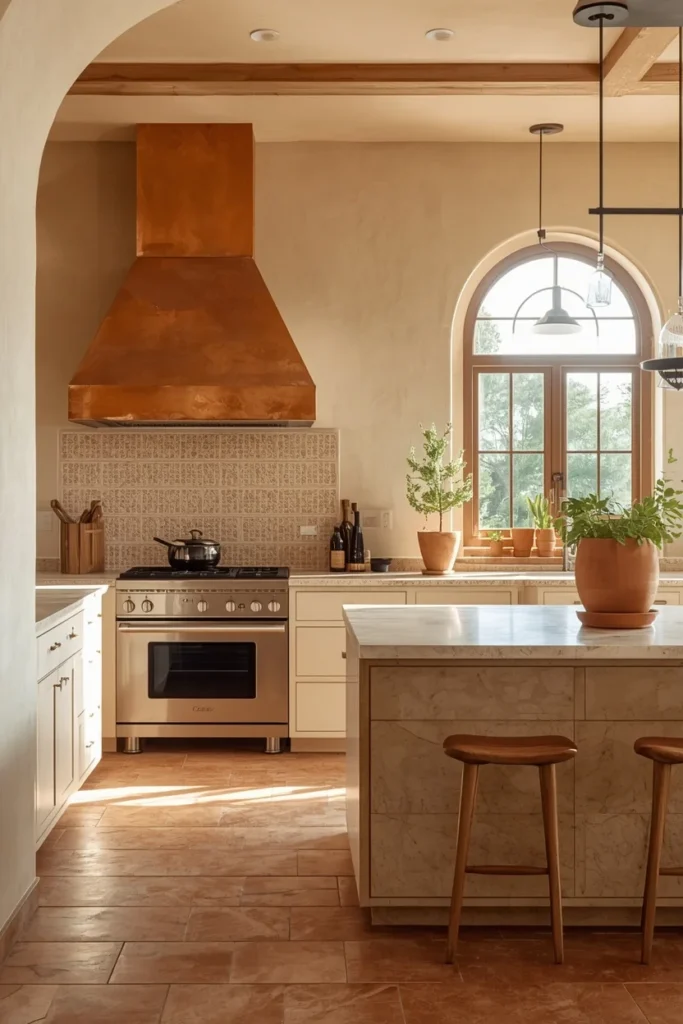
Today’s Mediterranean kitchen aesthetic is about warm minimalism grounded in authentic materials. Limewash plaster walls in warm ecru or soft terracotta that shows brush texture and slight color variation. A handmade zellige tile backsplash in warm amber, deep teal, or sandy cream behind the range. Cabinetry in natural warm linen or soft terracotta with unlacquered brass hardware. A large communal island in honed marble or travertine — not for sitting at but for gathering around while someone cooks.
Wrought iron details appear throughout but sparingly — a pendant light, window hinges, a simple pot rail. Copper and hammered brass cookware hangs visibly. Handmade ceramic dishes in earthy glazes line open shelves. A large terracotta pot with an olive tree or lemon tree in the corner near the window. The smell of fresh herbs from a cluster of pots on the windowsill.
This kitchen makes you feel like the light outside is stronger and warmer than it actually is. Like dinner might go on until midnight. Like slowing down is not just acceptable but expected.
Color palette: Warm ecru/plaster (walls), sandy linen or terracotta (cabinetry), honed travertine or marble (countertop), deep teal accent (zellige tile), unlacquered brass (hardware)
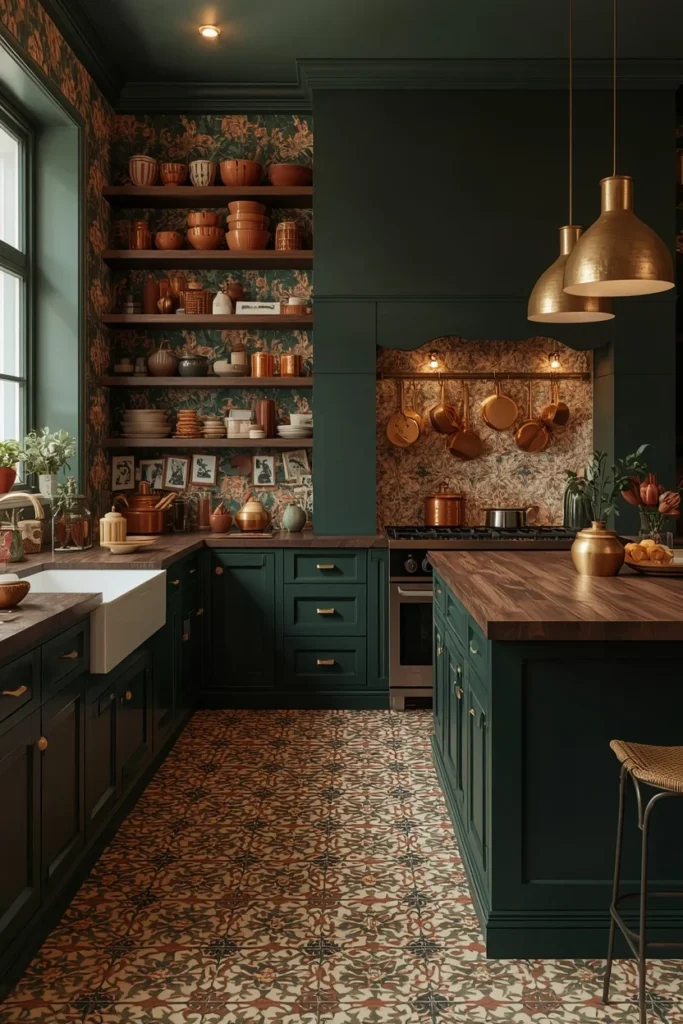
Aesthetic 6: Moody Maximalist Kitchen — More Color, More Texture, More Everything
Maximalist kitchens are not for the faint-hearted. But they are for the people who find joy in color, who collect things that mean something, who think a kitchen should feel like the most interesting room in the house.
The moody maximalist kitchen takes the “more is more” philosophy and applies it with enough design intelligence that it never collapses into chaos. The secret: maximalism needs a strong color anchor. Choose a dominant deep color — forest green, inky teal, deep plum, rich burgundy — and use it as the base that everything else responds to. Then layer in pattern: a patterned tile floor, a printed wallpaper on one wall, a stacked mix of ceramics and glassware on open shelves, textiles in mixed prints.
Every surface has something interesting on it. The shelves are genuinely full. The wall has art. The ceiling has a statement light. The counter has a coffee station with real personality. And somehow — through the color anchor and the curated rather than random nature of the layers — it all holds together beautifully.
The maximalist kitchen rule: Maximum quantity, maximum intentionality. Every piece is chosen. Nothing is random. A maximalist kitchen is not a messy kitchen — it’s a deliberate, considered one that happens to be full.
Color palette: Deep forest green or plum (dominant anchor), warm brass and copper (metals), patterned tile (floor or backsplash), mixed jewel tones (accessories and textiles), warm amber (lighting)
Aesthetic 7: Burgundy and Oxblood Kitchen — The Sophisticated Dark Side
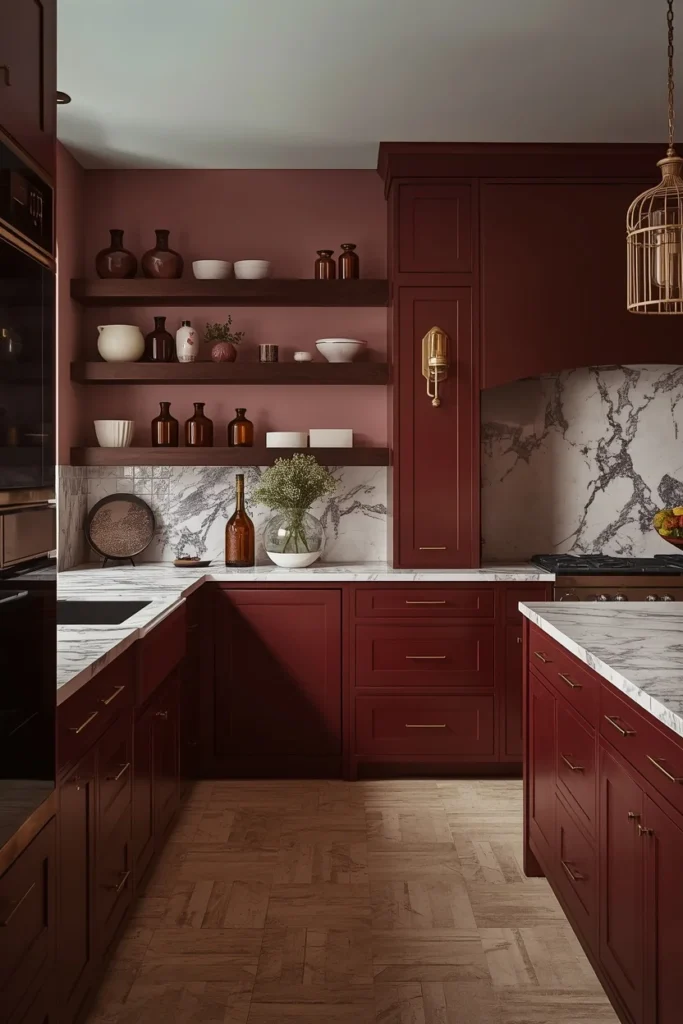
Burgundy is the kitchen cabinet color that designers were calling the boldest prediction — and it has delivered on every promise.
This is not a pink. Not a dusty rose. Not even a deep red. Burgundy and oxblood in a kitchen are the specific wine-stained, almost-brown-red tones that sit at the intersection of sophistication and warmth. They’re the colors of aged Bordeaux, of old velvet, of the kind of European kitchen you’d find in a building that’s been a home for 200 years.
The kitchen aesthetic built around these tones is inherently moody and theatrical. Burgundy or oxblood cabinets — matte finish, shaker or inset profile — against Calacatta Viola marble countertops (purple-veined white marble that looks made for this pairing). Aged brass hardware, naturally. A cream or warm stone floor. Open shelves in dark walnut with a mix of dark amber glass and cream pottery. A dramatic range hood in matching or slightly darker tone.
According to designers quoted in Veranda magazine, “Painting your kitchen cabinets burgundy and pairing with Calacatta viola marble countertops creates the most moody and sophisticated feel” — and the evidence on Pinterest completely agrees.
Color palette: Burgundy/oxblood (cabinetry), Calacatta Viola marble (countertop, purple-veined), aged brass (hardware), warm cream (floor and walls), dark walnut (shelving accents)
Aesthetic 8: Wabi-Sabi Kitchen Aesthetic — Beauty in Beautiful Imperfection
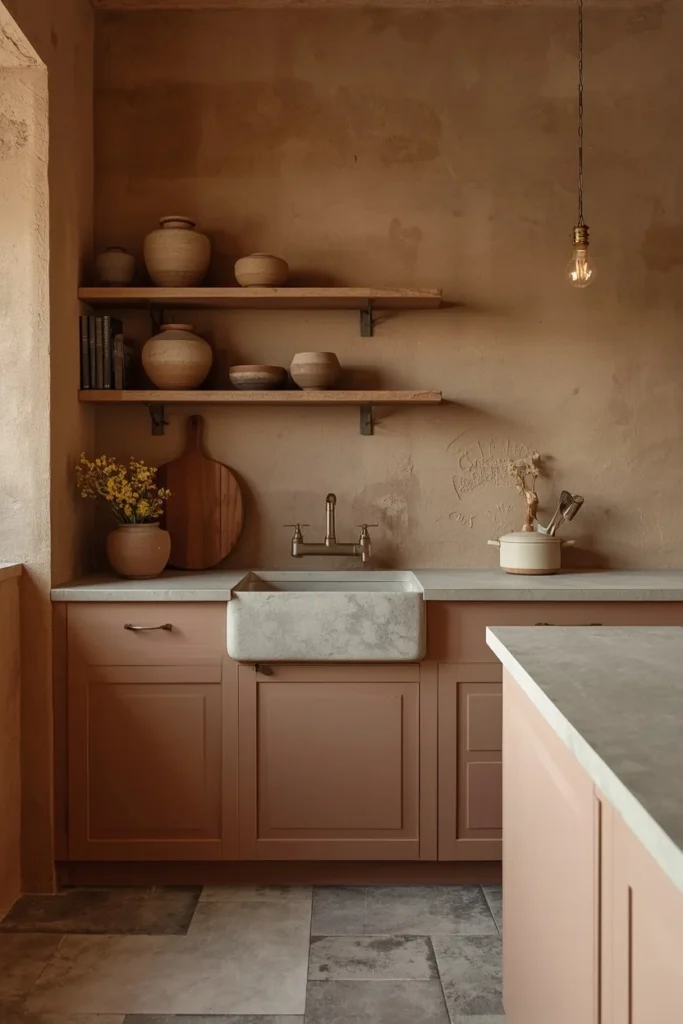
Wabi-sabi is the Japanese philosophy of finding beauty in imperfection, incompleteness, and transience. As a kitchen aesthetic, it’s one of the most genuinely peaceful and human-feeling design approaches available.
The wabi-sabi kitchen refuses to be perfect. The plaster wall has texture and slight variation. The cabinetry might be slightly distressed or have a hand-applied finish that shows brush marks. The ceramic sink has a slight irregularity in its lip. The countertop is honed stone with natural fissures left visible rather than filled. The open shelves hold handmade pottery with visible thumb marks and uneven glazing. The wooden cutting board has stains that have become part of it.
Everything in a wabi-sabi kitchen has been touched by time and use — or looks like it will be. The color palette is deliberately muted and earthy: warm sand, clay, pale taupe, cream, ash gray, stone. No bright whites. No high gloss. Nothing that refuses to age.
This aesthetic is for people who believe that a kitchen gets more beautiful the more it’s used.
Color palette: Warm sand and clay (walls/cabinetry), honed natural stone with visible fissures (countertops), ash gray or stone tile with variation (floor), unglazed or matte-glazed ceramic (accessories)
Aesthetic 9: Dark Cottagecore Kitchen — Where Botanical Meets Gothic
Dark cottagecore is the aesthetic that cottagecore fans didn’t know they needed — and that immediately feels like home the moment they discover it.
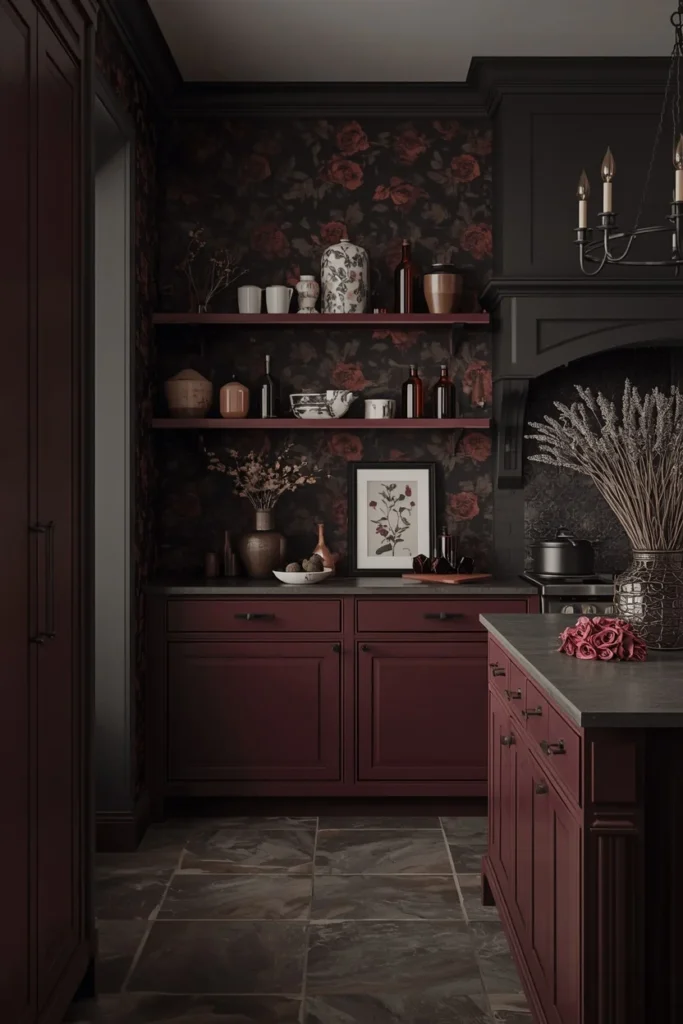
It takes the warmth, the botanical abundance, and the handmade character of cottagecore, and pulls it into a moodier, more dramatic register. The cabinets are not soft sage or cream — they’re deep plum, forest green, or near-black with a slightly distressed patina. The open shelves hold the same mismatched pottery as regular cottagecore, but alongside dark amber apothecary glass, dried black-tipped botanical specimens, and deep-toned pressed flower art in ornate dark frames.
The walls might have a dark floral wallpaper — something dense and Victorian with deep burgundy roses on an almost-black background. Or a limewash in deep charcoal with visible brush marks. The lighting is low and amber — iron chandeliers with real candles, or Edison bulb pendants that cast warm circles rather than flooding the room with light.
This kitchen feels like it belongs in a beautiful old house. The kind where something has always been growing on the windowsill and something has always been simmering on the stove.
Color palette: Deep plum or near-black (cabinetry), dark floral or charcoal limewash (walls), forest floor greens (botanical elements), warm amber (lighting), dark amber glass and cream (accessories)
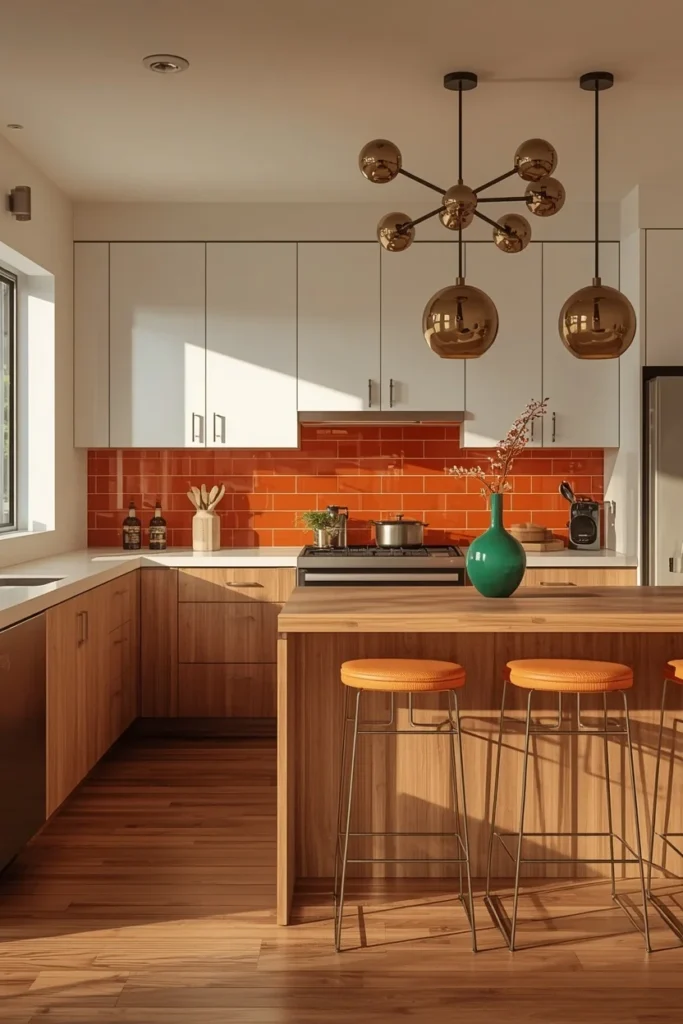
Aesthetic 10: Mid-Century Modern Kitchen Aesthetic — Retro Warmth Reimagined
Mid-century modern is having a genuine revival in kitchens — and the latest version is smarter than the 1960s original in every way.
The key elements of the mid-century modern kitchen aesthetic: clean, geometric cabinet profiles with no ornate detail. Natural wood — walnut or teak in medium-to-dark tones — prominently used, either as the cabinet finish itself or as a warm-toned contrast to painted uppers. A statement color pop somewhere unexpected — a burnt orange backsplash, a mustard yellow painted lower cabinet section, an avocado-green island in a kitchen that otherwise stays neutral.
Lighting in a mid-century modern kitchen is always a moment — the Sputnik-style chandelier above the dining table, the globe pendants above the island, the arc floor lamp in the kitchen-dining zone. Hardware in a brushed chrome or matte brass with a slightly retro profile — not the plain bar pull, but one with a slight concave or geometric detail.
The mid-century modern kitchen aesthetic is the one most likely to look both current and timeless simultaneously — because it’s working from design principles that have already survived six decades.
Color palette: Walnut or teak (cabinetry/accents), warm white or cream (painted elements), burnt orange or mustard (accent), brushed chrome or matte brass (hardware), warm amber (lighting)
Aesthetic 11: Coastal Grandmother Kitchen — Breezy, Refined, and Incredibly Charming
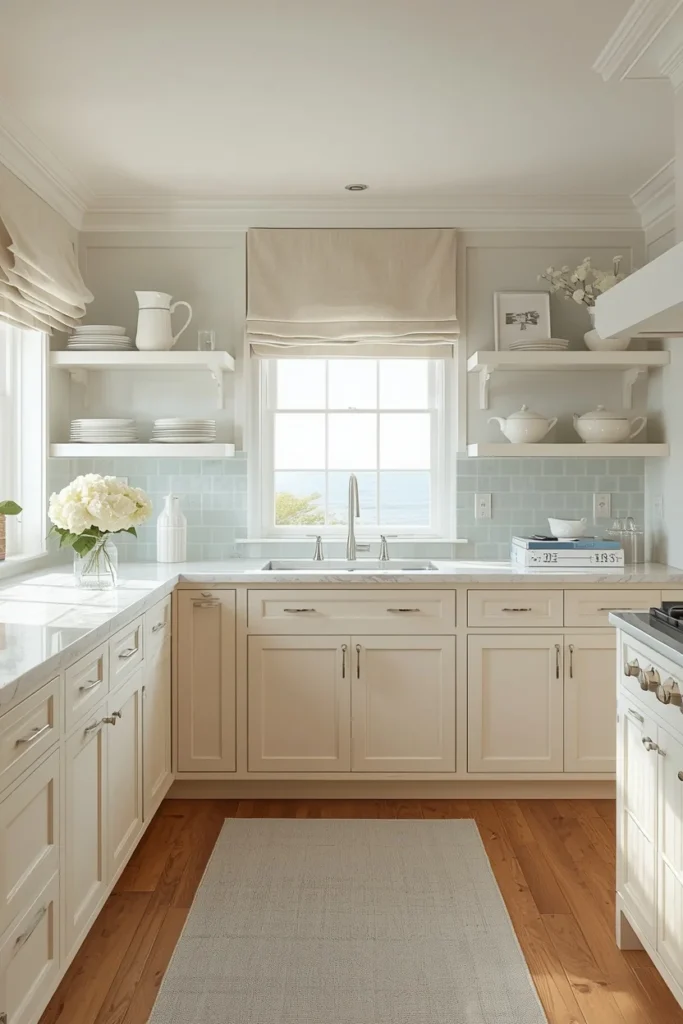
The coastal grandmother aesthetic — popularized as the Diane Keaton in “Something’s Gotta Give” look — is one of the most genuinely livable kitchen aesthetics. It’s not coastal in the driftwood-and-lobster-trap way. It’s coastal in the way of a sophisticated, well-traveled woman who happens to live near the sea and makes it look effortless.
The coastal grandmother kitchen has white or warm cream cabinetry — proper painted shaker style with quality hardware in brushed nickel or aged brass. The countertops are honed white marble or quartz with soft gray veining. The backsplash is either classic white subway tile or a simple sea-glass-toned tile in the palest possible blue-green. Open shelves display white and cream pottery alongside glassware in soft aqua tones.
Textiles do enormous work here: a linen valance above the window in natural ecru, a cotton rug in soft blue-and-white stripe underfoot, linen dish towels on the oven rail. Fresh flowers — white hydrangeas, white peonies, or whatever is in season — always in a simple clear glass vase on the counter.
The whole thing feels like it costs nothing because everything chosen is so quiet and confident that it doesn’t need to announce itself.
Color palette: Warm cream or white (cabinetry), soft blue-green (accent tile/textiles), warm linen and ecru (soft furnishings), honed white marble (countertop), natural light (the most important element of all)
Aesthetic 12: Industrial Farmhouse Kitchen — Raw and Warm in Equal Measure
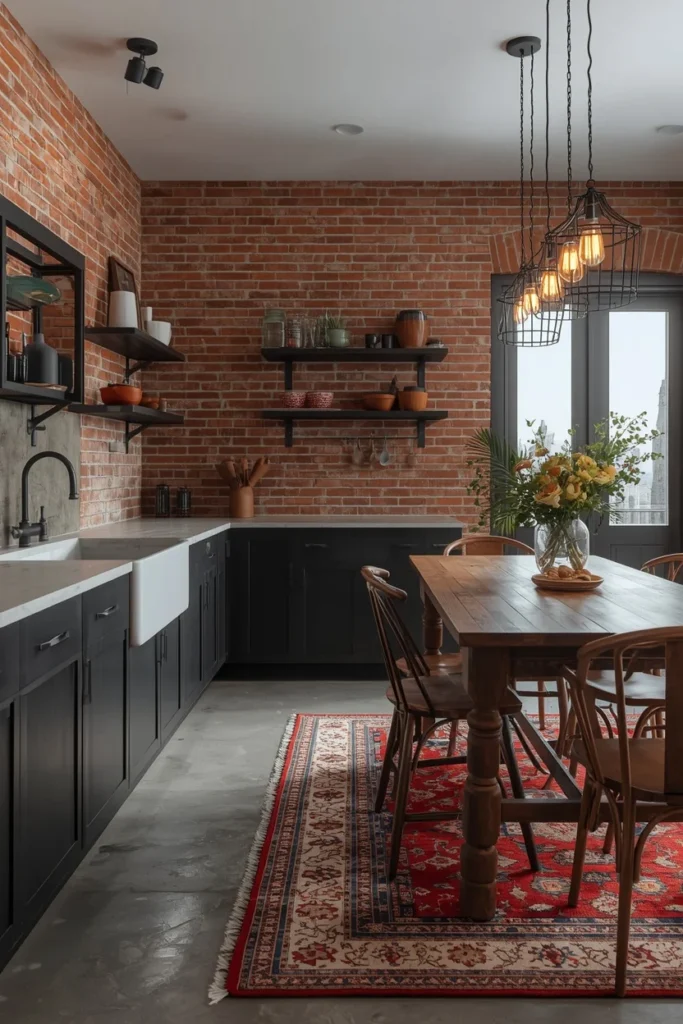
Industrial farmhouse takes the hard, honest materials of industrial design — exposed steel, raw concrete, blackened iron — and softens them with the warmth that only natural wood, ceramic, and textiles can provide.
The tension between these two aesthetics is exactly what makes the kitchen so interesting. Matte black open-frame steel shelving against a warm brick wall. A poured concrete countertop beside a warm walnut island. An industrial cage pendant light above a farmhouse apron sink. A vintage wooden farmhouse table in a kitchen with polished concrete floors.
Nothing here is delicate. But it’s not cold either — because the wood, the ceramics, the textiles, and the warmth of the brick or stone keep pulling it back toward livability.
The essential industrial farmhouse balance: For every hard, industrial element (steel, concrete, blackened iron), add a warm counterpoint (wood, ceramic, linen, woven texture). The ratio should be roughly 50/50. Too much industrial and the kitchen becomes a workshop. Too much farmhouse and you lose the edge that makes this aesthetic distinctive.
Color palette: Charcoal black (steel elements), warm walnut (wood), raw concrete gray (countertop option), warm brick (backsplash), matte black (hardware), natural linen (textiles)
Aesthetic 13: Organic Modern Kitchen Aesthetic — Nature-Informed, Artful, Grounded
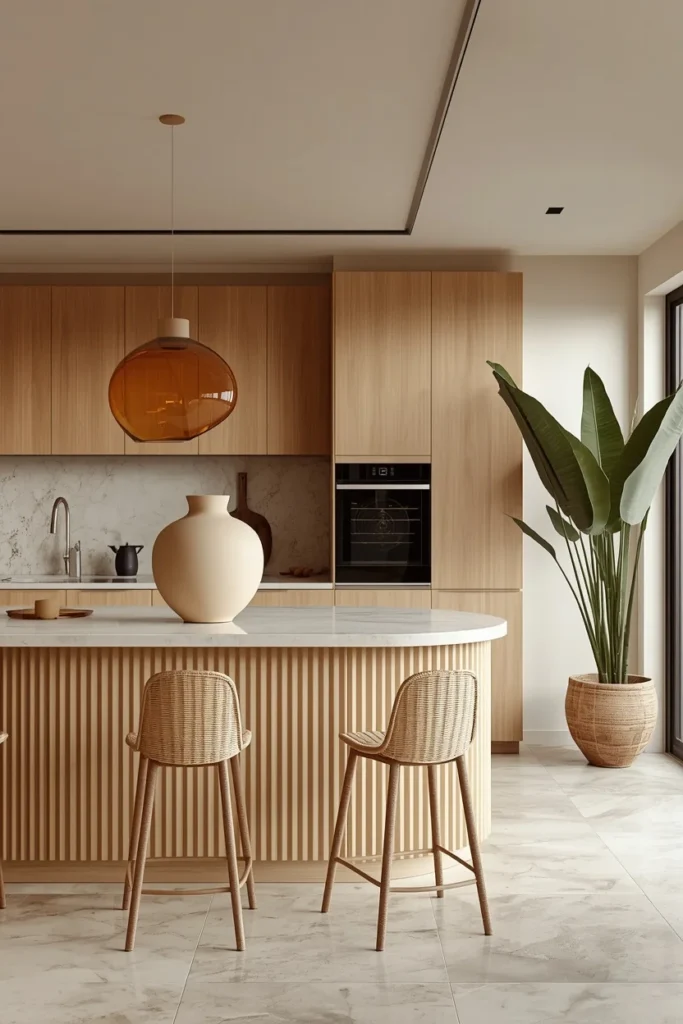
Organic modern is the kitchen aesthetic for people who love nature’s forms but aren’t ready for the rustic texture of farmhouse or the imperfection of wabi-sabi. It’s nature interpreted through a modern, artful lens.
The signature element of organic modern kitchens is the curved or fluted island. Instead of the standard right-angled box, the island has gently rounded corners, or a fluted front panel, or a slight organic curve that makes it feel sculpted rather than constructed. This single detail changes the entire kitchen’s energy — it softens the space without losing sophistication.
Around this island: cabinetry in warm sand, clay, or warm greige with a barely-there texture on the door front. Honed natural stone countertops in a warm travertine or pale limestone. Earthy woven bar stools at the island. A large organic-shaped ceramic vessel on the counter that’s too beautiful to be purely functional. Pendant lights in hand-blown glass with slight imperfections. A large monstera or bird of paradise in the corner.
Color palette: Warm sand or clay (cabinetry), honed travertine or pale limestone (countertops), warm terracotta and cream (accessories), earthy woven textures (bar stools, textiles)
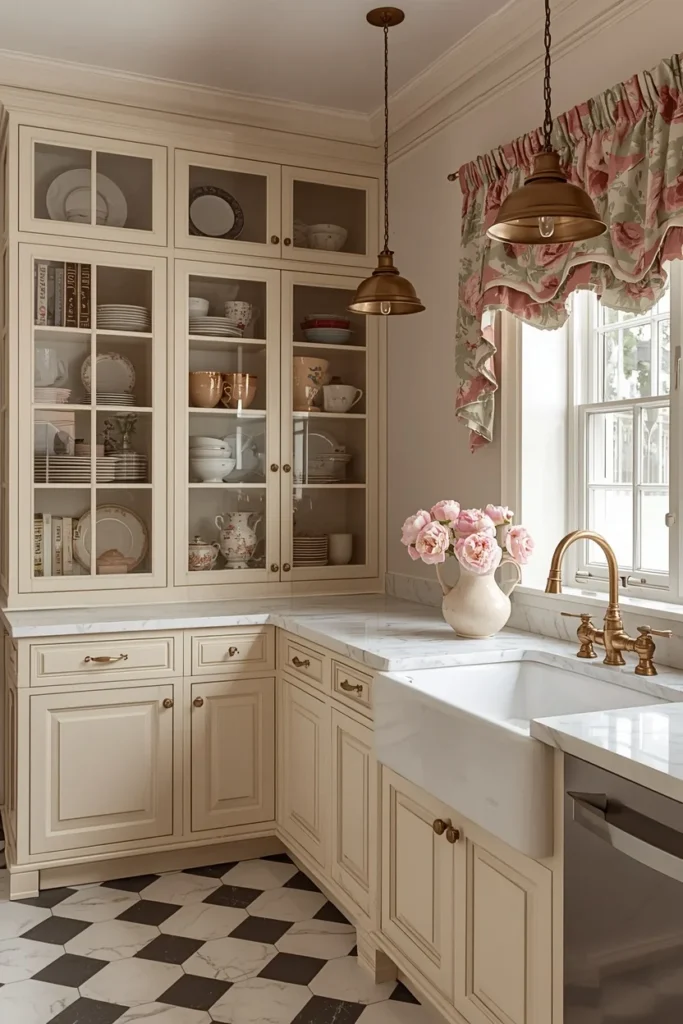
Aesthetic 14: Grandmillennial Kitchen — Traditional Details with a Fresh Twist
Grandmillennial style is what happens when younger people fall genuinely in love with the traditional, the ornate, and the sentimental — and then bring their own modern sensibility to it rather than apologizing for the interest.
A grandmillennial kitchen has details that feel inherited: glass-front upper cabinets with scalloped trim, a china display of real china that actually gets used, a collection of floral or toile-patterned textiles (curtains, dish towels, the rug), vintage-inspired lighting in bronze or aged brass. The countertops are marble — real marble, or a quartz that has the movement and warmth of real marble. The floor might be a classic black-and-white checkerboard, or wide plank oak with a subtle traditional border.
The twist is in how it’s all put together. The floral curtain fabric is a bold, large-scale print — not a fussy Victorian miniature. The china in the glass-front cabinets is styled, not just stored. The overall palette is warm and bright — cream, dusty rose, sage, brass — rather than the heavy dark tones of a traditional grandmother’s home.
Color palette: Warm cream (cabinetry), dusty rose, sage, soft blue (textiles and accents), aged brass (hardware/lighting), classic marble (countertop), black-and-white (floor option)
Aesthetic 15: Scandinavian Kitchen Aesthetic — Soft, Functional, and Effortlessly Beautiful
True Scandinavian kitchen design — not the cold, gray, minimalist version that gets misrepresented — is one of the warmest, most livable kitchen aesthetics in existence.
The Scandinavian kitchen aesthetic is characterized by soft, organic shapes with genuine warmth. Cabinet profiles have subtle curves at the top rather than hard angles. The wood is warm birch or pale oak rather than cold gray laminate. The color palette is cream, warm sand, and the palest possible sage or dusty blue-green — colors that read as neutral but aren’t actually neutral. Functional, considered storage solutions: deep drawers, integrated appliances, everything having a place.
The lighting here is crucial — and notably different from the US approach to kitchen lighting. Rather than recessed grid lighting, Scandinavian kitchens use pendant lighting above the counter, under-cabinet strips for task light, and often a large statement fixture above the dining area. The overall light temperature is warm, never cool.
Color palette: Warm birch or pale oak (cabinetry), warm cream and sand (walls/tiles), pale sage or dusty blue-green (accent tiles), warm white (large surfaces), natural warm amber (lighting)
Aesthetic 16: Tuscan Kitchen Aesthetic — La Dolce Vita Brought Home
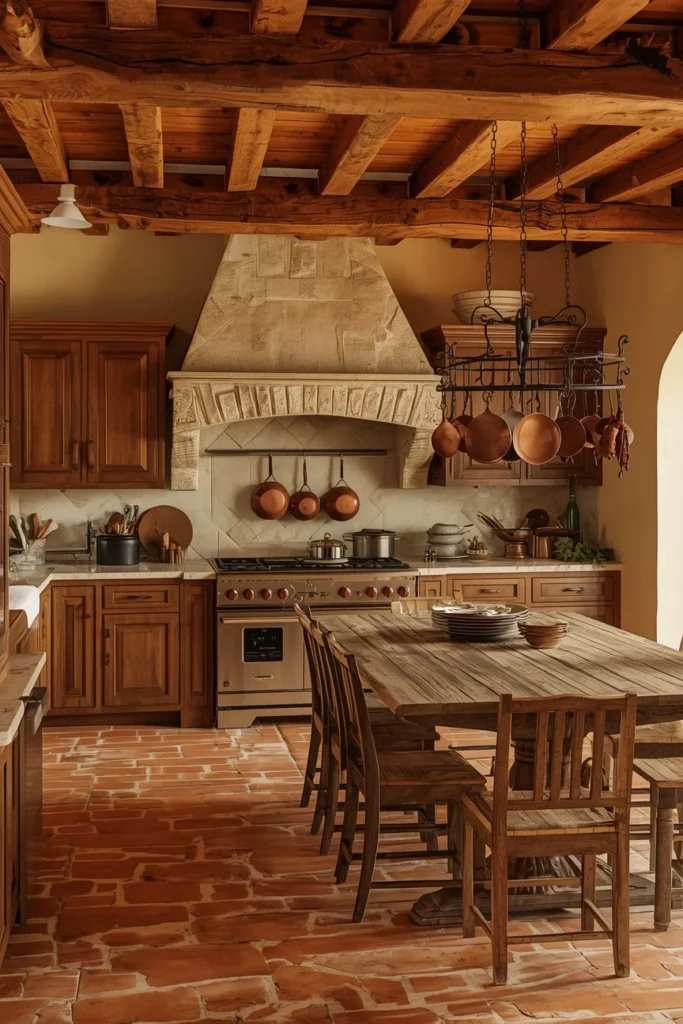
The Tuscan kitchen is one of the oldest and most enduring kitchen aesthetics in Western interior design — and the latest version has shed the heavy, overdone excesses of its early 2000s interpretation to become something genuinely beautiful again.
Today’s Tuscan kitchen aesthetic is built on natural stone and warm wood. Knotty alder or hand-rubbed walnut cabinetry with inset panel doors. A carved stone or plaster range hood as the room’s architectural centerpiece. Terracotta floor tiles — either original handmade pavers or high-quality reproduction — with slightly irregular surfaces that catch the light. A natural stone backsplash in limestone or travertine. Wrought iron accents: the pot rack, the light fixtures, the window hardware.
The color palette is the Italian countryside at golden hour: warm cream, sandy taupe, terracotta, burnished olive, aged copper. Nothing cool. Nothing gray. Everything golden-hour warm.
The Tuscan kitchen finishing detail that most people miss: A large wooden farmhouse table positioned in the kitchen eating area — not a breakfast bar, not a kitchen island with stools, but an actual table with mismatched chairs where people clearly sit and eat full meals. This is the most culturally authentic element of the Tuscan aesthetic.
Color palette: Warm knotty wood (cabinetry), terracotta (floor tiles), warm cream and sandy taupe (walls and stone elements), burnished copper (cookware/accents), wrought iron (fixtures)
Aesthetic 17: Parisian Kitchen Aesthetic — Effortless, Layered, and Achingly Beautiful
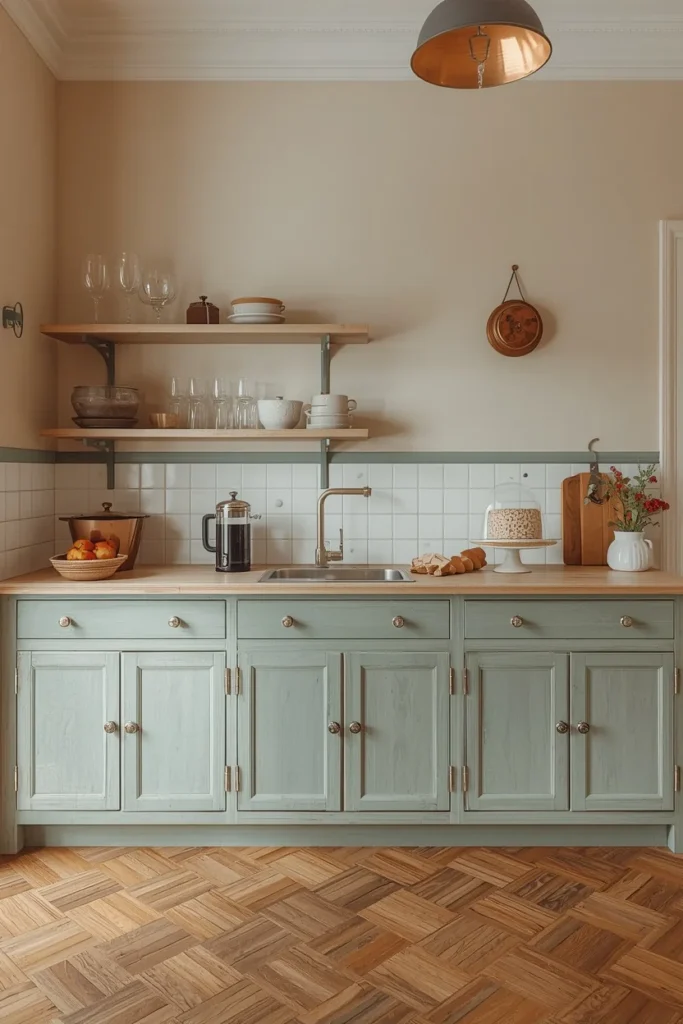
The Parisian kitchen aesthetic is possibly the most difficult to define — because its defining quality is effortlessness. It looks like nothing was particularly planned. It looks like it came together gradually, beautifully, and without too much thought. Which is, of course, the result of a great deal of thought.
The Parisian kitchen has herringbone or parquet wood floors that have been walked on for decades. The cabinetry is either painted in a warm, slightly faded tone — dusty sage, aged cream, a blue-green that is impossible to name exactly — or it is genuine old wood with a patina that couldn’t be manufactured. The hardware is simple but beautiful: ceramic knobs with a hand-painted detail, or simple aged brass cup pulls.
There are objects everywhere, but they’re real objects — not styled sets. A copper pot hanging from a simple hook. A cake stand with an actual cake under a glass dome. Several different heights of wine glasses on an open shelf. A small coffee-maker from a French manufacturer beside a Moka pot. A vase of something seasonal — not arranged, just placed.
The Parisian kitchen aesthetic is what happens when a beautiful kitchen is also genuinely, completely lived in.
Color palette: Faded sage or aged cream (cabinetry), warm parquet or herringbone (floor), aged brass and ceramic (hardware), warm cream and copper (accessories), soft ambient (lighting)
Aesthetic 18: Dark Rustic Kitchen Aesthetic — Bold, Earthy, and Unapologetically Dramatic
The dark rustic kitchen aesthetic is the one that jumped 290% in Pinterest searches — and nothing about looking at these kitchens is surprising. They’re stunning.
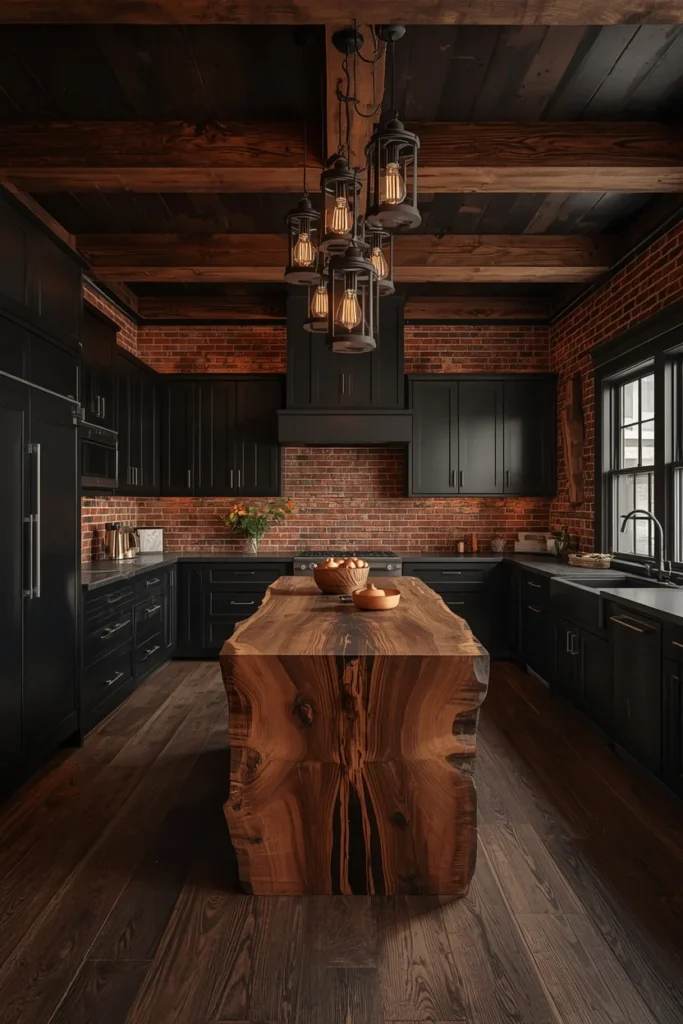
This is the aesthetic built from matte black or very dark espresso cabinetry paired with raw, textural earthy materials: exposed brick walls, reclaimed wood ceiling beams, a raw-edge wood island, natural stone countertops with visible movement. The lighting is deliberate and atmospheric — never recessed grids, always pendant lanterns in blackened iron, or Edison bulbs on exposed cord drops.
The dark rustic kitchen feels ancient and alive simultaneously. The black cabinets look intentional against exposed brick. The raw wood island looks like it came from a different century. The stone countertop has stories in its veining. And the whole thing photographs with the kind of depth and drama that stops a Pinterest scroll cold.
This is the kitchen aesthetic for: People who find beauty in shadow. Who want their kitchen to feel like a mountain restaurant that’s been serving food since before your grandparents were born. Who believe “warm” and “dark” are not opposites.
Color palette: Matte black or dark espresso (cabinetry), warm brick or reclaimed wood (walls/beams), raw-edge walnut (island), natural stone (countertop), blackened iron (hardware/lighting)
Aesthetic 19: The Warm Minimalist Kitchen — Stripped Back, Never Cold
Minimalism has a reputation for coldness — and in kitchens, that reputation is often earned. Gray cabinets, gray countertops, gray floor, white walls, handle-less doors, recessed lighting, nothing on any surface. Technically minimal. Emotionally a void.
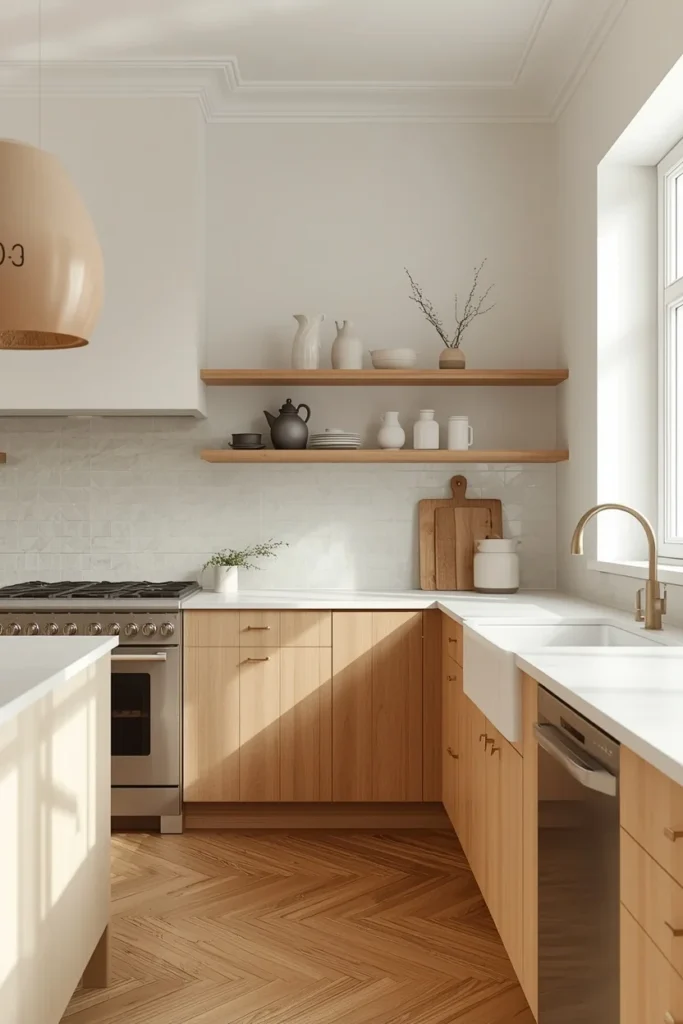
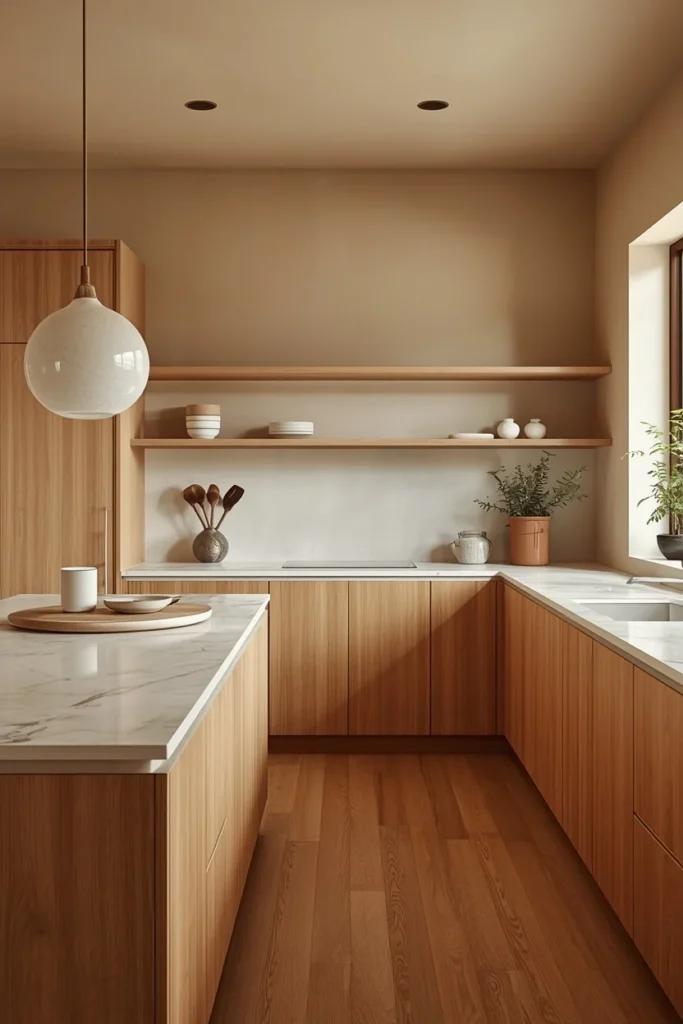
Warm minimalism is the correction. It keeps the reduced clutter, the clean lines, and the “nothing unnecessary” philosophy — but builds it entirely from warm materials, warm colors, and warm light. The result is a kitchen that feels genuinely restful without feeling empty or institutional.
Warm minimalist kitchens have flat-front cabinetry in warm honey oak or muted terracotta. Countertops in honed Calacatta or warm cream quartz. A single, beautifully considered pendant above the island. One row of open shelving with three handmade ceramics and nothing else. The counter is clear — not because it was staged, but because there’s a place for everything else. The floor is wide plank warm oak or a warm-toned stone. The walls are warm white or the palest sand.
This is the kitchen for people who find peace in absence — but who understand that absence must be warm to feel beautiful rather than barren.
Color palette: Warm honey oak or muted terracotta (cabinetry), warm cream or sand (walls), honed warm stone (countertop), warm amber (lighting), natural white oak (floor)
How to Find Your Kitchen Aesthetic?
With 19 aesthetics laid out, the question isn’t which one is most beautiful — they all are, in their own way. The question is which one is most yours.
Here’s a framework that actually works:
Step 1 — Follow the feeling, not the look. When you scroll through these ideas, which one made you stop and stay for a moment? Not “that’s beautiful” — but “I want to be in that room.” That’s the one.
Step 2 — Match your personality, not your house. A small apartment kitchen can absolutely house a moody dark academia aesthetic. A large open-plan kitchen can be warm minimalist. The aesthetic is about who you are, not what square footage you have.
Step 3 — Identify your non-negotiables. Are you someone who will genuinely keep a wabi-sabi kitchen’s surfaces clear? Or will they quietly fill up with stuff? Do you love having objects around you, or do they make you anxious? An aesthetic that fights your natural personality will fail in six months.
Step 4 — Find the three core elements. Every kitchen aesthetic has three elements that establish it — a color, a material, and a detail. Japandi: warm oak, honed stone, minimal matte hardware. Dark academia: navy cabinetry, aged brass, vintage glass and books. Identify those three for the aesthetic you love, and start there.
Step 5 — You don’t have to commit to all of it. The best real-life kitchen aesthetics are usually 80% one thing and 20% another. A warm minimalist kitchen with one maximalist open shelf. A cottagecore kitchen with a japandi-inspired empty counter policy. Aesthetics can hybridize — they just can’t fight each other.
Kitchen Aesthetic Styling Tips That Apply to Every Style
Lighting before everything. No kitchen aesthetic survives bad lighting. The right pendant, the right color temperature (2700K–3000K for warm aesthetics, 3000K–3500K for clean minimalist), and the right number of sources transform the space at night. This is the investment that pays back every single evening.
Hardware is not an afterthought. The knobs and pulls on your cabinets are touched dozens of times a day. They contribute to the room’s color story, its warmth, and its material personality. Spend the extra $3–$5 per pull for the right finish. It’s always worth it.
One statement surface. Every great kitchen aesthetic has one surface that does the visual heavy lifting — a patterned tile backsplash, an expressive countertop with movement, a bold cabinet color, a statement range hood. Choose your moment and let it be the thing the room is “about.”
Plants, always. Every kitchen aesthetic on this list benefits from living things. Fresh herbs on the windowsill. A trailing pothos on an open shelf. A large structural plant in a beautiful pot in the corner. Kitchens with no plants feel like they’re missing something, even when everything else is perfectly designed.
Textiles are the warmth switch. A runner rug, a linen valance, cotton dish towels on a peg rail, a cushion on the kitchen stool — these fabric elements are what allow the eye and the body to relax in a kitchen. Hard surfaces alone — even beautiful ones — don’t provide that quality. Textiles do.
Common Kitchen Aesthetic Mistakes to Avoid
Choosing an aesthetic that doesn’t match how you actually cook. A maximalist kitchen full of open shelving is beautiful — and a nightmare to maintain if you cook messily and don’t enjoy styling. A warm minimalist kitchen is peaceful — and only stays that way if you’re naturally tidy. Choose an aesthetic that works with your real behavior, not an idealized version of it.
Mixing too many aesthetics. Two aesthetics can coexist when they share materials, tones, or a general warmth level. Dark academia and moody maximalist can share a kitchen. Japandi and wabi-sabi share DNA. But dark academia and coastal grandmother, or Tuscan and industrial, create visual tension that no amount of good furniture can resolve.
Over-relying on trends. Pantone’s Color of the Year — Mocha Mousse — is genuinely beautiful. So is oxblood. So is the fluted island. But design trends move, and a kitchen that is entirely trend-based will date in 3–5 years. Choose an aesthetic built on an emotional response to materials and feeling, and the specific trend expressions within it will age better than any trend-first decision.
Ignoring the bones. No aesthetic can fully overcome bad cabinet proportions, a dysfunctional layout, or terrible lighting infrastructure. Before styling, address the bones. Good layout, good lighting infrastructure, and properly proportioned cabinetry are the foundation every aesthetic needs.
FAQs
Conclusion
Your kitchen aesthetic is not the most expensive option. It’s not the most popular option. It’s not the option your neighbor chose or the one that’s currently trending on every design account you follow.
It’s the one that makes you feel something real when you walk into your kitchen in the morning.
Maybe that’s the deep, quiet calm of a Japandi kitchen with nothing on the counter and the light coming through just right. Maybe it’s the moody, amber-lit drama of a dark academia kitchen with your cookbooks arranged beside your apothecary jars. Maybe it’s the ridiculous, joyful warmth of a cottagecore kitchen with dried herbs hanging from every available hook and wildflowers that need to be replaced every three days.
All of them are right. All of them are beautiful. Only one of them is yours.
Find it. Build it slowly. And every morning, before you do anything else, let it be the first good thing that happens to you.